Material Glossary
| Material | Definition | Relation to specialism |
|---|---|---|
| Paper-weaving | Taking strips of paper and placing them over and under the base piece of paper. You can use different colours to create different patterns and structures. | Some artists use paper-weaving methods to create pieces of jewellery and fun pendants with different patterns, shapes and colours. (people use different types of papers to create jewellery. Recycled paper for example to make a sustainable piece) |
| Re-purposed material- weaving | unique materials can be used in the weaving process. for ex. yarns, ribbons, shoelaces, cords, rubber, leather, plastics etc. Old clothes and knitwear are taken apart, the yarns and garments are used again. | Materials are reused to create jewellery. |
| Weaving applied to specialism | Using weaving techniques inside a specific area of study is known as weaving applied to specialisation. The term “specialism” in this sense can apply to a number of fields, including interior design, fashion design and jewellery design. | We used wire for example to create jewellery. |
| artist response | responding to an artist means creating your own art work or design inspired by his style, materials or techniques | I responded to Oscar de la renta and created a flower using organza to create a piece of jewellery. Responding to artists helps you draw inspirations and get more ideas |
| Clay modelling |
Mind Map
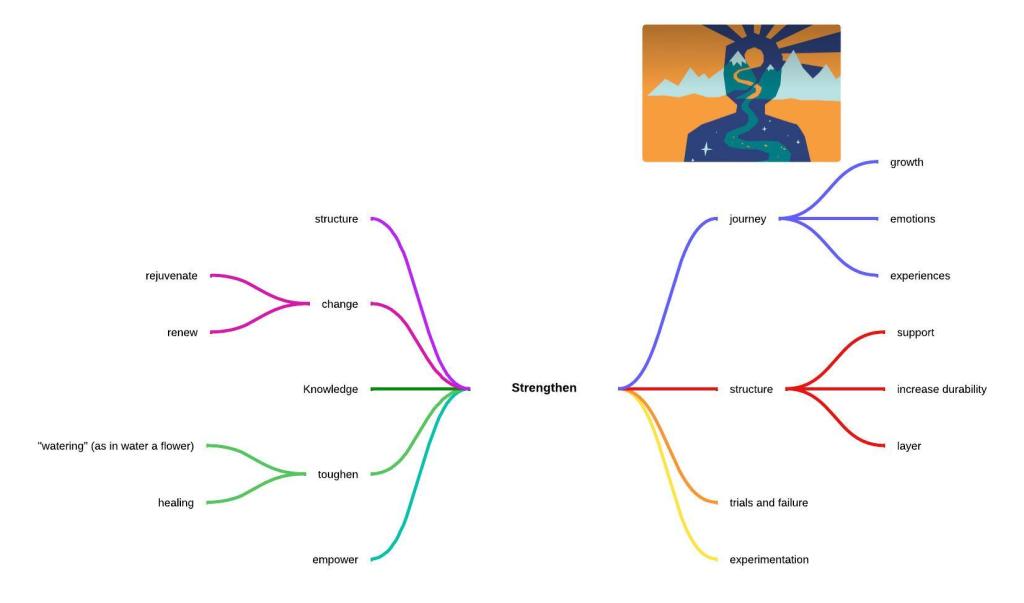
During this lesson we were asked to create a mind map for last semesters chosen words. I felt like the was some sort of refresher to start thinking about how I want to interpret my word and develop my ideas this semester. I felt like I needed this quick refresher to start connecting my word to ideas again.
Pictures that connect with our words

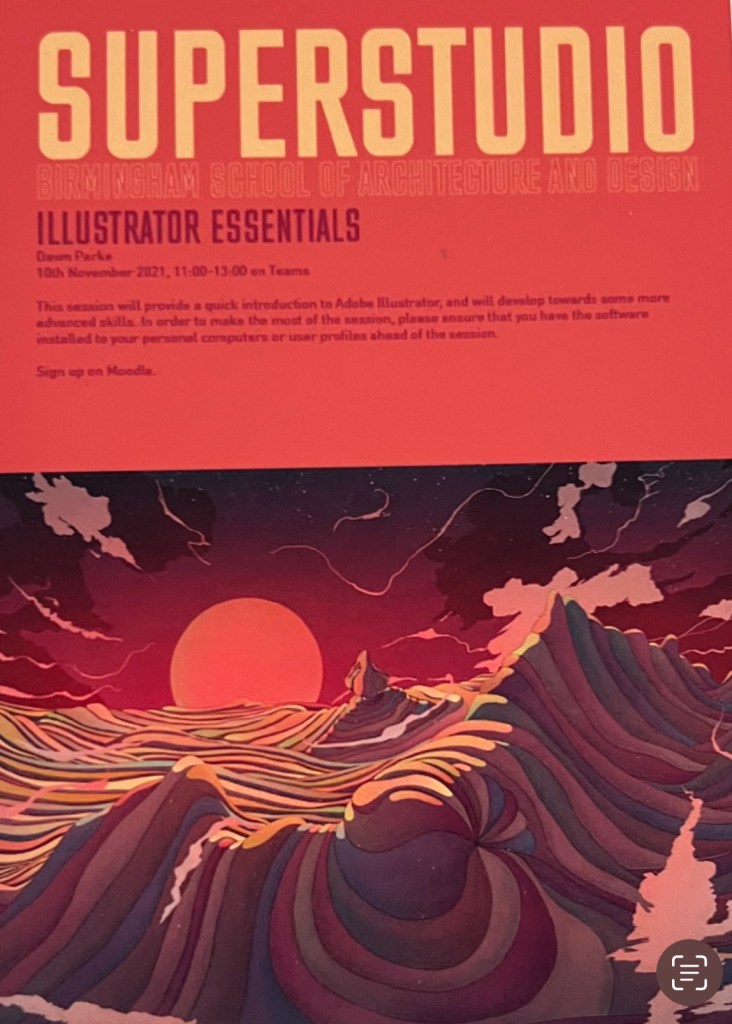
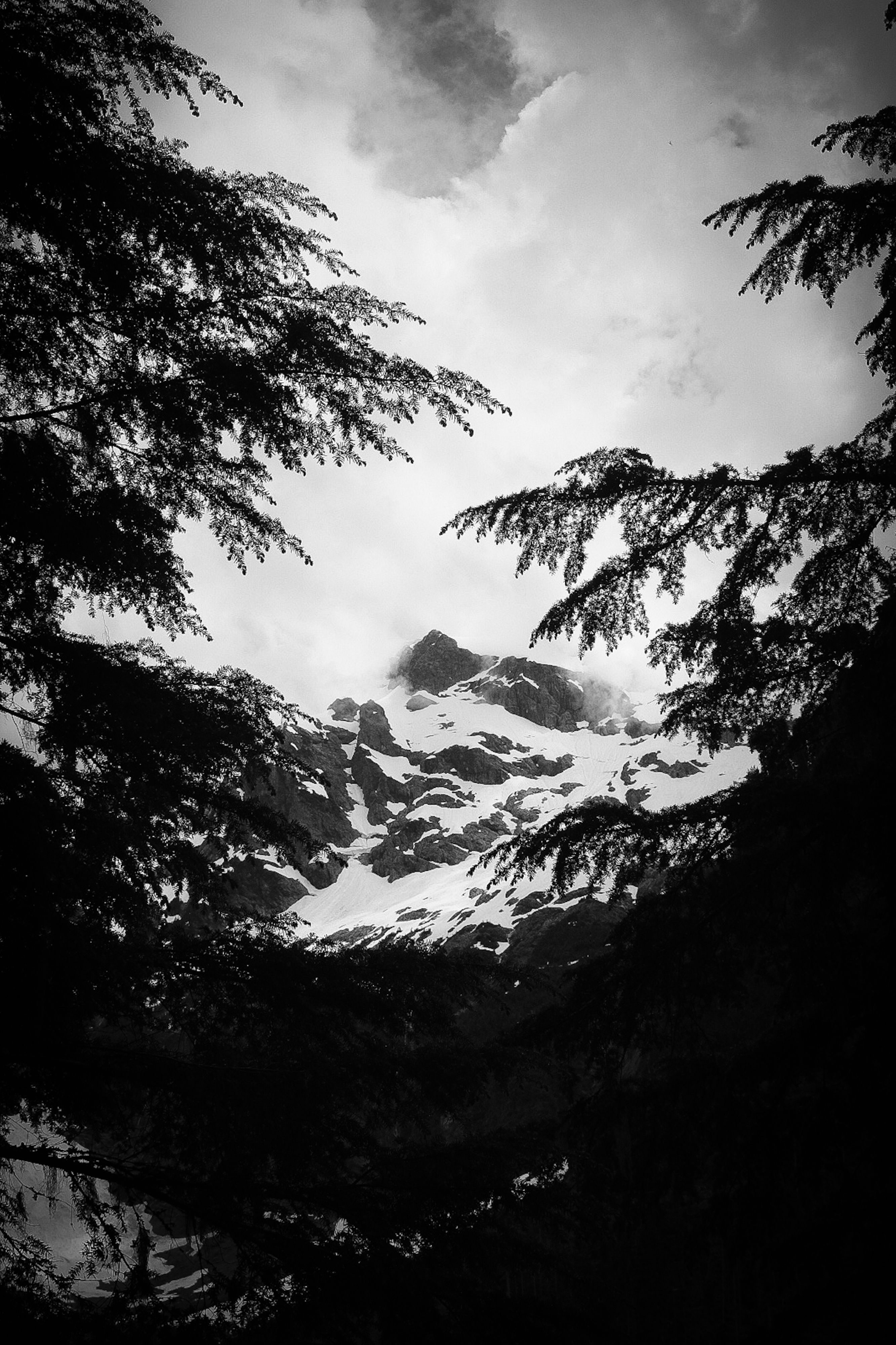
My chosen word is the word strengthen. Everyone has a journey they go through and things they experience which makes them grow stronger. A journey full of obstacles that make you become the strongest version of yourself. When we were asked to take pictures of things around the campus that we think have some sort of connection to our word I found these three pictures. They all portray some sort of map or a view of mountains which all reminded me of a journey.

This is a picture of a boy who is praying. I think that believing having an external power who is always looking out for you wherever you are, makes you feel safe and comfortable. When I feel safe and comfortable I feel stronger, knowing there is an external power always looking out and taking care of me strengthens me.
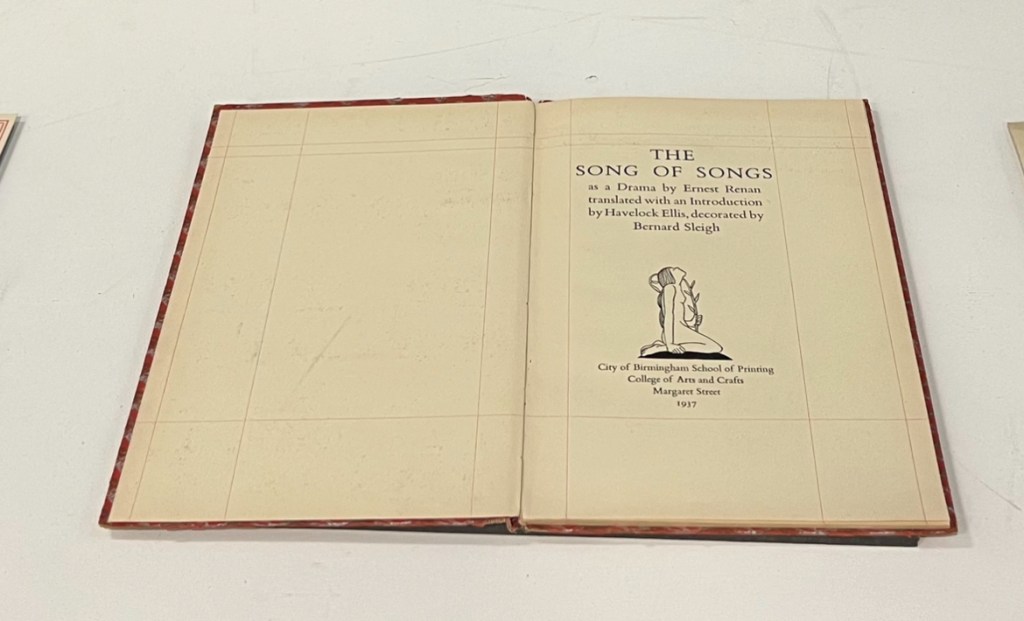
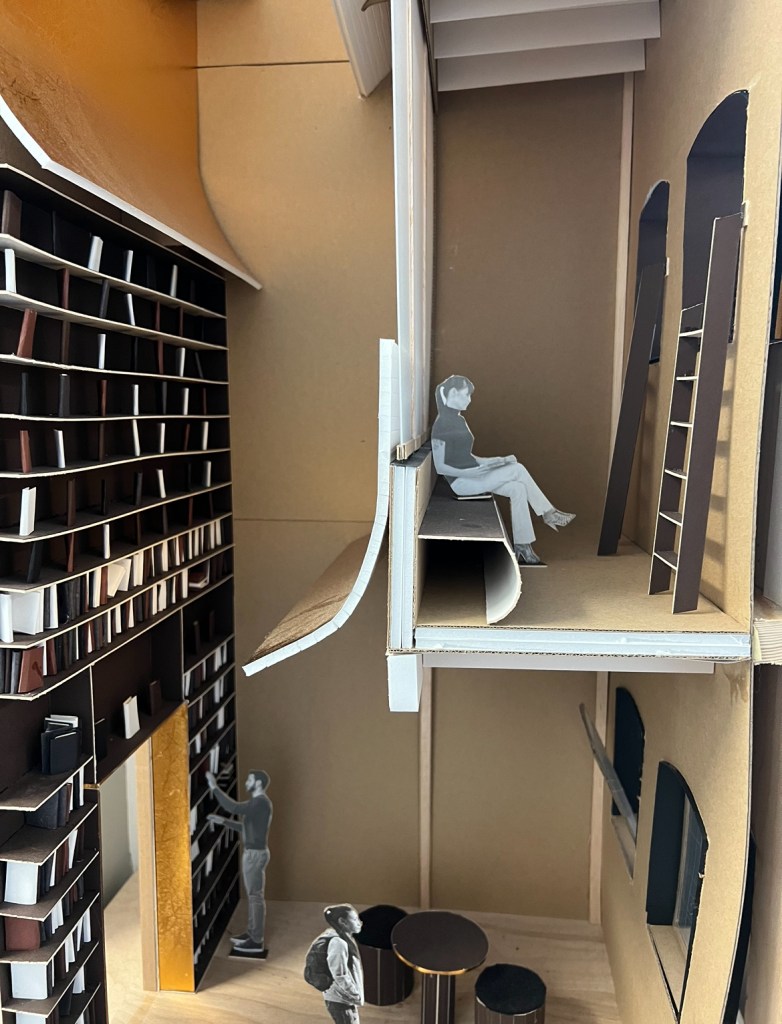
These two pictures portray wisdom. Wisdom gives people inner strength. It comes from experience and understanding, helping them see things clearly and make good choices. Unlike just knowing facts, wisdom is about understanding people and values. With wisdom, people handle challenges better, showing empathy and learning from their experiences. It helps them grow and adapt, making them more confident and resilient in tough times.

I always link flowers to strength. Flowers start of as little tiny seeds that keep developing and growing until it becomes a beautiful flower. Humans are just like flowers, experiences make them grow into a more resilient version of themselves.
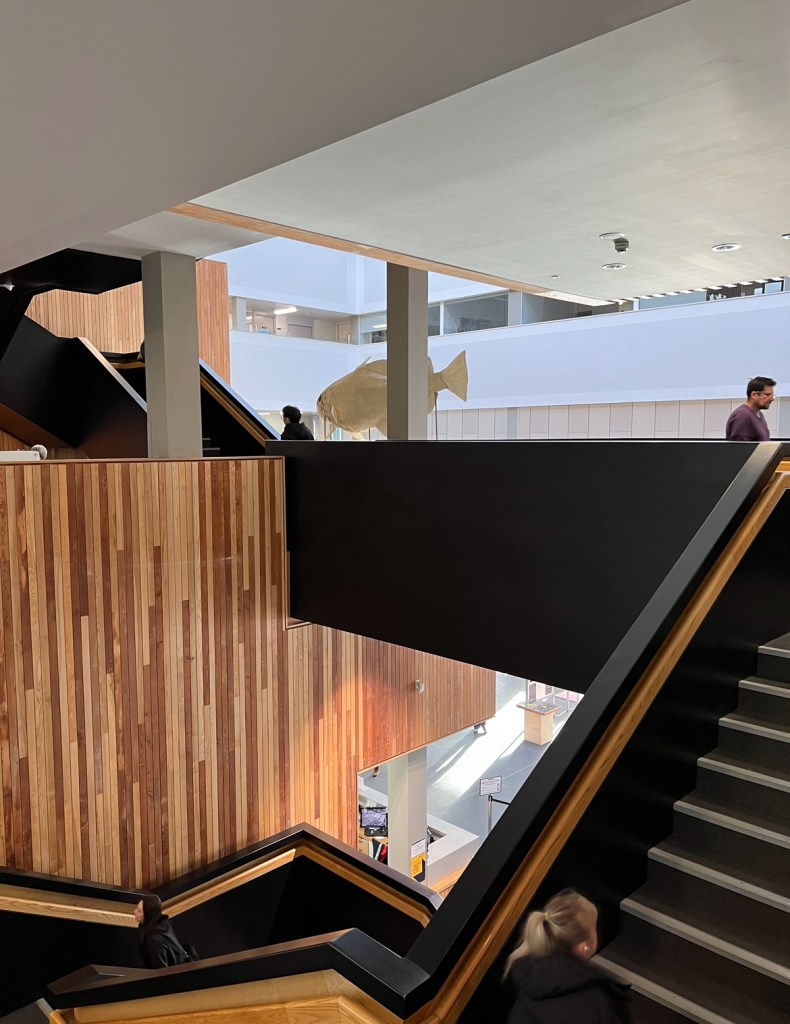
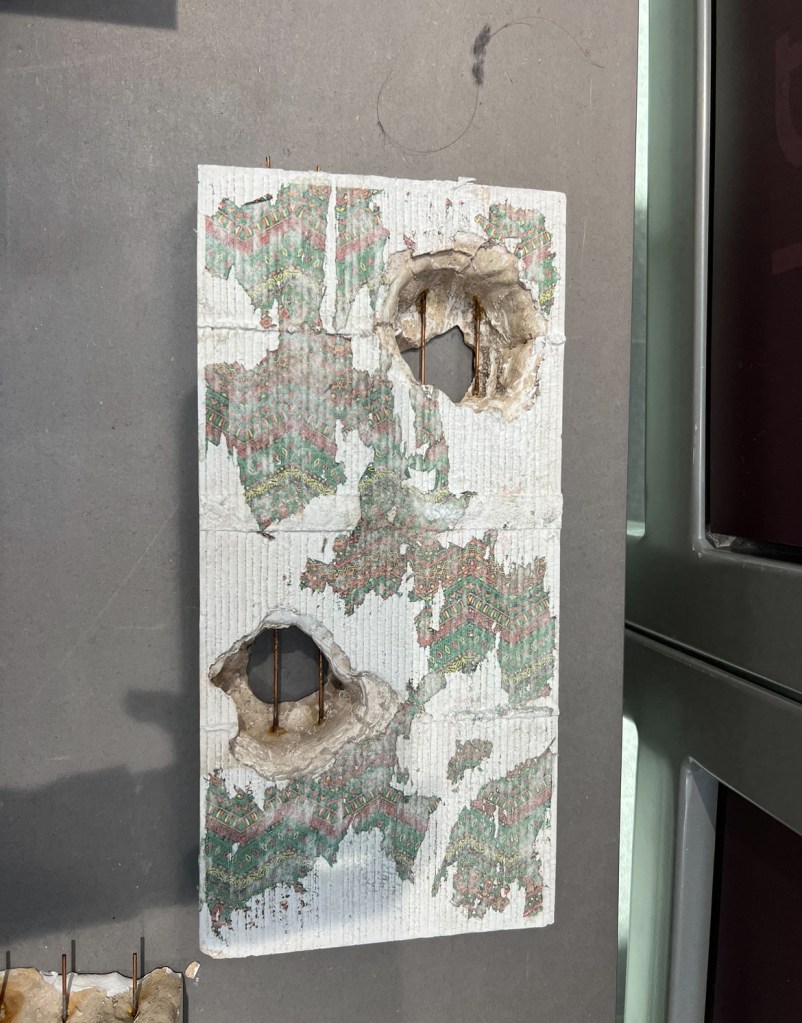
To me this picture portrays support. Just like buildings need walls to hold them up people also need some sort of support. Support from friends, family, and mentors makes people stronger. It gives them confidence and helps them face challenges. Knowing there are people to listen, help, and encourage them makes tough times easier. Supportive relationships create a sense of belonging and empowerment, helping individuals navigate life’s difficulties with courage and resilience. Ultimately, having support makes people feel stronger and more capable.
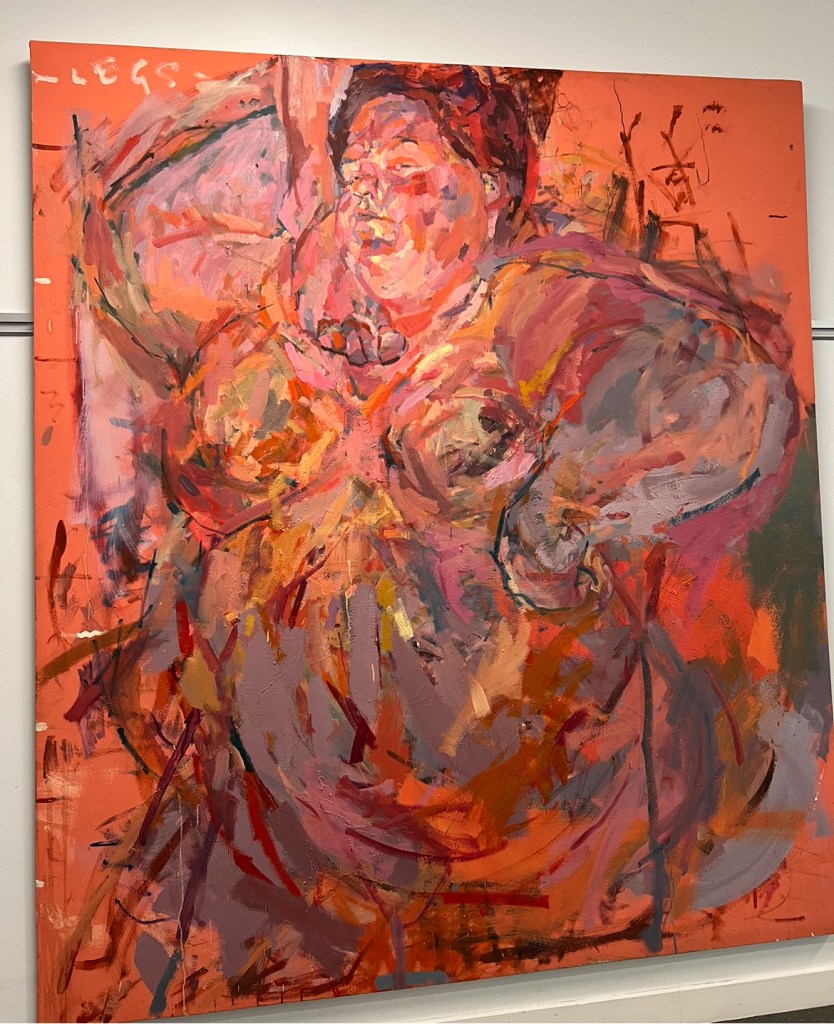
The second I looked at this picture I saw confidence. Confidence makes people stronger by giving them belief in themselves. It helps them face challenges, take risks, and grow. With confidence, individuals feel more capable, resilient, and able to handle whatever comes their way.
Paper weaving

I started with the picture of the book. My idea was to only weave paper into the pages of the book. It was my first time trying this technique so I started off my cutting straight lines into the paper using a crafting knife.

When I cut strips out of the other pictures and started weaving them into the lines I had cut. I realised the strips were too short to fit the whole page, so I had to cut strips out of another picture to fill the pages which made the pages look different. But I was quite proud of the outcome as it made it look quite creative loud, and colourful.

This was the final outcome. I felt like I cut the strips too wide which made the checkerboard effect I was trying to achieve not very visible. But other than that I rally liked the different colours.
Second attempt

For the second picture I decided to cut the lines and strips thinner to make the pattern stand out. I got inspired by Edward Honker who would use the paper weaving technique on only parts of his pictures giving it a blurry effect. I decided to try and use the paper weaving technique on the prayer rug.

Because I cut the strips thinner, I was able to make the checkerboard pattern appear more visible.

I find this piece quite creative and aesthetically pleasing. The blurred out rug gives the initial meaning behind this picture more room for interpretation and makes a broader range of people relate to it. I blurred out the Islamic prayer rug in the picture to make it relatable to everyone, no matter their religion. It represents faith and belief in general, showing how they make us stronger. Whether through prayer, meditation, or other spiritual practices, faith gives us courage, resilience, safety and comfort. It helps us face tough times with determination and guides us through life’s challenges.
Third attempt

I started feeling more comfortable and confident using the paper weaving technique and decided to try and weave different patterns.

So instead of the checkerboard pattern I decided to create this sort of zigzag one which I find quite aesthetically pleasing.
weekly reflection
Learning the new paper weaving technique was an enjoyable experience for me. It was fascinating to explore the intricate patterns and textures that could be created through weaving paper strips together. However, I found the process of combining two pictures together less enjoyable, as it made the patterns less visible. In the future, I would prefer to work with one picture and one plain paper to enhance the visibility of the patterns. Additionally, I realized that cutting thinner lines and strips would make the patterns more pronounced, and I want to experiment with different weaving patterns using plain paper. Moreover, I’m excited to explore how this technique can be connected to jewellery by creating shapes and pendants. I want to try experimenting with coloured wire or combining different fabrics with wire to create jewellery and objects. I believe these experiments will lead to creative and visually appealing outcomes.
Arline Fisch
Arline Fisch was born on January 18 1931 in Brooklyn New York.
She is an American jewellery designer and educator who is known for her creative application of textile techniques to metalworking. In her work, Fisch explores themes of identity, memory, and heritage while pushing boundaries of traditional skills. Throughout her career, Fisch has made a significant contribution to the field of modern jewellery.
Arline started exploring the boundaries of jewellery and clothing in the mid seventies.
She knitted, braided or wove using wire to create body adornments and jewellery.
Fisch travelled extensively and her first inspiration was Egyptian jewellery.
When she was a little girl, she would often visit the Metropolitan Museum of Art,
Where she was especially inspired by the Egyptian jewellery collection.
But she has also drawn inspiration by pre-Columbian textiles, Mediterranean cultures, viking and Celtic metalwork and Elizabethan ruff collars.
She has studied historical textile traditions from around the world, including lace making, embroidery, and weaving, and has adapted these techniques to create intricate and delicate metal jewellery.
The dramatic design of Egyptian broad collars, the extravagant style of African tribal ornaments, the richness of a Scythian gold helmet, and the extravagant designs of ornaments worn by nomadic peoples have always captivated her.

Fisch addressed themes of adaption often throughout her work. She draws inspiration from historical textile traditions and applies them to contemporary contexts, giving them an updated feel and meaning.
This idea is a reflection of Fisch’s belief that creativity has the ability to connect the past and present and that history is adaptable.

Fischer’s Headpiece “Flavour of the east”shows her ability to blend Eastern jewellery influences with her own innovative techniques. In my opinion, the design has elements that are reflective of Egyptian Bedouin inspiration, especially the whimsical usage of dangling coins that connect to the region’s rich history of culture and lifestyle. Overall “Flavour of the East” is showcases Fischers creative vision and her ability to combine several inspirations into a single and fascinating work of wearable art.
Fisch addressed themes of adaption often throughout her work. She draws inspiration from historical textile traditions and applies them to contemporary contexts, giving them an updated feel and meaning.
This idea is a reflection of Fisch’s belief that creativity has the ability to connect the past and present and that history is adaptable.

For this artwork Fisch got inspired by the hanging Gardens of Babylon.
One of the world wonders of the ancient world which was made around the Euphrates River around 600 B.C
Archaeologists claim to have discovered the ruins of the garden walls, although it’s possible that they never existed beyond the imagination of Greek poets and historians. Based on descriptions provided by these ancient Greek poets and historians, the only images that exist are creative reconstructions of the gardens. It was said that the exotic, growing plants in the gardens were grown above ground and dangled above the heads of the people.
She constructed her own interpretation of the hanging garden, with vibrant flower shapes hanging on long, green, knitted stems and hanged from the ceiling.
Critical analysis
Arline Fischer shows her ability to combine creativity, skill, and cultural awareness in her work. Her skill at weaving, which is clearly seen in pieces like “Hanging Garden,” displays her skills with metalworking and her ability to produce complicated and visually appealing textures. Her art gains depth and richness from the historical inspirations she incorporates, which also offers a basis for additional research and interpretation. In “Hanging Garden,” the vivid colours and complex patterns emphasise the vibrant and organic look that is created by the wire weaving process. It also showcases her ability to connect past and present and interpret historical inspirations to contemporary designs. I aim to apply her wire weaving techniques to my final project to create Islamic patterns and calligraphy.
Fischers “Flavour of the East” headpiece is an example of her ability to transform traditional Eastern wear into contemporary jewellery. The addition of dangling coins and the overall design, even though it may not use her trademark weaving skills, perfectly capture the essence of Eastern adornments. From my perspective the headpiece also showcases her Egyptian inspirations. As I am planning on integrating my Egyptian heritage and culture into my final design think her headpiece is a very good source of inspiration.
Sources
Museum, V. and A. (no date) ‘Lace Ascot’: Fisch, Arline M. (professor): V&A explore the collections, Victoria and Albert Museum: Explore the Collections. Available at: https://collections.vam.ac.uk/item/O55143/lace-ascot-brooch-fisch-arline-m/ (Accessed: 08 February 2024).
Art Jewelry Forum (2022) Arline Fisch: Hanging gardens, Art Jewelry Forum. Available at: https://artjewelryforum.org/articles/arline-fisch-hanging-gardens/ (Accessed: 08 February 2024). Arline Fisch (no date) Smithsonian American Art Museum. Available at: https://americanart.si.edu/artist/arline-fisch-5748 (Accessed: 08 February 2024
weaving using yarn
During the session we were introduced to another weaving technique. We flipped the chairs upside down and wrapped yarn around it creating warps for us to start weaving.

We chose another colour of yarn for the weft. I started by weaving it over the warp and then under creating this tight weave. I was only able to use the first four wraps as the other ones overlapped and were hard to use.

Weekly reflection
After I finished I wrapped around my yarn to create a flower. I think I can use this technique in my final project as I am creating a floral headpiece and this gives it a nice kitsch feeling.
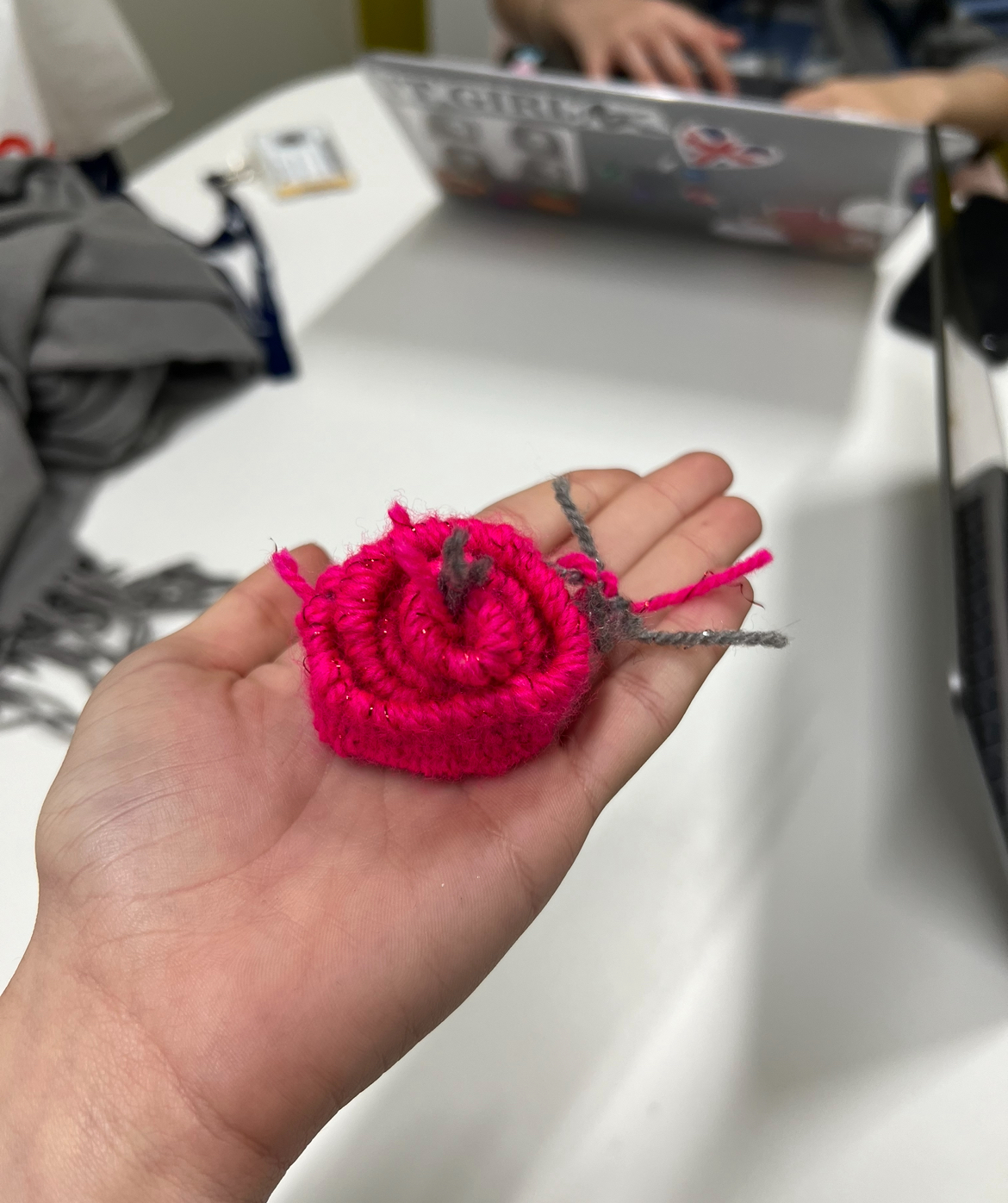
During this lesson we looked at an artists called Arline Fisch who is an American jewellery designer and educator who is known for her creative application of textile techniques to metalworking.
Arline started exploring the boundaries of jewellery and clothing in the mid seventies.
She knitted, braided or wove using wire to create body adornments and jewellery. We then started experimenting by weaving using repurposed materials like yarn for example.
During this week’s lesson, I explored weaving with different materials, trying to connect it to my project. While experimenting, I came up with an idea to weave something that could be rolled into a flower shape. This got me thinking about traditional weaving techniques used in Egypt for centuries. It inspired me to experiment with yarn for my final project.
I realized how much potential there is in trying new materials and techniques. It made me excited to keep experimenting and blending tradition with innovation in my project. This week reminded me of the importance of staying open to new ideas and being creative. It’s motivating me to continue exploring and creating something meaningful.
Clay Modelling
Clay modelling is the art of moulding clay into different shapes to make ceramics, jewellery, sculptures, illustrations and more.
Clay is a useful material for a wide range of applications because of its many special qualities. First of all, clay is extremely flexible, which makes it simple to mould and shape while wet. This property helps artists and craftspeople to precisely carve complicated shapes. Also, clay has outstanding cohesiveness, which enables particles to stick to one another when worked, maintaining its strength in ceramics and sculpture. Clay can be fired in kilns to create strong ceramic artefacts because it stiffens and holds its shape after it has dried. Moreover, clay holds moisture well due to its high absorption, which is helpful for hand-building methods and texturing effects in pottery. With the addition of pigments or glazes, its natural tint can be improved or changed, providing an array of artistic possibilities.
All things considered, clay is an ideal medium for painters, potters, and craftspeople because of its distinct mix of flexibility, cohesiveness, strength, absorbency, and colour diversity.
responding to an artist
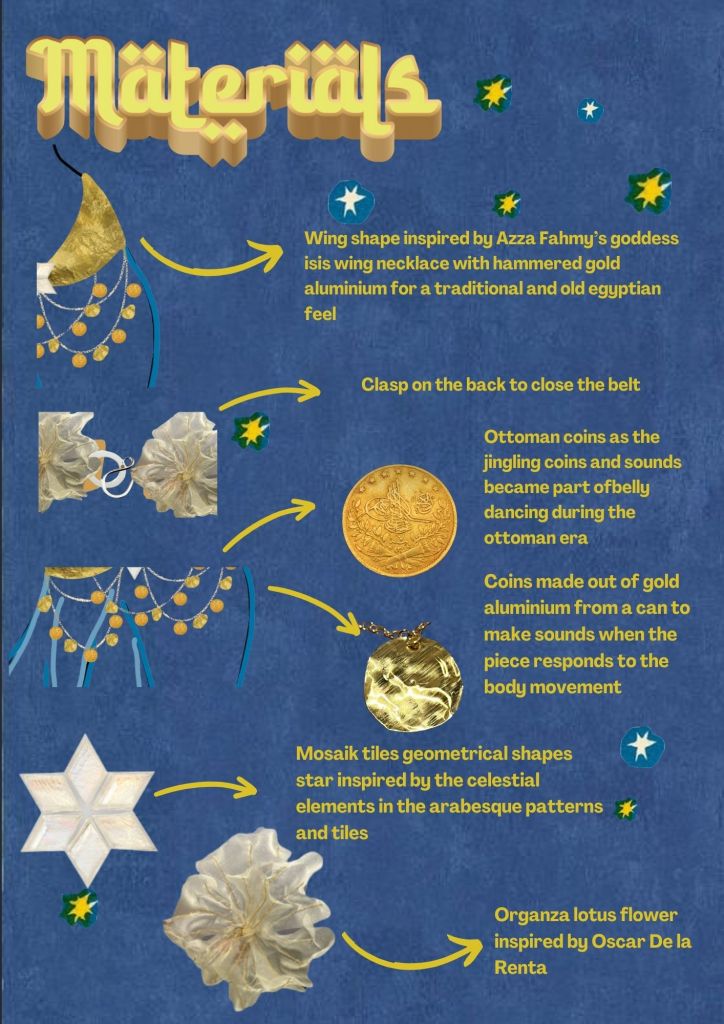
Oscar de la Renta is a fashion designer who has always been influenced by flowers and nature. I decided to respond to him by creating a flower made out if organza fabric.
Process
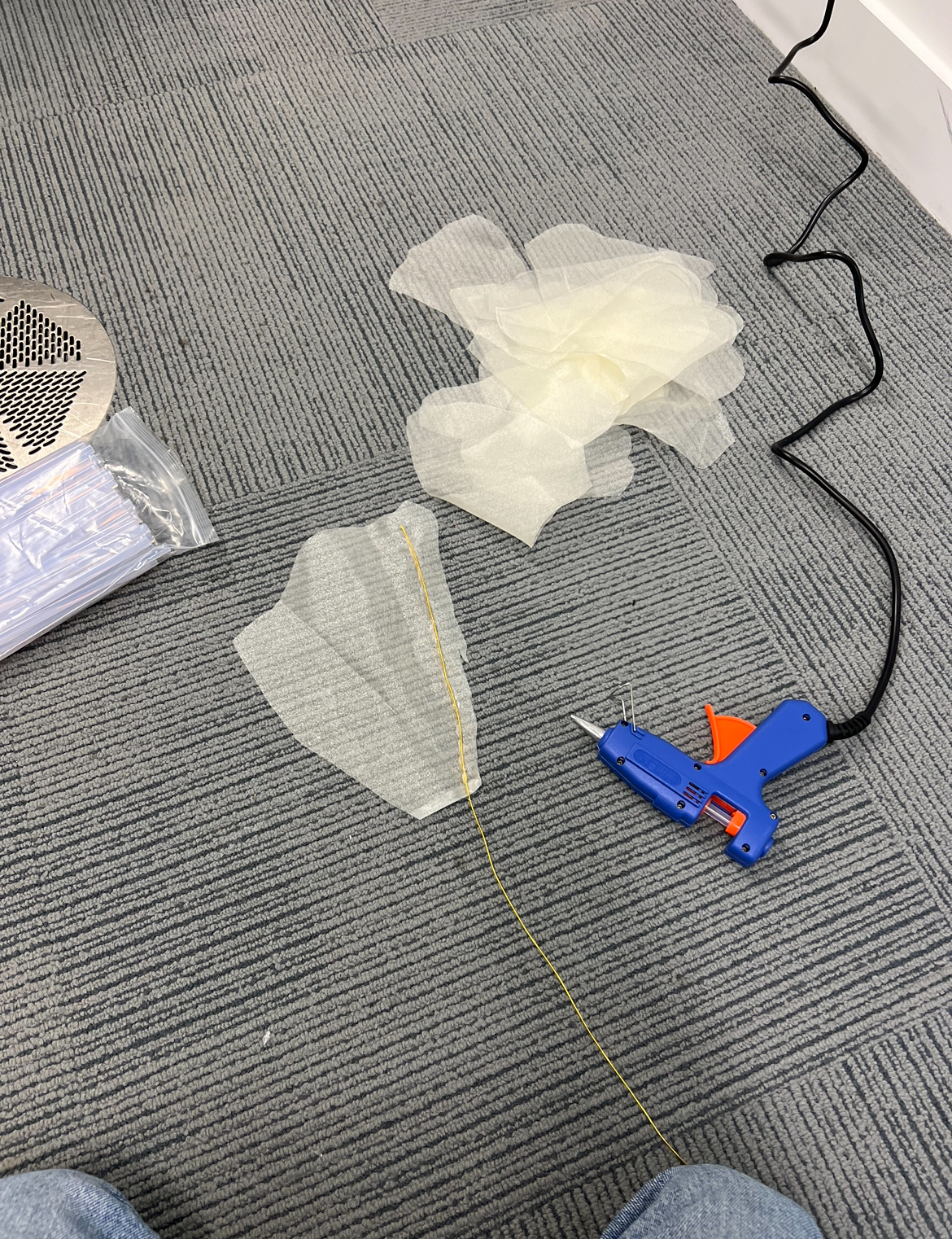
First I started off by cutting different sizes of petals from the organza fabric to create different layers and make it look like flower.
Reflection
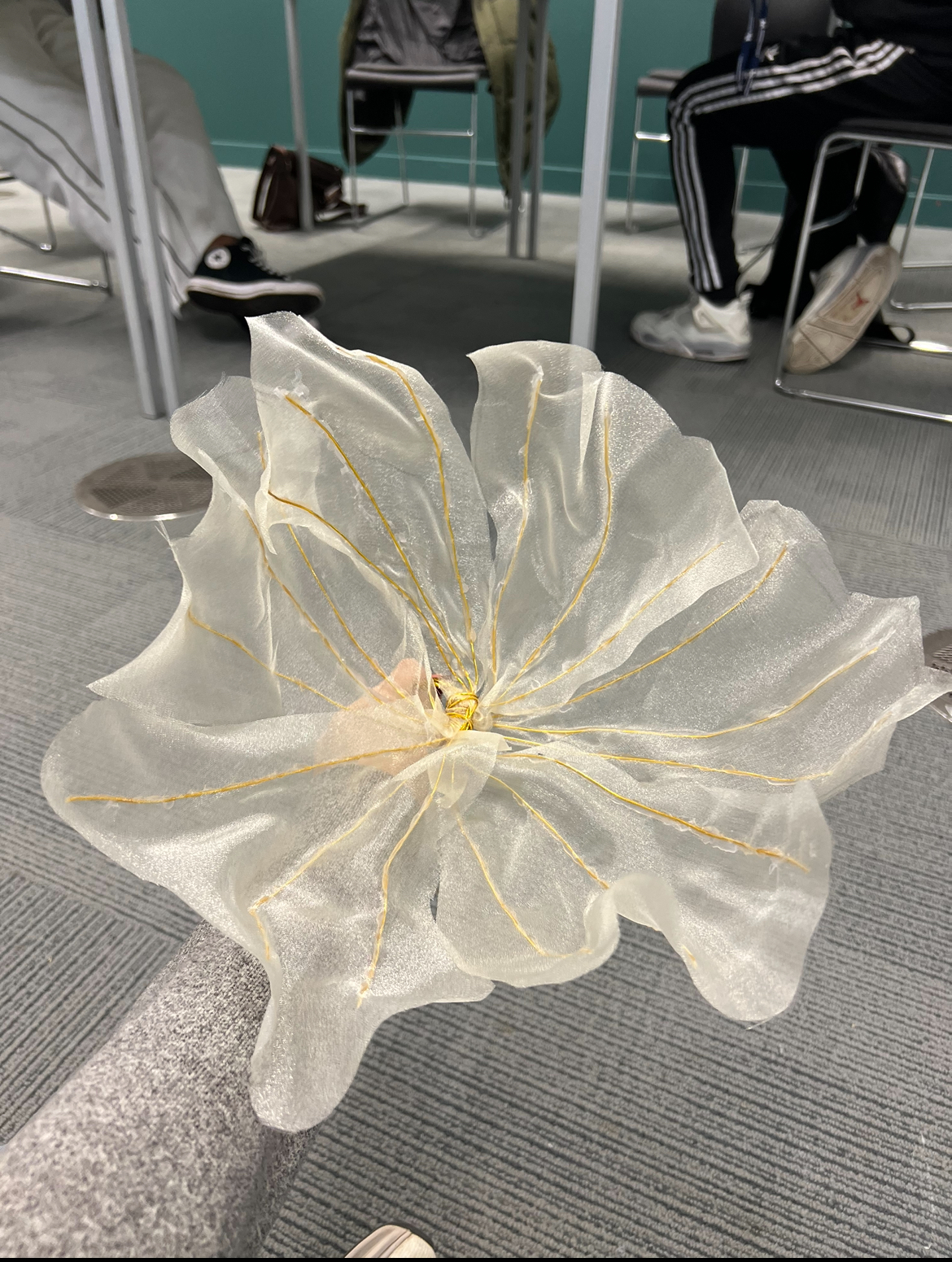
I then glued the petals to wire using a hot glue gun and shaped the ruffles in the fabric and make it look like flower petals.

I then attached the different layers on each other making it look like a flower.

Reflecting on this task, I realised that there is a lot of room for improvement. I did enjoy the process and I like the final outcome but there are things I’d like the improve. As I used a hot glue gun, it was quite hard to make the glue not show. It dried on the sides of the wire making it show on the fabric which I didn’t like, and I didn’t feel like it looked clean enough. Next time I would like to try and use super glue to be more precise and make it now show. What I did like was how the fabric was shiny and played with the light. This task made me realise that I would like to use organza for my final project but maybe create a smaller version
working with clay
During this lesson we started working with clay, each got to choose a design to make using clay.
Process

First I took a piece of clay and rolled it flat to start using cookie cutters to cut out shapes. This shape looked like petals so I started cutting the petal shapes and attaching it to each other to create a flower.
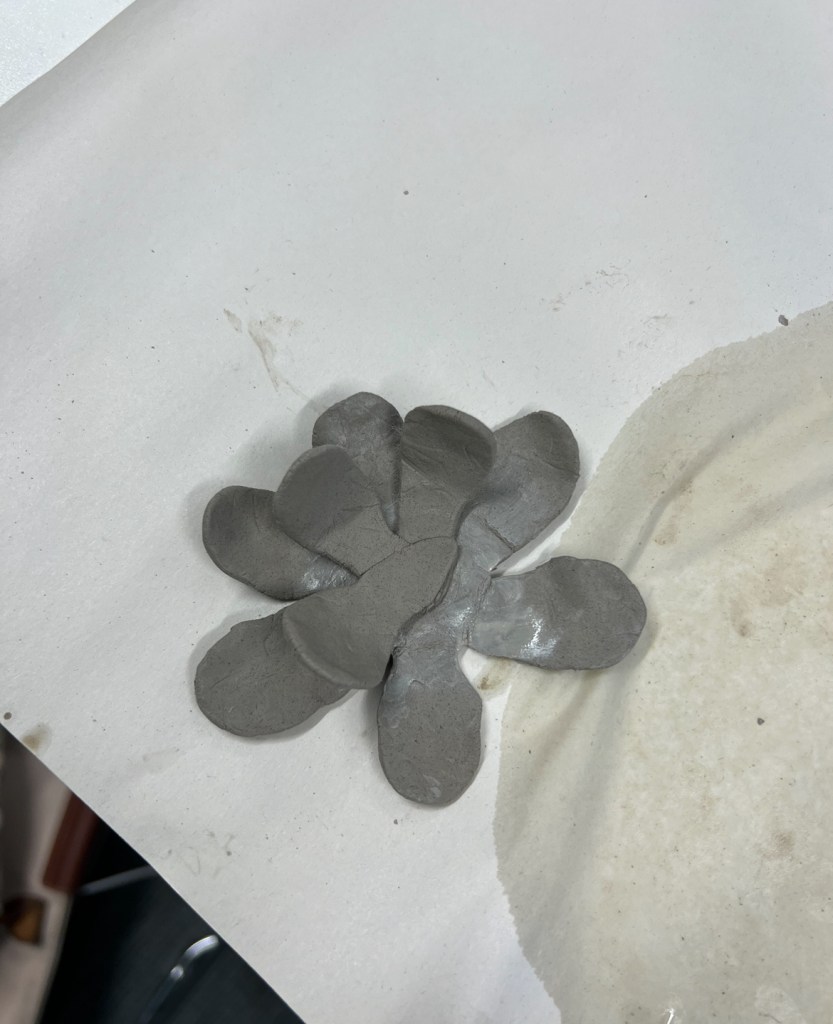
I started creating different sizes to make layers and make the lotus flower look more realistic.
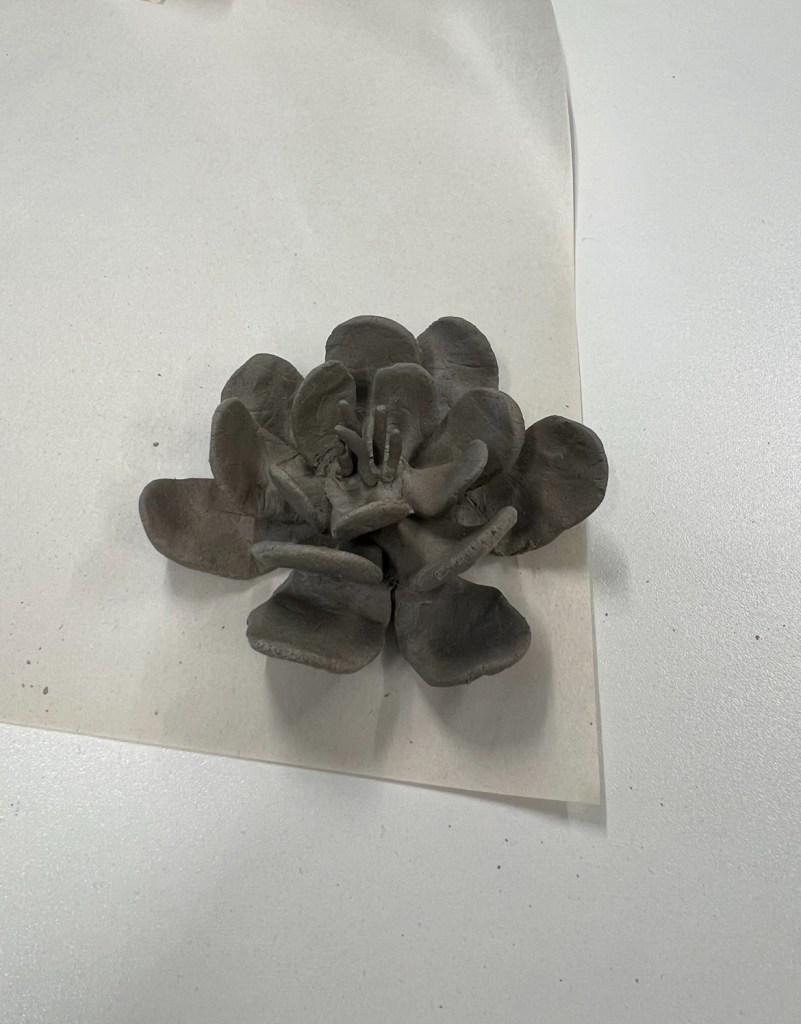
This was how the lotus flower ended up looking like which I was quite impressed by.

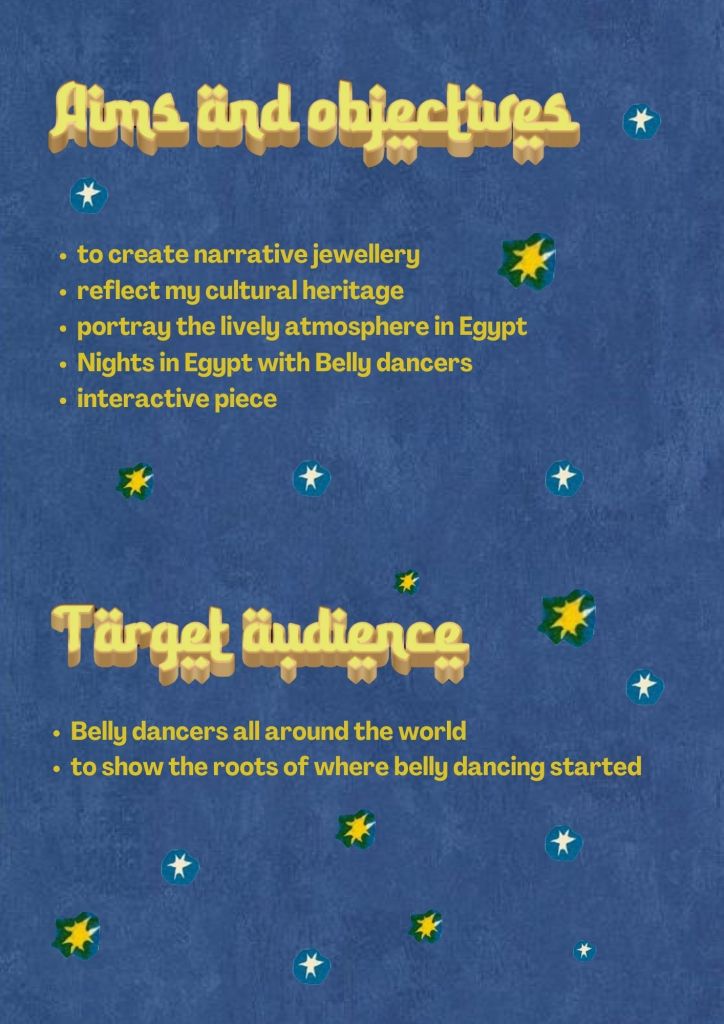
I felt like the lotus flower alone was too plain and empty and needed some creativity. The best thing about clay is that you can keep transforming and bending it as much as you want when it it still wet. So decided to create a GIF of the lotus flower opening and closing. This GIF inspired me to create something interactive for my jewellery, whether it’s a video or a sound I felt like having something more than just a piece of jewellery.
Weekly Reflection
During this week’s lesson, we experimented with clay as a material. I decided to make a lotus flower, as I was drawn to its symbolism of growth and adaptability. I was satisfied with shaping the petals and seeing the flower come to life. However, what really inspired me was the realisation that I could create an interactive element to accompany my design. Inspired by how the lotus flowers moves, I created a gif of the lotus flower opening and closing its petals. I felt that the interactive element enhanced the presentation of my design and helped me convey its essence more effectively.
I left the lesson feeling inspired by the possibilities of incorporating interactive elements into my final project. Whether through sound, video or other mediums, I aim to explore ways to engage the viewer and bring my design to life.
While I enjoyed working with clay, but I have decided that it may not be the best fit for my final project. But the exploration of the material provided new inspirations for elements to integrate.
Experimentation with wire
I decided to experiment with sounds, so my goal was that every piece I make should create sounds when moved. So my first experiment I wanted to trap beads into a piece made out of wire so it creates a jingling sound when moved.


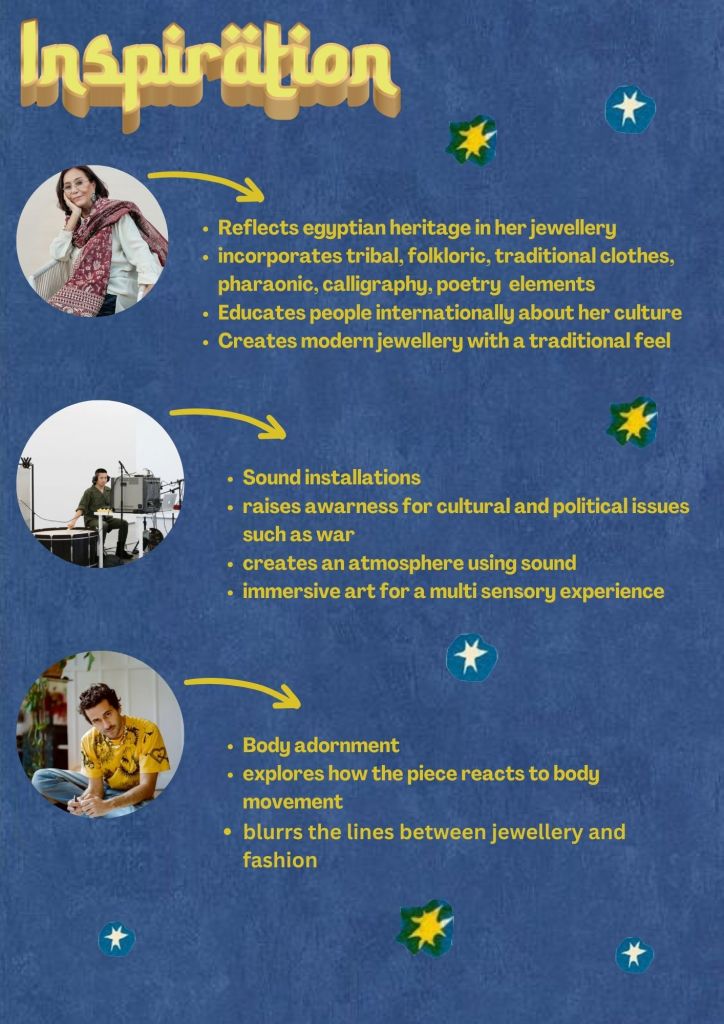
I got inspired by an earring Azza Fahmy had designed. The crescent carries very deep significance in Islam. The crescent moon holds diverse and multifaceted symbolism in Islam, representing elements of timekeeping, cultural identity, spiritual devotion, and artistic expression within the Islamic tradition.
I felt that the crescent moon is very compatible for my project because of the symbolism behind it. The crescent also symbolises new beginnings and renewal just like the lotus flower and the story behind my project. The crescent moon is used to determine the beginning of each month in the Islamic lunar calendar. The sighting of the crescent moon marks the start of the new Islamic month, also the cyclic nature of the moon, including its waxing and waning phases, is sometimes interpreted as a symbol of renewal and spiritual growth in Islam. Just as the moon undergoes phases of darkness and illumination, Muslims believe in the potential for personal growth, repentance, and spiritual transformation throughout their lives. The lotus flower also symbolises new beginnings as it starts as a seed under water and has to navigate obstacles until it can blossom on the surface. I felt that I wanted to integrate both motifs into one design to symbolise my experience of moving abroad and starting a new life in a new country and having to navigate obstacles at the start. I decided to integrate both motifs into one design while also making a lively and crowded piece that reflects my Egyptian heritage and the atmosphere in Egypt.
Crescent experimentation

First I cut out a piece of cardboard in the shape of a crescent so I can wrap the wire around it and achieve the shape I wanted.

After that I put a few beads in between the wire and wrapped more wire around them to trap them and make them do jingling sounds when the moon is moved.
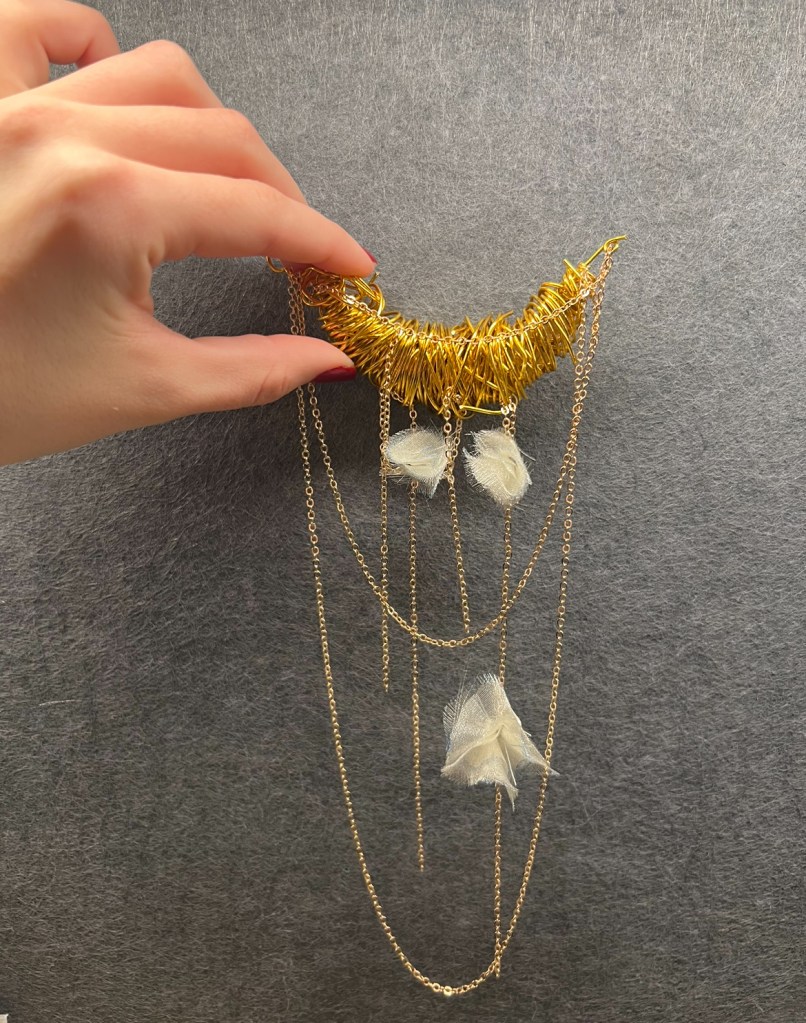
I then attached some chains to it, to give it a lively and loud feel. I was inspired by jewellery and body adornment worn by belly dancers as I felt they were quite loud and reminded me of my word kitsch.

After some experimentation I felt like it looked better as a belt, also because I was so inspired by belly dancers to represent the lively atmosphere in Egypt. So I decided to make it into a belt because most of the movement that happens while belly dancing is around the hips and waist area. The belts and scarves worn around the waist serve to accentuate the movements of the hips and torso during the dance. These accessories add visual interest and drama to the performance, enhancing the overall aesthetic appeal of the dance. Many belly dance belts are adorned with coins, beads, or metal embellishments that create a jingling or tinkling sound as the dancer moves. This auditory element adds another layer of excitement and rhythm to the performance, enhancing the music and captivating the audience. Reflecting back on this experiment, I like the outcome of the crescent shape and using wire allowed me to trap the beads inside which I also quite liked as the jingling sound of the beads bumping against the wire remind me of belly dancers and Egypts lively atmosphere. The way I attached the belt using yarn is something that I don’t find aesthetically pleasing and it also kept falling off so for next time I will have to problem solve this.
Experimenting with tiles
I was always fascinated by the geometrical forms on arabesque tiles and I decided that I wanted to somehow integrate that into my designs.

Most islamic ornament was governed by the principles of geometry. Many artists were trained to use a compass and a ruler. Geometric patterns, like nature, plants and celestial based designs were used both in religious and secular contexts. The geometric elements in the patterns can be detected by the repeated patterns, straight lines and exact curves of the designs and letters.
One motif really inspired me which was the 12- pointed star. I decided to get inspired by it and used geometric mosaic tiles and arranged them into a star shape.

Another element I wanted to add to my designs were coins as they are vey recurrent in Egyptian traditions and culture. Belly dancers always wear them around their waists to create sounds they were also used to show status.
Experimentation

After talking to Anne about how I could make gold coins that look quite authentic, she suggested using the inside of a tomato pure can which I found very useful. So I started cutting out circles to use them as coins. I really liked the hammered gold look the box made the coins have.
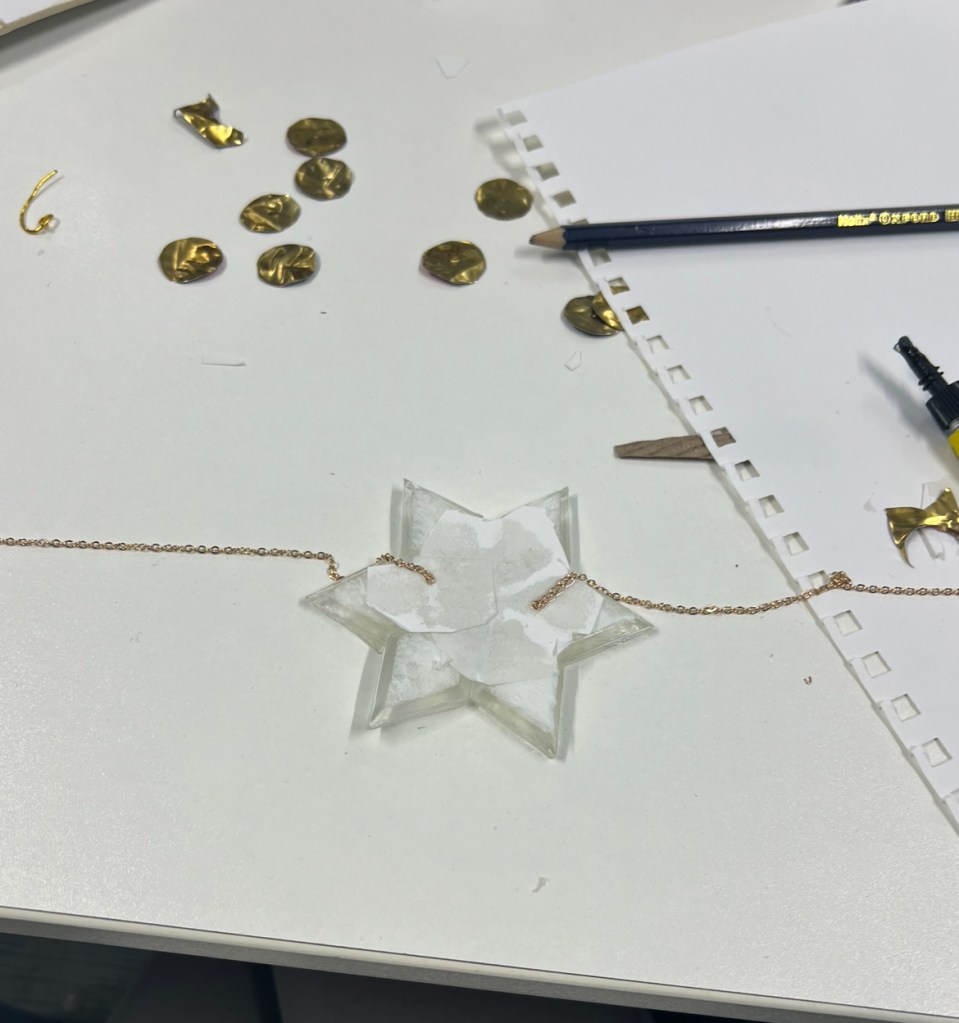
I struggled a bit with attaching the tiles to each other. First I tried using superglue and it didn’t work so I used a glue gun which didn’t work either. Chelsea suggested gluing the tiles onto another material, so I tried gluing it onto paper and cutting around it so the paper wouldn’t show.

I then attached the coins and I really liked the outcome. I felt like the hammered gold coins and the geometric shapes gave it this arabesque feel. What I struggled with was figuring out how to attach it to a back. I brainstormed some ideas with my classmates and felt that maybe attaching a necklace to it and making the neck hold up the back would be a good idea, also with clips and clipping it to the straps of the dress or shirt this person is wearing was another solution.


After I thought about the atmosphere I was trying to convey by getting inspired by belly dancers, I felt there is also a lot of movement happening in the neck and head area while dancing, so I decided to experiment and try it out as a headpiece. I really liked how it looked however I felt that the star in the middle was quite big and wouldn’t be very comfortable while dancing, on the other hand I felt that having it on the head would make it more of a statement piece and more visible, also the sounds it would create would be louder. Both the back and the headpiece were a successful experiment in my opinion and also inspired me to look further into body adornment.
Material comparison
Artists often make choices about the materials they choose based on which resonates with their idea more. This comparison focuses on clay and wire weaving, which are two materials I have experimented with in ART105. Clay is known for its flexibility and ease of shaping, while wire weaving demands precision. In this evaluation we will be discussing the unique characteristics of each material, considering their strengths, weaknesses and the personal experience of the artist using the materials.
Clay stands out for its malleability, allowing the artist to manipulate it with ease, it can be shapes and moulded repeatedly while still wet. These characteristics allowed the artist to experiment with different geometrical shapes that she moulded together into one piece. The idea behind the artists project is to create an interactive piece that portrays the atmosphere in Egypt, her project is a narrative jewellery piece which tells a story through the symbolism of the lotus flower, which is the national flower of Egypt and holds big significance in both modern and ancient Egypt. Because clay can be reshapes endlessly while still wet, it allowed her to create a gif, an interactive video showing how the flower opens and closes symbolising new beginnings, which really inspired her, it is also a traditional material that people have used in Egypt throughout the centuries and also carries significant symbolism for her project, as it is believed in Islam that god created us humans out of clay and throughout our life, our experiences shape us and make us the people we are now. However, after the clay dried, she felt that it wasn’t very dynamic and lively anymore which is the atmosphere she aims to portray through her designs. She felt that it was too still and only moved while still wet which wasn’t very compatible with her project as she was creating a piece that shows Egypt’s lively and dynamic culture and atmosphere through interactive elements, belly dancers and movement.
Another material the artist got to work with was wire. Wire is more intricate and delicate in contrast to clay, it isn’t as easy to create shapes with it and it needs precision and patience, however it felt more dynamic to the artist. Working with wire allowed her to also experiment with sounds, delicate arabesque geometrical shapes and Arabic calligraphy, which she felt showed her inspiration by the Egyptian culture more. While the process might’ve been harder, it felt like it resulted into more unique and intricate pieces. Wire can be used to create shapes and designs, as well as to attach elements to each other, the multipurpose characteristic the material carries makes it very practical as well.
Both clay and wire are materials the artist enjoys working with in general, however for this project she felt that working with wire would be more suitable. Clay is a flexible material that can be reshaped and is easy to create big shapes with, however wire is more delicate and results in more precise designs which is what the artist is looking for, for this project. Wire is also a traditional material that has been used in jewellery throughout the years. To create delicate Islamic patterns, that are still dynamic in a way the artist felt that wore would be more suitable.
In conclusion, experimenting with materials is a very important aspect of an artistic practice as it inspires you and brings you closer to understanding what exactly it is you want to convey. All in all the artist enjoyed working with wire more for this project, because she felt it allows her to create more detailed and intricate patterns.
Crescent experimentation
First I cut out a piece of cardboard in the shape of a crescent so I can wrap the wire around it and achieve the shape I wanted.
After that I put a few beads in between the wire and wrapped more wire around them to trap them and make them do jingling sounds when the moon is moved.
I then attached some chains to it, to give it a lively and loud feel. I was inspired by jewellery and body adornment worn by belly dancers as I felt they were quite loud and reminded me of my word kitsch.
After some experimentation I felt like it looked better as a belt, also because I was so inspired by belly dancers to represent the lively atmosphere in Egypt. So I decided to make it into a belt because most of the movement that happens while belly dancing is around the hips and waist area. The belts and scarves worn around the waist serve to accentuate the movements of the hips and torso during the dance. These accessories add visual interest and drama to the performance, enhancing the overall aesthetic appeal of the dance. Many belly dance belts are adorned with coins, beads, or metal embellishments that create a jingling or tinkling sound as the dancer moves. This auditory element adds another layer of excitement and rhythm to the performance, enhancing the music and captivating the audience. Reflecting back on this experiment, I like the outcome of the crescent shape and using wire allowed me to trap the beads inside which I also quite liked as the jingling sound of the beads bumping against the wire remind me of belly dancers and Egypts lively atmosphere. The way I attached the belt using yarn is something that I don’t find aesthetically pleasing and it also kept falling off so for next time I will have to problem solve this.
Experimenting with tiles
I was always fascinated by the geometrical forms on arabesque tiles and I decided that I wanted to somehow integrate that into my designs.
Most islamic ornament was governed by the principles of geometry. Many artists were trained to use a compass and a ruler. Geometric patterns, like nature, plants and celestial based designs were used both in religious and secular contexts. The geometric elements in the patterns can be detected by the repeated patterns, straight lines and exact curves of the designs and letters.
One motif really inspired me which was the 12- pointed star. I decided to get inspired by it and used geometric mosaic tiles and arranged them into a star shape.
Another element I wanted to add to my designs were coins as they are vey recurrent in Egyptian traditions and culture. Belly dancers always wear them around their waists to create sounds they were also used to show status.
Experimentation
After talking to Anne about how I could make gold coins that look quite authentic, she suggested using the inside of a tomato pure can which I found very useful. So I started cutting out circles to use them as coins. I really liked the hammered gold look the box made the coins have.
I struggled a bit with attaching the tiles to each other. First I tried using superglue and it didn’t work so I used a glue gun which didn’t work either. Chelsea suggested gluing the tiles onto another material, so I tried gluing it onto paper and cutting around it so the paper wouldn’t show.
I then attached the coins and I really liked the outcome. I felt like the hammered gold coins and the geometric shapes gave it this arabesque feel. What I struggled with was figuring out how to attach it to a back. I brainstormed some ideas with my classmates and felt that maybe attaching a necklace to it and making the neck hold up the back would be a good idea, also with clips and clipping it to the straps of the dress or shirt this person is wearing was another solution.
After I thought about the atmosphere I was trying to convey by getting inspired by belly dancers, I felt there is also a lot of movement happening in the neck and head area while dancing, so I decided to experiment and try it out as a headpiece. I really liked how it looked however I felt that the star in the middle was quite big and wouldn’t be very comfortable while dancing, on the other hand I felt that having it on the head would make it more of a statement piece and more visible, also the sounds it would create would be louder. Both the back and the headpiece were a successful experiment in my opinion and also inspired me to look further into body adornment.

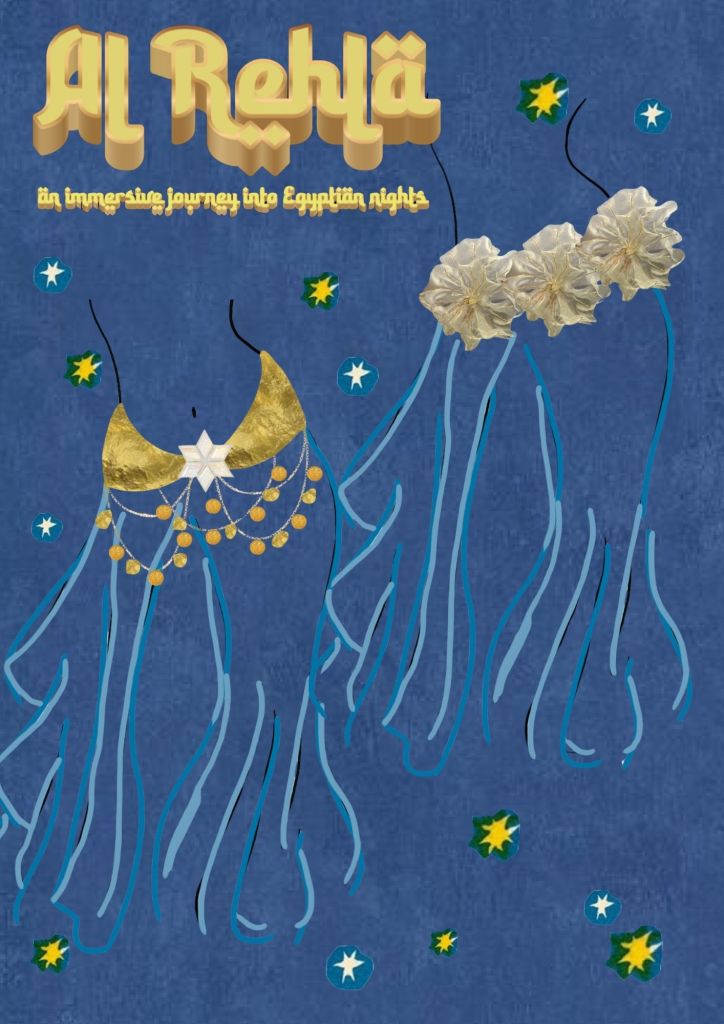
I wanted to further develop this design so I decided to experiment with other Egyptian inspired elements. I decided to create a belt as I was inspired by how it reacts to belly dancers movements as it’s all in the hips, belly and waist. I liked how the coins would jingle with every movement, making people draw attention to the belly movements with both visually appealing elements and sounds.

I decided to get inspired by this necklace by Azza Fahmy and create shapes with wire that look like wings. Wings are elements that are included a lot in ancient Egypt. It especially reminded me of the goddess isis’ wings that symbolise healing and rebirth. I felt that it was quite connected to my narrative of starting a new life abroad.

I decided to further develop this design. I really liked the shape of the vultures wings they reminded me of goddess Isis wings. Godess Isis is a pharaoh who symbolises rebirth and new beginnings, I felt like the symbolism is really connected to my story. I wanted to fill in the wire shape as I felt like it needs to show the shape more so I tried it with hammered gold and I really liked the outcome as the geometric shapes of the wings were now more visible. I was quite fascinated by the celestial elements in the islamic patterns as they also carried very strong symbolism. The islamic calendar is a lunar calendar and the moon holds big symbolism for islam which inspired me to also get inspired by the starts. In the ancient times they would follow the stars in their travel, as it guided them to their destination. I felt like the star should be in the middle of the belt so it’s the centre of the attention it guides the eyes of the viewer with the movement of the belly dancer. I also felt connected to the symbolism, because even when you travel and start a new life you might feel lost but everywhere you go you can look up to the stars and have some sort of familiar feeling.

I decided to put some organza lotus flowers at the back of the belt also for the symbolism.
Design sheets
Sounds

I recorded sounds and layered them on top of each other to portray how the atmosphere feels like in Egypt. To me Egypt feels lively and crowded 24/7, Cairo is a city that never sleeps. People there are extremely talkative, friendly and joyful. From street vendors in the street to cars honking, people chatting and laughing. It’s chaotic, loud and crowded but in a happy way which is an atmosphere I am trying to portray using sounds and my jewellery piece. I felt like one thing that can kind of sum up the whole feeling is when a belly dancer is performing. The joy that is in the air with the music and people cheering and laughing when a belly dancer performs sums up Cairos atmosphere in just one minute. So I decided to create a mood board and sounds, so the viewers have a multi sensory journey into Egyptian nights and imagine what it feels like there.

Evaluation
This semesters module gave me a chance to explore the world pf physical and digital material experimentation, which ultimately shaped my creative journey and improved my artistic vision. I did a broad range of experimentation during the course, which helped me select the materials that most closely matched my artistic style and project goals.
I also gained understanding of the materials that did not fit my creative vision. One of the best things about this module was how flexible it was to experiment with different kinds of materials. I was able to explore a wide range of creative ideas using everything from digital tools and techniques to conventional mediums like clay, fabric, and wire.
Working with both digital and actual materials allowed me to expand my creative toolset and deepen my understanding of materials which allowed me to approach my projects from new perspectives.
Most importantly our teachers’ advice and criticism were really helpful to me as I experimented. Through informative conversations, they recommended different materials and techniques that I had not previously thought of, greatly improving my creative process and inspiring new areas of exploration. Their advice served as an inspiration to experimentation, motivating me to step outside of my comfort zone and confidently explore new mediums.
I saw noticeable improvement in my ideas and creativity over the semester. Compared to last semester, I was much more excited to experiment with new materials and full of ideas. I took on ambitious projects like making a larger scale body adornment piece that responds to the movement of the human body, which forced me to explore new materials and techniques.
Clay was such material that sparked my imagination. Even though I had previously worked with clay, its malleable quality encouraged me to use my imagination and consider new concepts. Making a GIF that showed me clay flower opening and closing acted as an inspiration to incorporate an interactive element in my final project.
In addition to clay, I also experimented with sounds, layering them to recreate the atmosphere of Egypt. This exploration inspired me to integrate sounds into my final project and adding an auditory element.
During my experimenting, I came across new materials that made a connection with my creative vision, but I also became aware of some materials limitations in terms of producing the results I wanted. In the end, this module gave me the confidence to decide on the materials I would use for my final project.
In addition to clay, I also experimented with sounds, layering them to recreate the atmosphere of Egypt. This exploration inspired me to integrate sounds into my final project, adding an auditory element.
Even though there were obstacles to overcome, including figuring out how to work with materials that don’t need specialised equipment, I am proud of the creativity and experimentation that went into my final design.
 Farida’s Art and Design blog