
Kitsch Mindmap
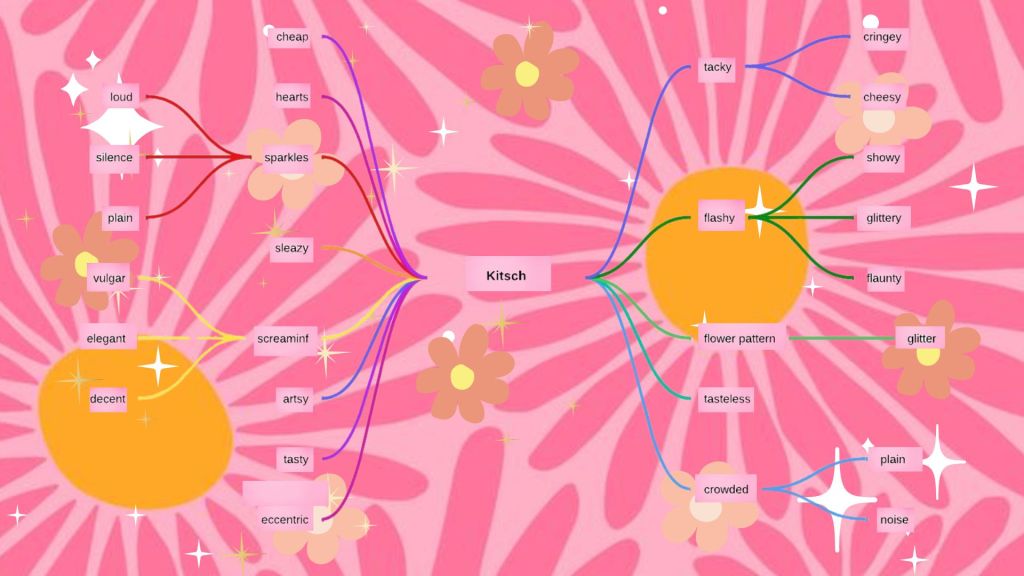
Today we were each given a word. We were su Today we were each given a word. We were supposed to first look this word up to understand the
meaning and then create a mind map with different buzzwords for this word.
After creating our mind maps on paper the paper was passed around to all our classmates who were asked to add buzzwords to it. To deepen our understanding of the words our papers were passed around one more time and we were supposed to each write down an opposite of any word written on the mind map. were supposed to first look this word up to understand the
meaning and then create a mind map with different buzzwords for this word.
After creating our mind maps on paper the paper was passed around to all our classmates who were asked to add buzzwords to it. To deepen our understanding of the words our papers were passed around one more time and we were supposed to each write down an opposite of any word written on the mind map.
S C A M P E R
What does scamper stand for?
Substitute Combine Adapt Modify Put to another use Eliminate Reverse
How to use SCAMPER
1.Define the problem or idea you want to improve.
2.Go through each letter of SCAMPER, asking yourself questions related to that specific approach.
3.Write down all the ideas that come to mind, no matter how crazy they seem.
4.Evaluate the ideas and choose the most promising ones to develop further.
Our Task
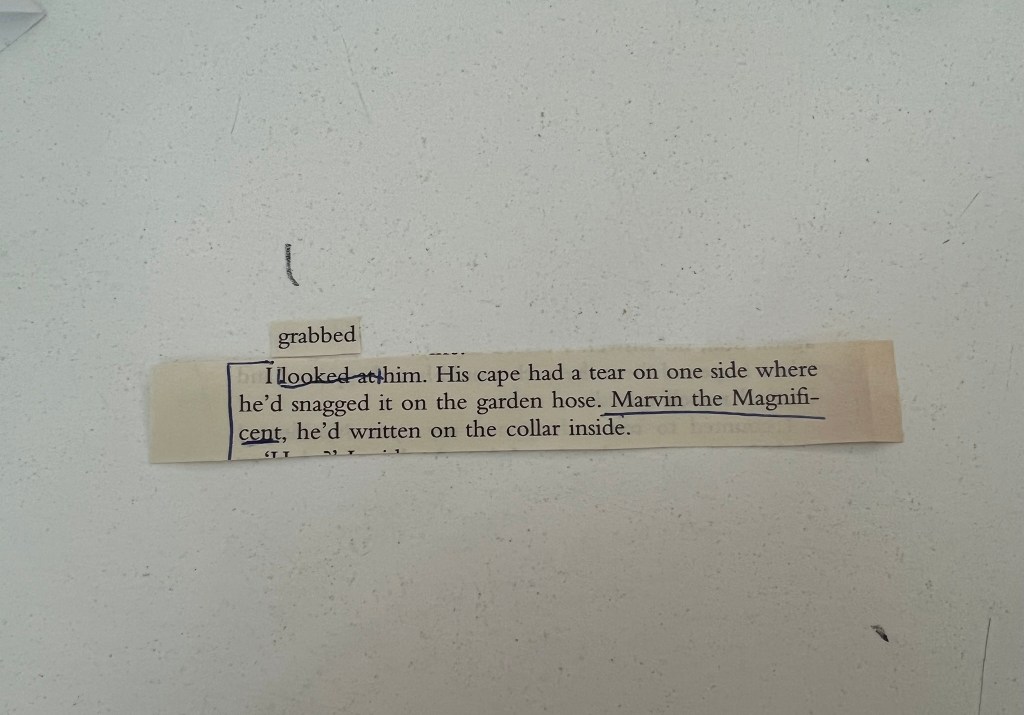
For this task we were each given a random page out of the book. We were first asked to read the page to understand the content. After that we were supposed to each pick one sentence from our given page that we like.

After that we were asked to choose some words from the rest of the page and Substitute words from our sentence with them to create a new meaning to the sentence.
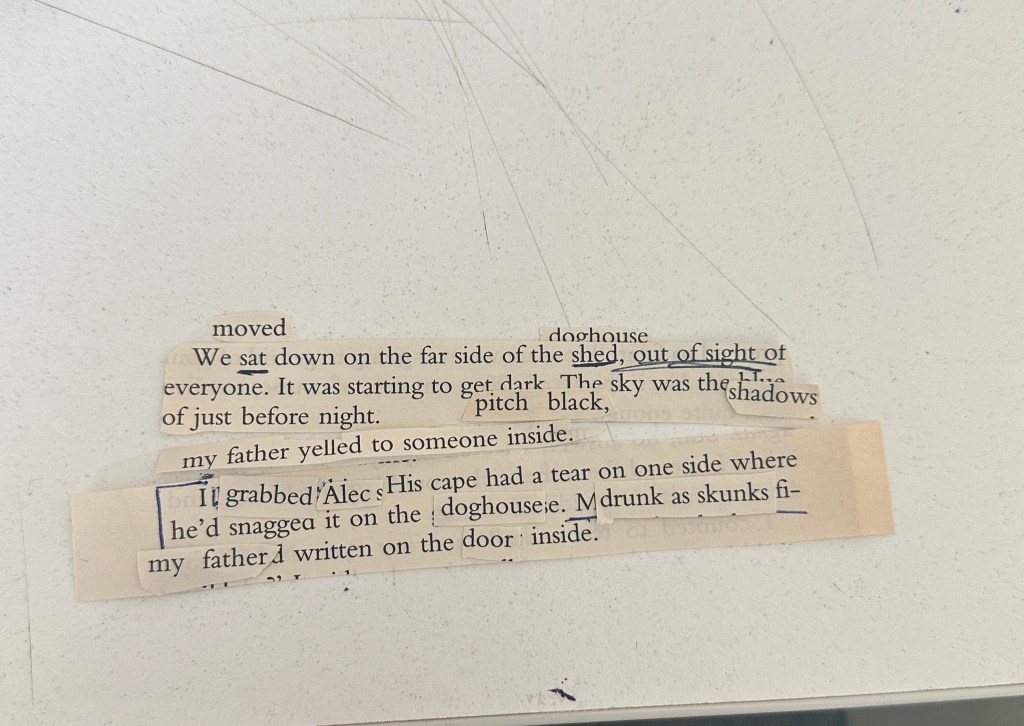
Then we combined our sentences with one of our classmates sentences and also added a few words to create a short story and a new meaning to the sentences.

The next step was adapting the sentences to something new. Me and Jenny (my classmate) decided to change it up and create a comic that portrays the story we created when we combined our sentences.

To modify our comic we decided to add the suitable sentences to the comic to help narrate it.

We put the sentences to another use by rearranging the words in our sentences and creating messages for our classmates. It didn’t matter how crazy they were as long as they has a new meaning.
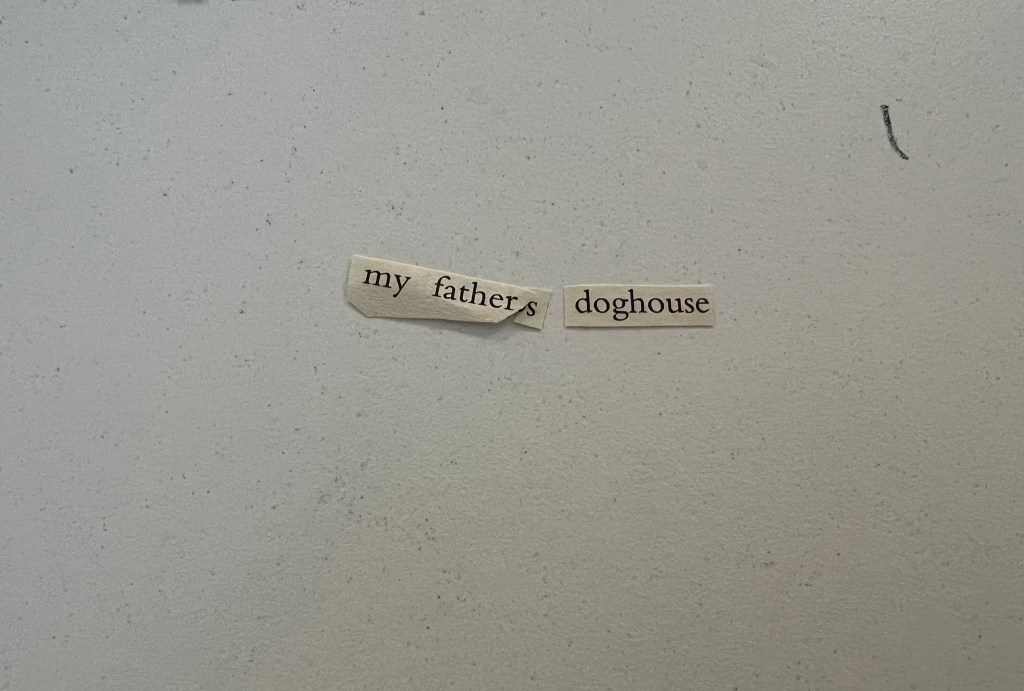
After that we eliminated some of the words and created a new sentence with a whole new meaning.
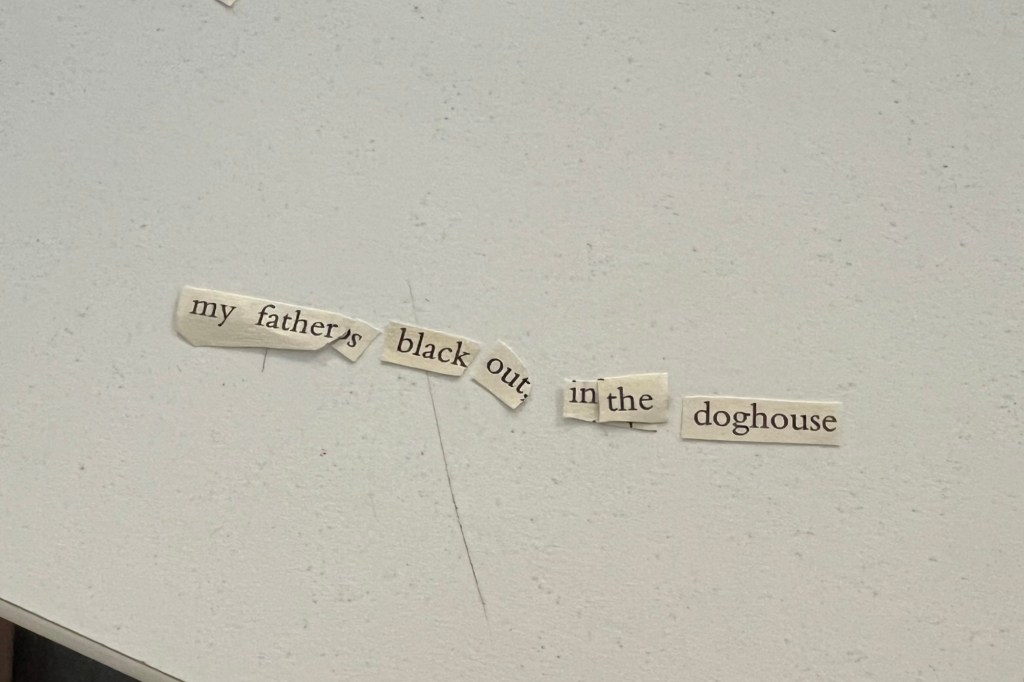
For the last task we were asked to reverse our words and try to make a sentence out of it. Me and Jenny decided to put our words together to be able to create a sentence that makes sense.
Weekly Reflection
During this lesson we were first each given a word . we then had to find buzzwords for our word and create a mind map. We were then asked to pass around our mind maps and each of us added a buzzword on every classmates mind map. After that we were introduced to the SCAMPER technique. We picked out a sentence from a book page and kept developing the sentence using the SCAMPER technique.
Reflecting on this task I feel that it showed me how many ideas can be created out of a single one. Every buzzword lead to another one helping me create a whole mind map. Also the buzzwords on the mind maps helped me understand the meaning of the initial word more in depth. The very simple sentence out of the book page created many other sentences with completely different meanings. It showed me how an idea can lead to a thousand other ones.
Last semester I struggled with coming up with a broad range of design ideas and exploring different designs . This semester I want to apply the SCAMPER technique to my project and see how each design idea develops into another one which then leaves me with a broad range of creative, innovative and different designs .
A kitsch writing
In the morning I woke up and went to my grandmas house. As soon as I entered the door I found this flashy, glittery sculpture. I looked at her and I told her my opinion right away. I said:” Grandma this sculpture with the hearts and sparkles and flower patterns on it is the most cheap looking cringey kitsch thing I’ve seen in my in my entire life. She started screaming at me telling me how this is an elegant piece of art and that only people with taste will understand hoe eccentric it is. To be honest I found it too cheesy and tacky. My mother came out of the room asking why were being so loud and I told her its because grandma has no taste. There was complete silence in the room. I continued ” I think it’s just too crowded with all the patterns I dont like the noise it creates and I feel like I like plain sculptures more. This one is too showy. Again my grandma started being loud she said that it isn’t some cheap sculpture, that all her friends love it and that it’s something vintage she had bought at an auction for 5000 pounds. My mom told her that’s too much and that she should stop being so flaunty she said it isn’t decent to talk about prices and that my grandmas friends are influencing her too much , that she started becoming vulgar like them. I said yes mom its a sleazy sculpture and I find it cringe. We walked out the door and left.
Arte povera
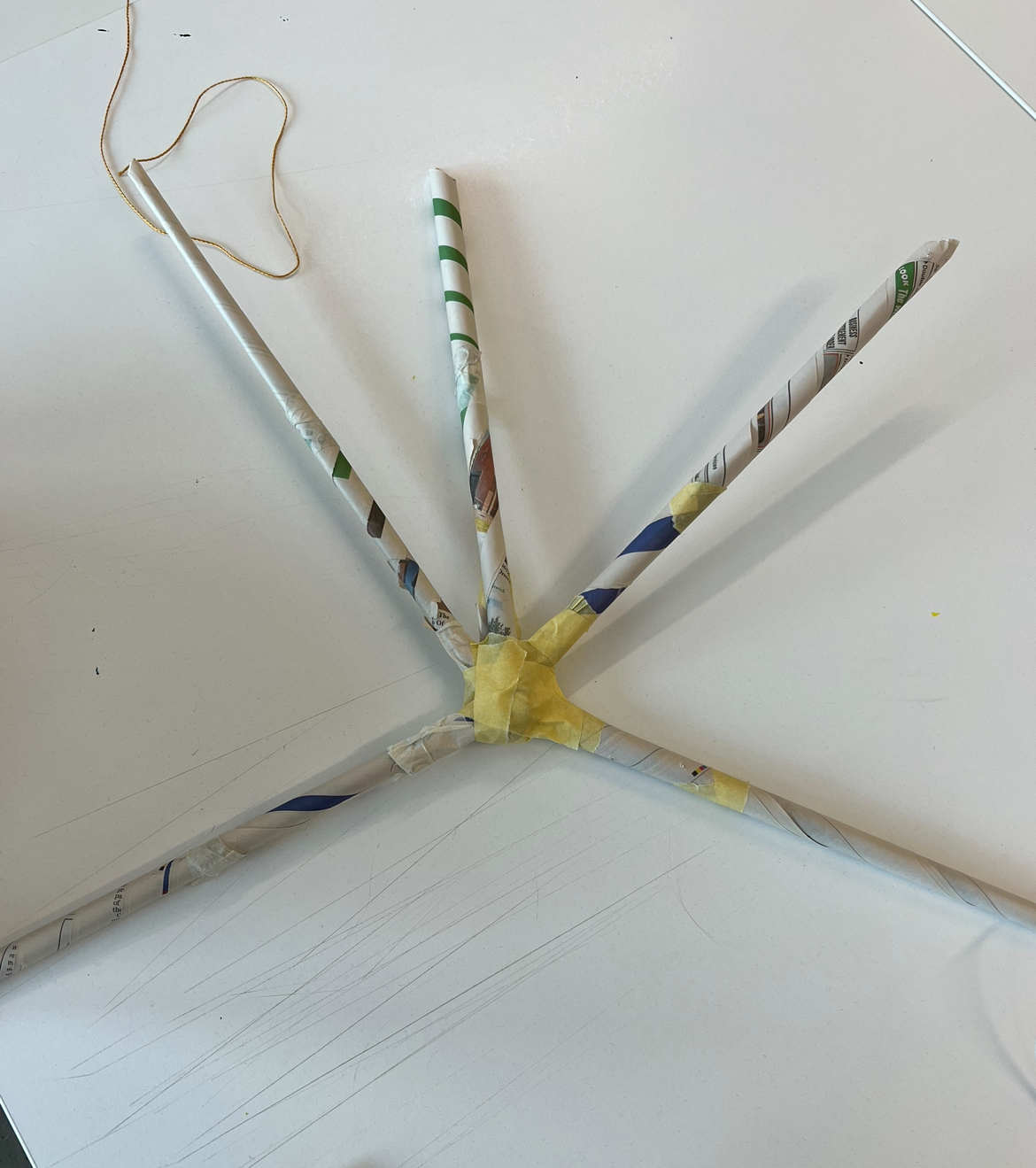
First we were asked to roll up paper to create these sticks we would use to create our designs. I started putting them together in the shape of a lotus flower. Because my two words are kitsch and strengthen. I chose to create a lotus flower because it symbolises new beginnings which is what I’m going through right now with being in uni.
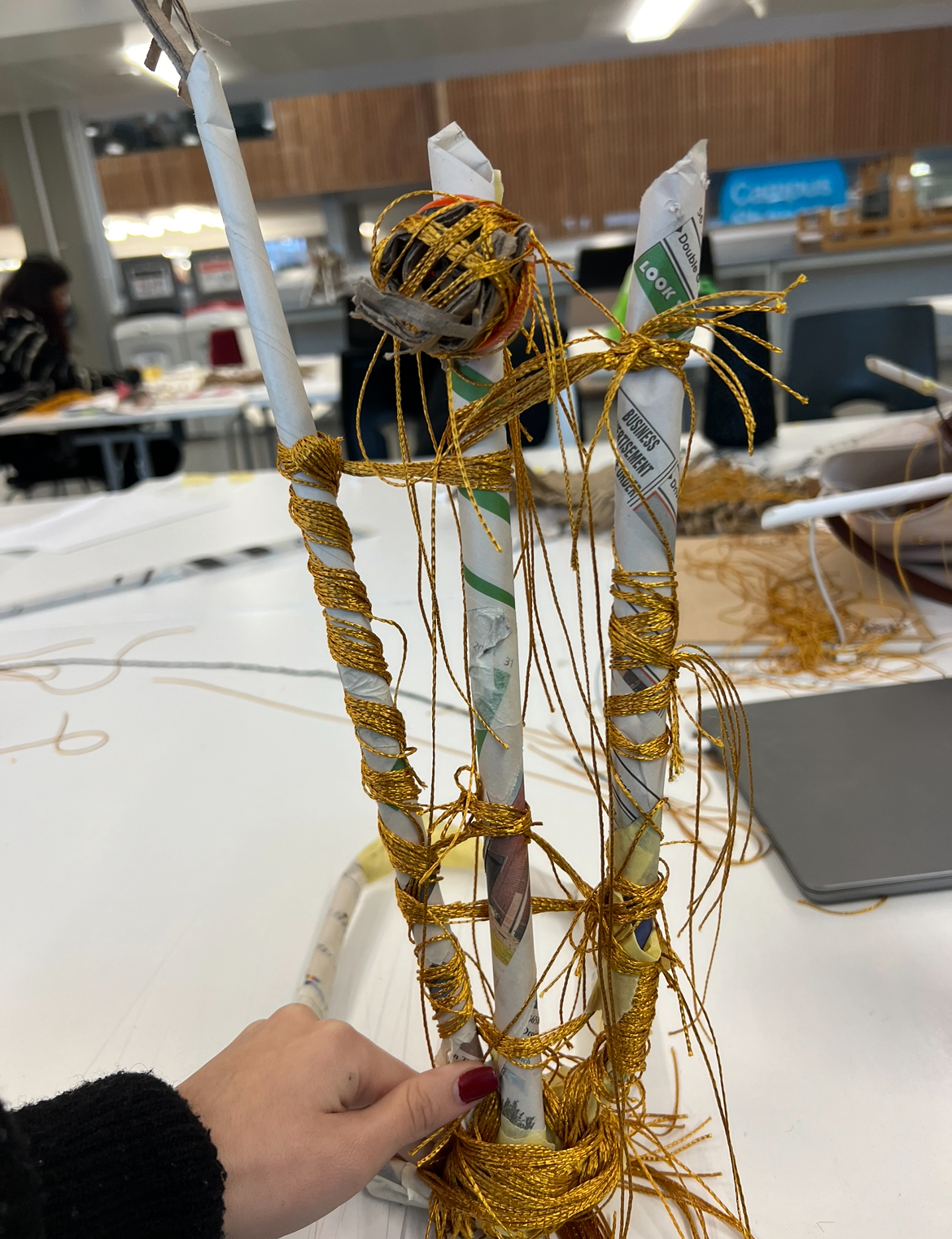
After that I got a bit of yarn and tied the paper sticks together which made them stronger and more stable which also connects to my word strengthen. I taped the back together and created a crown.

Here I added more coloured yarn to the crow. Kitsch to me means something loud that stands out and I felt by adding more colour to it I’m making it look more kitsch.

This activity turned out being quite fun because we all created a story. As three of us had made crowns we decided we’re creating a kingdom with a king, a queen and a princess. Kushi had created a pyramid which is also quite royal and Jenny made wings so she was the fairy in our kingdom.
About arte povera
Translated as “Poor Art,” Arte Povera began as a radical artistic movement in Italy in the late 1960s. Artists of the Arte Povera movement rejected conventional techniques and methods in an effort to escape the commercialization of art and experiment with more natural, everyday supplies like branches, dirt, and rocks. The goal of this avant-garde movement was to question conventional thought and encourage a deeper investigation of the relationship between life and art. A new era of conceptual art was brought in by the Arte Povera artists, whose innovative use of poor materials and emphasis on process over outcome had a long-lasting influence on the development of contemporary art practices across the globe.
Luciano Fabro
Italian artist Luciano Fabro had a close connection to the Arte Povera movement. Fabro, who was born in Turin, Italy, on November 20, 1936, first attended the Accademia di Belle Arti. He experimented with a variety of materials and methods when he first started his artistic career in the late 1950s and early 1960s.
Fabro’s paintings started to more closely resemble the ideas of Arte Povera, emphasising the importance of using common, everyday materials instead of traditional artistic techniques. He became well-known for his installations and sculptures, which frequently included metal, glass, and marble—natural materials—arranged in unusual and thought-provoking ways.
Fabro investigated topics including the relationship between art and nature, the body, and space in his work during the course of his career. His conceptual approach to art-making was well-known, since it pushed viewers to rethink how they perceived both the art and the world around them.
Fabro’s position as one of Italy’s most important modern artists was strengthened by his contributions to the Arte Povera movement. Up until his passing on June 22, 2007, he kept up his creative and significant output, leaving a legacy that now is an inspiration to artists around.

Luciano Fabro engaged with the material, philosophical, and historical aspects of human civilization in his artistic practice focusing on culture. His research frequently explored the connections between history, art, and society, offering critical reflections on cultural values and identities.
Through his artistic approach, which rejected commercialization, embraced unusual materials, and pushed the boundaries of artistic categorization, Luciano Fabro challenged social standards. He promoted simplicity and criticised consumer culture as a member of the Arte Povera movement, and his broad approach to art questioned conventional creative disciplines. Through his concentration on process over product and his interventions in architectural spaces, Fabro challenged current norms within the art world and invited deeper observations on the relationship between culture and society. These actions encouraged viewers to engage with art in new and reflective ways.

Many important aspects of Fabro’s work reflect his investigation of culture:
1. Culture of Materials: Everyday materials like marble, glass, and metal are often used by Fabro in his installations and sculptures. He highlighted the things and materials that influence human existence by referencing the materialistic culture of society through the use of these materials.
2. Historical references: Fabro frequently referenced to past events, individuals, and artistic traditions in his work. He examined how the past shapes culture and how historical stories affect modern society.
3. Cultural critique: There were times when Fabro’s artwork acted as a critique of existing social norms and views. He challenged the audience to rethink what they believed about
culture by challenging the values and beliefs that form the basis of society.

Many of Luciano Fabro’s pieces reflect his cultural impact, frequently combining philosophical, historical, and artistic themes. “Habitat,” a series of his works that directly addresses cultural and historical events, is one important example.
Fabro produced a series of sculpture installations titled “Habitat” (1967–1970) that are modelled after architectural features or structures. Marble, glass, and metal are common materials used in these pieces; these materials are associated with classical building and creative traditions.
“Habitat.4” (1968), a large-scale installation with a rectangular frame made from metal rods and wrapped in transparent plastic, is one particular example from the “Habitat” series. Fabro positioned a bed of rocks or pebbles inside the frame to represent a tiny landscape or historical site. This piece, which draws comparisons between the earth’s geological formations and the constructed structures of cities, might be read as a reflection on the interaction between human civilization and the environment.
Sources
Luciano Fabro (2022) Castello di Rivoli. Available at: https://www.castellodirivoli.org/en/artista/luciano-fabro/ (Accessed: 18 February 2024).
Celant, G. (2023) Luciano Fabro: The image that isn’t there, Artforum. Available at: https://www.artforum.com/features/luciano-fabro-the-image-that-isnt-there-206116/ (Accessed: 18 February 2024).
Tate (1972) Luciano Fabro 1936–2007, Tate. Available at: https://www.tate.org.uk/art/artists/luciano-fabro-1076 (Accessed: 18 February 2024).
Luciano Fabro: Museo Nacional Centro de Arte Reina Sofía (no date) Exposición – Luciano Fabro – Fabro, Luciano. Available at: https://www.museoreinasofia.es/en/exhibitions/luciano-fabro (Accessed: 18 February 2024).
Several events in history, such as post-war reconstruction, the Italian Renaissance, classical art and architecture, and 1960s countercultural movements, had an impact on Luciano Fabro’s artwork. His research of technical skill and philosophical topics shows his interest in Renaissance aesthetics, while his use of materials and forms reflective of ancient monuments demonstrates his connection with classical traditions. Fabro drew inspiration for his experimental approach to art and rejection of conventional conventions from the bohemian culture of the 1960s, while the political and social environment of post-war Europe shaped his criticism of consumer society and his dependence on common materials.
weekly reflection
I really enjoyed this weeks activity. First of all looking at Arte Povera exposed us to new materials. Materials that are sustainable and repurposed. Creating the crown out of paper wasn’t quite easy. At first I struggled, I didn’t know what I want to create as we had no instructions or themes to stick to. Just our paper sticks and or chosen words. I enjoyed how I felt challenged to create something new and innovative which also related to my theme. At first I put a lot of thought into it, but then I thought about an artist I had researched who said that he likes his subconscious to lead him through his designs so I just started making something. In the end I created a crown which looked like a lotus flower and by adding yarn to it I strengthened and stabilised it. I learned how ideas can sometimes just come to your mind and that you have to let loose. Sometimes it’s a good idea to just let your subconscious lead, it makes unique and innovative designs.
responding to an artist
Oscar de la Renta is a fashion designer who has always been influenced by flowers and nature. I decided to respond to him by creating a flower made out if organza fabric.
Process
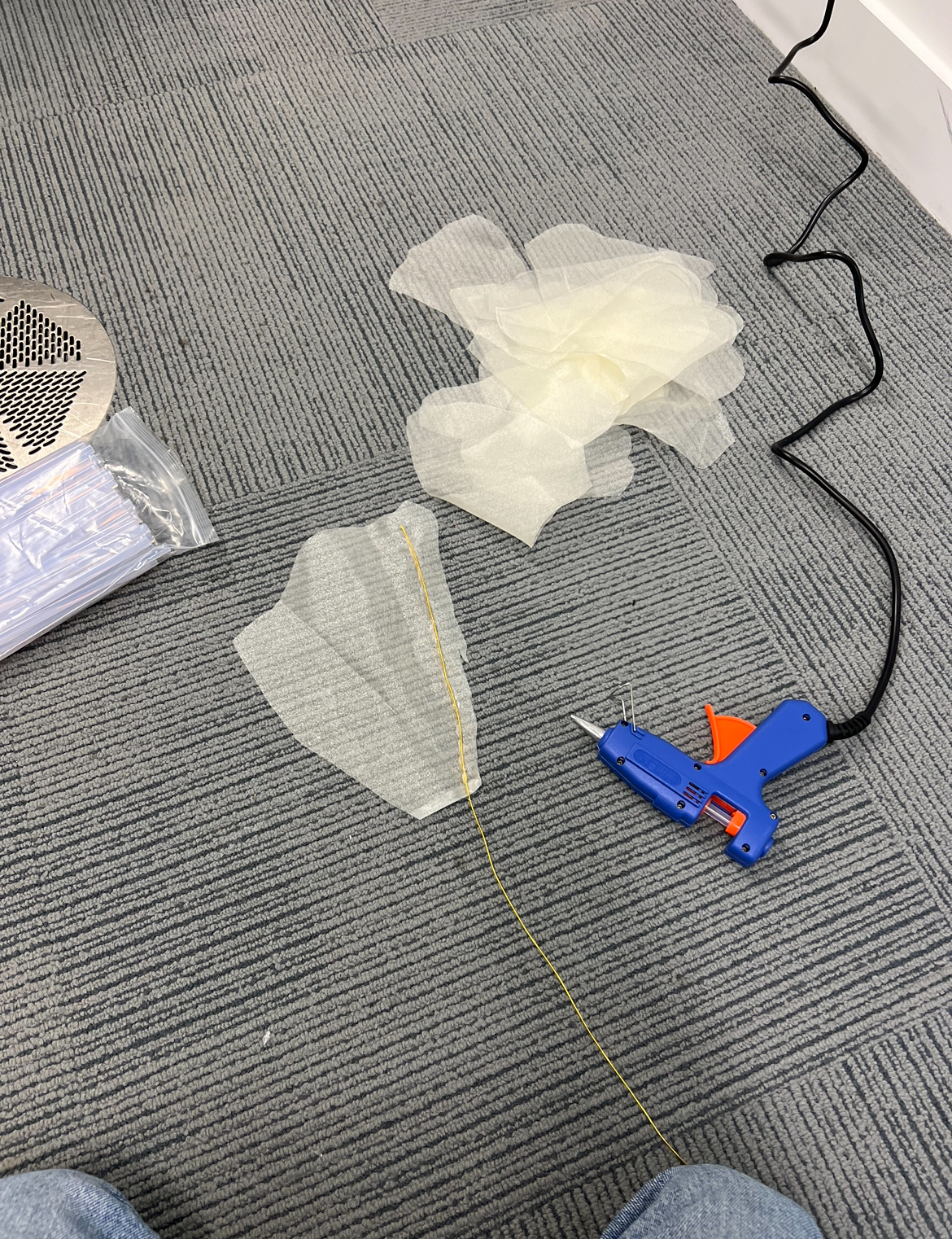
First I started off by cutting different sizes of petals from the organza fabric to create different layers and make it look like flower.
Reflection
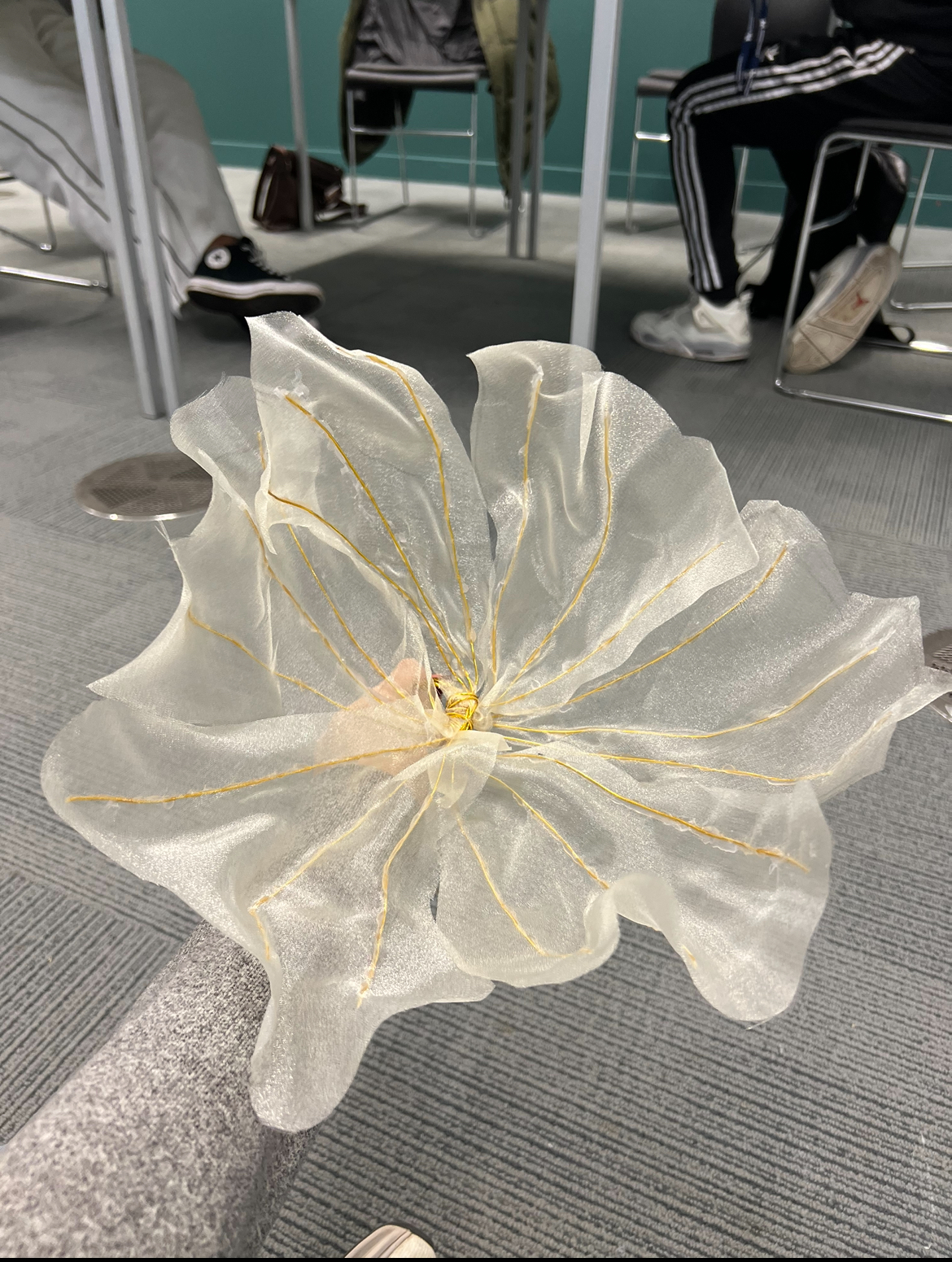
I then glued the petals to wire using a hot glue gun and shaped the ruffles in the fabric and make it look like flower petals.

I then attached the different layers on each other making it look like a flower.

Reflecting on this task, I realised that there is a lot of room for improvement. I did enjoy the process and I like the final outcome but there are things I’d like the improve. As I used a hot glue gun, it was quite hard to make the glue not show. It dried on the sides of the wire making it show on the fabric which I didn’t like, and I didn’t feel like it looked clean enough. Next time I would like to try and use super glue to be more precise and make it now show. What I did like was how the fabric was shiny and played with the light. This task made me realise that I would like to use organza for my final project but maybe create a smaller version
Sound art
During this lesson we went out in the street to record sounds. I layered some of these sounds on each other creating other sounds of atmospheres in Egypt to relate to my final project.
When I think of the word kitsch, it brings up images of the atmosphere in Egypt which is always loud, lively and crowded.
From the lively streets filled with laughter, chatter, and street vendors, to the rich sounds of traditional music played on Arabic drums and the rhythmic dances of belly dancers wearing scarves full of coins (that make jingeling sounds).
I decided to put together some sounds to create other sounds of atmospheres in Egypt.
Cairo streets
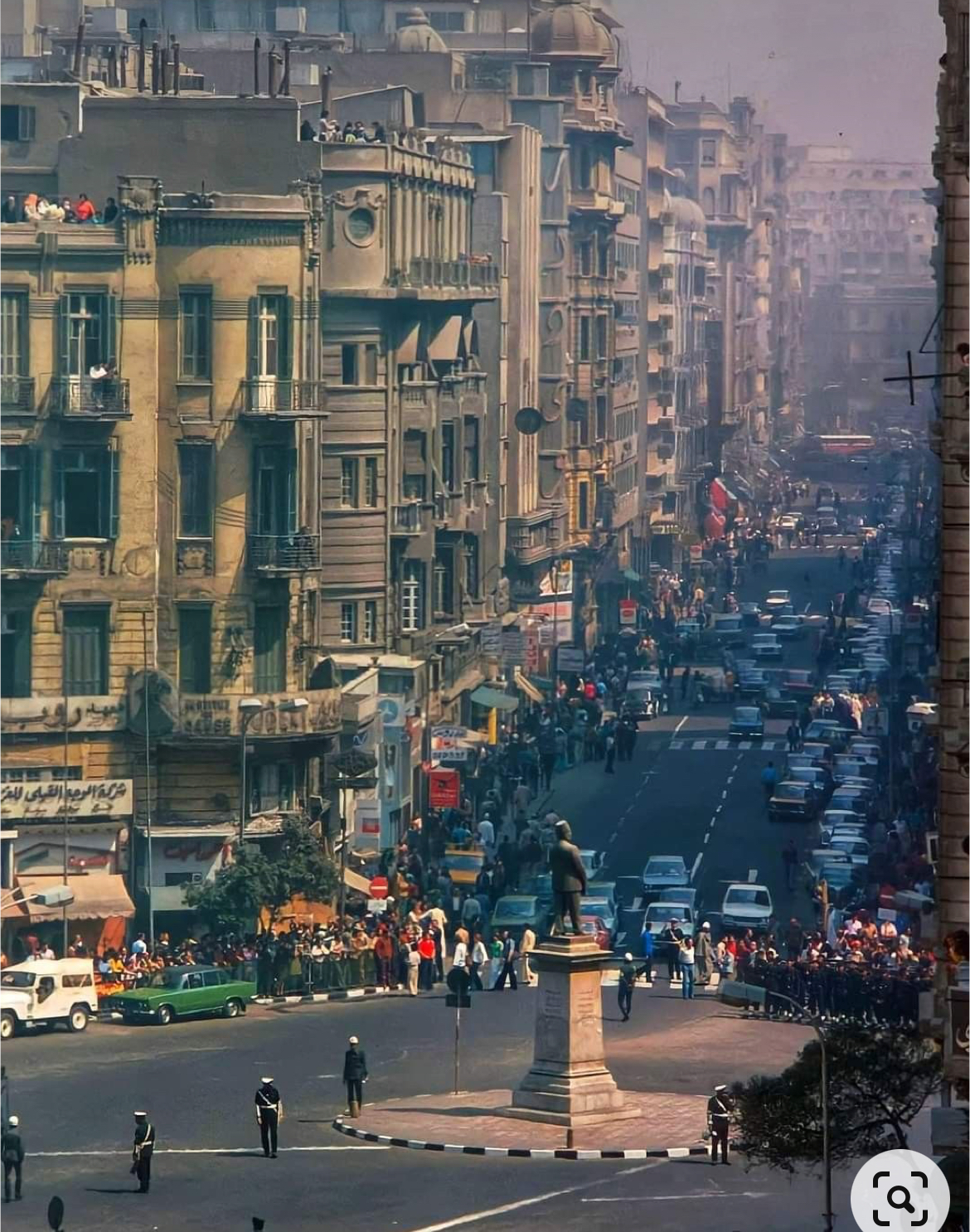
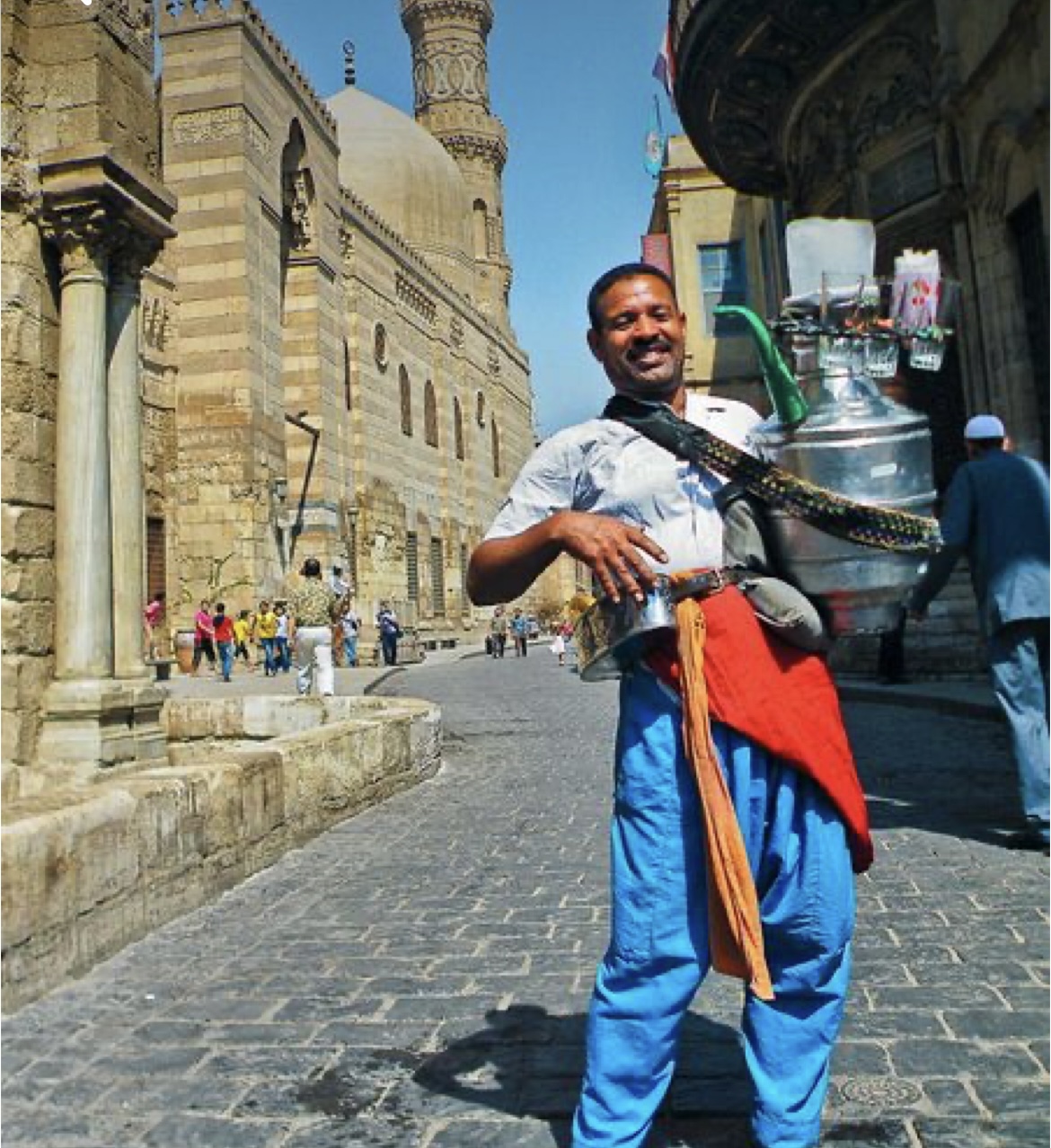
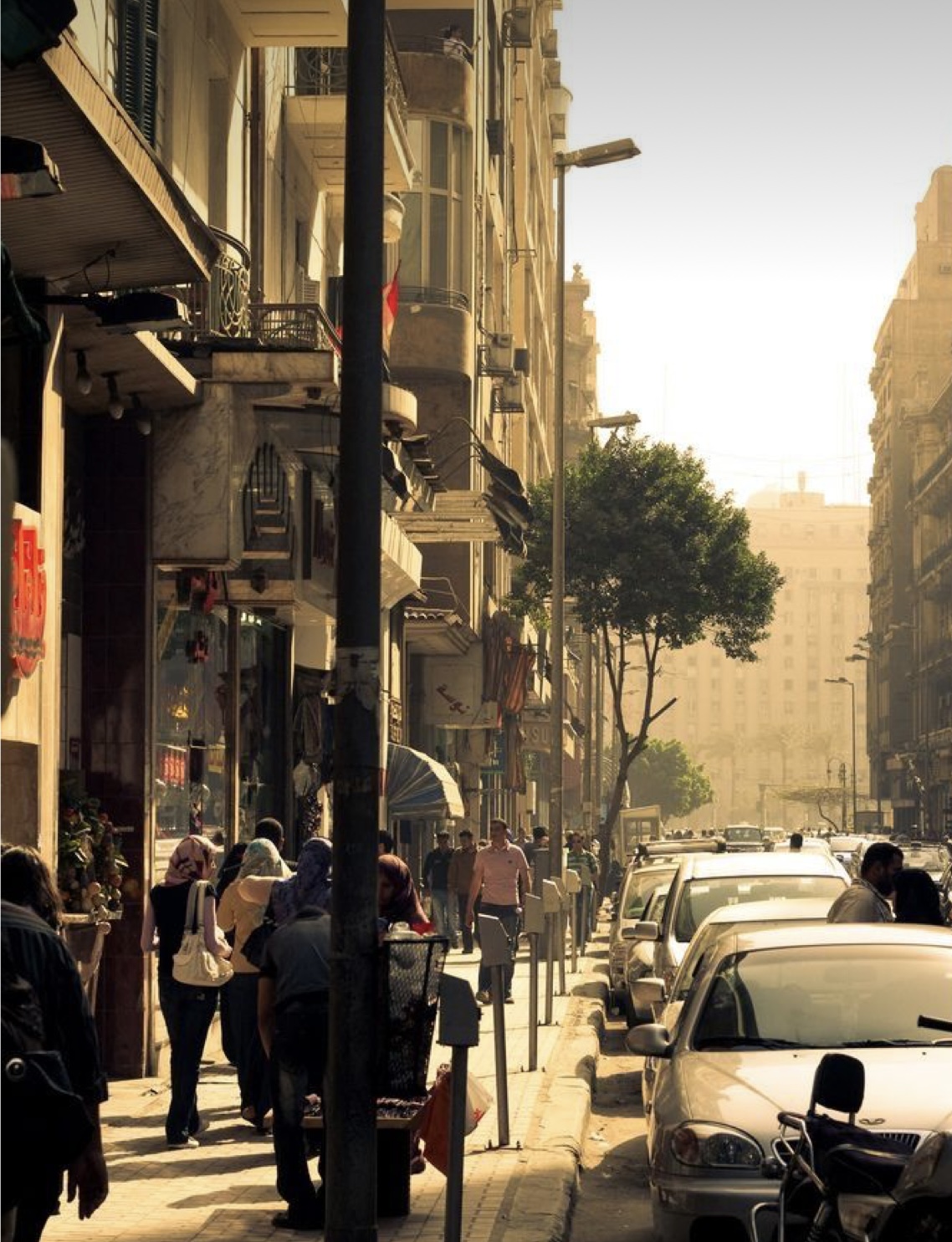
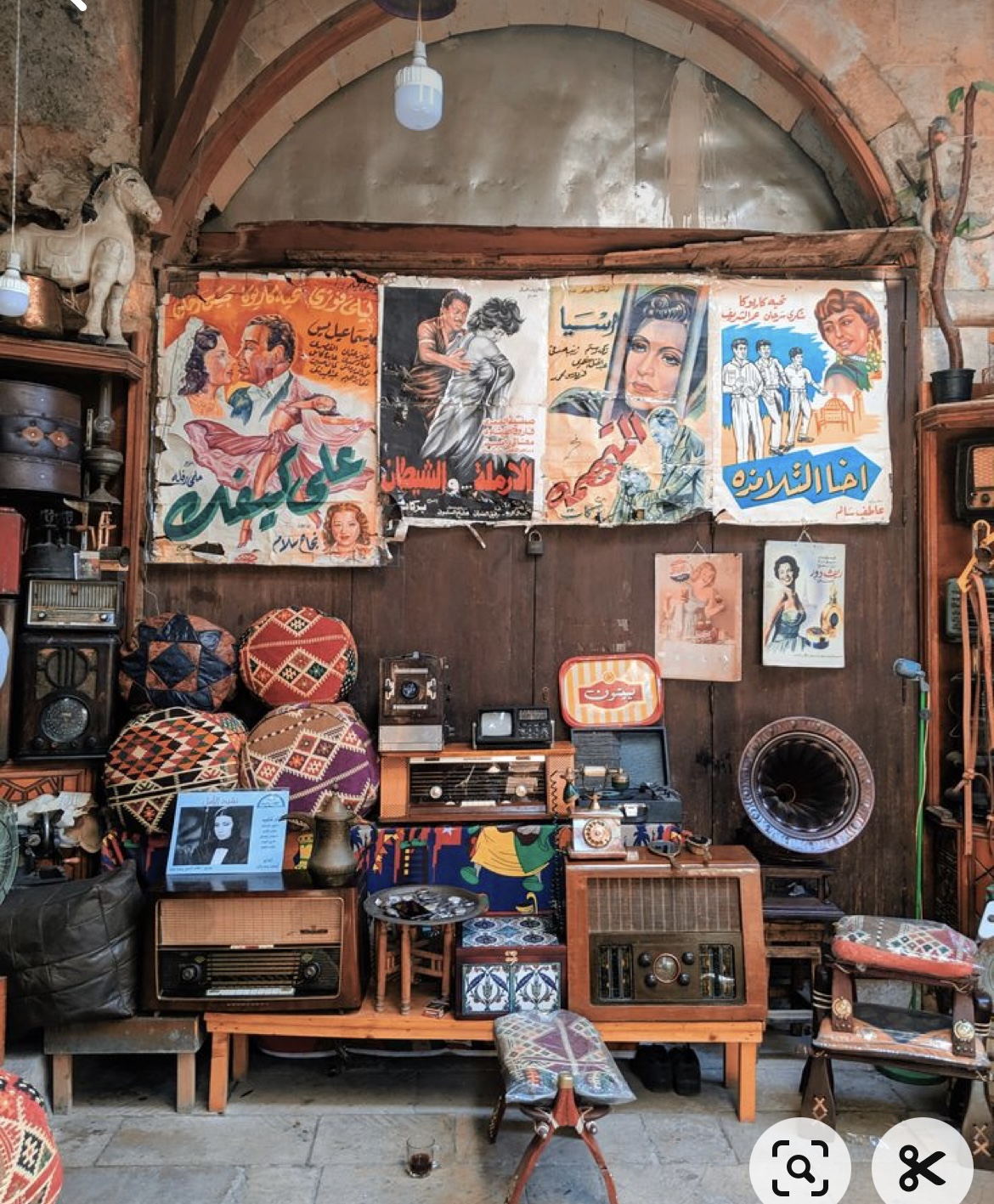
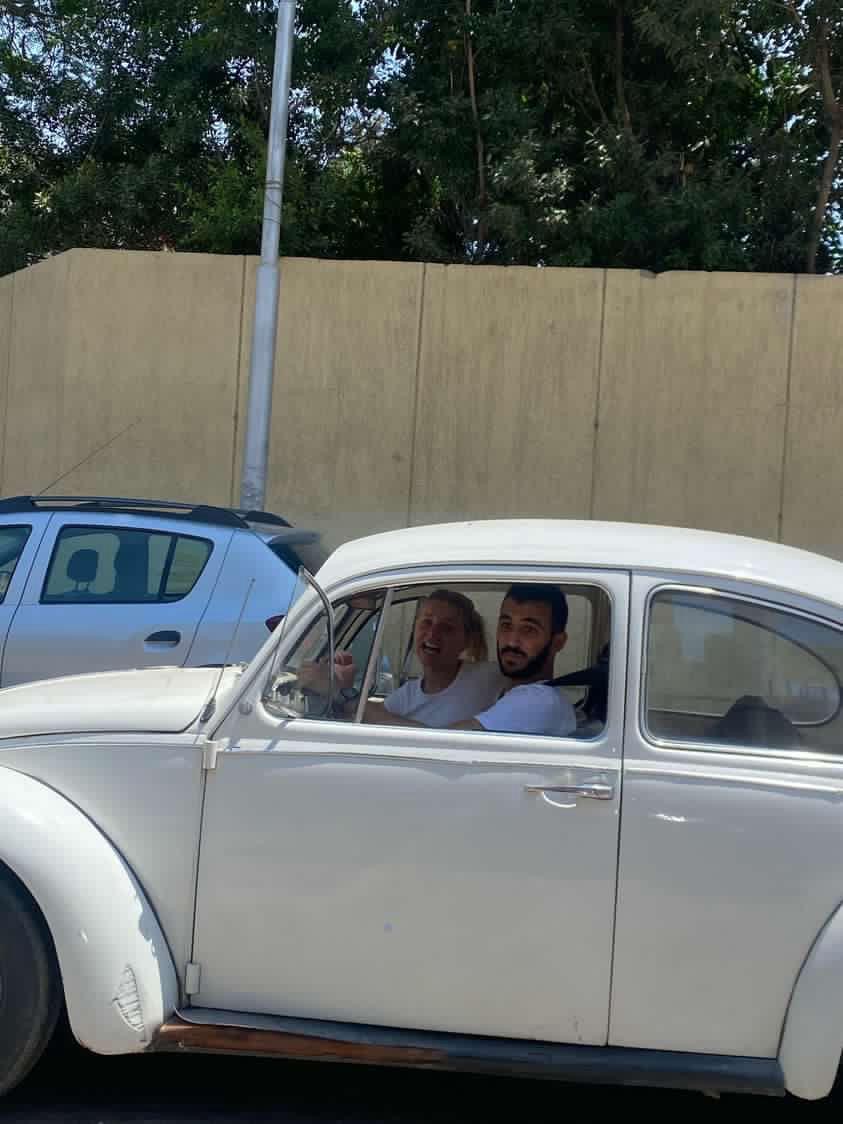
So I put together sounds that sound like these streets and here are some images to help imagine the atmosphere.
Belly dancer
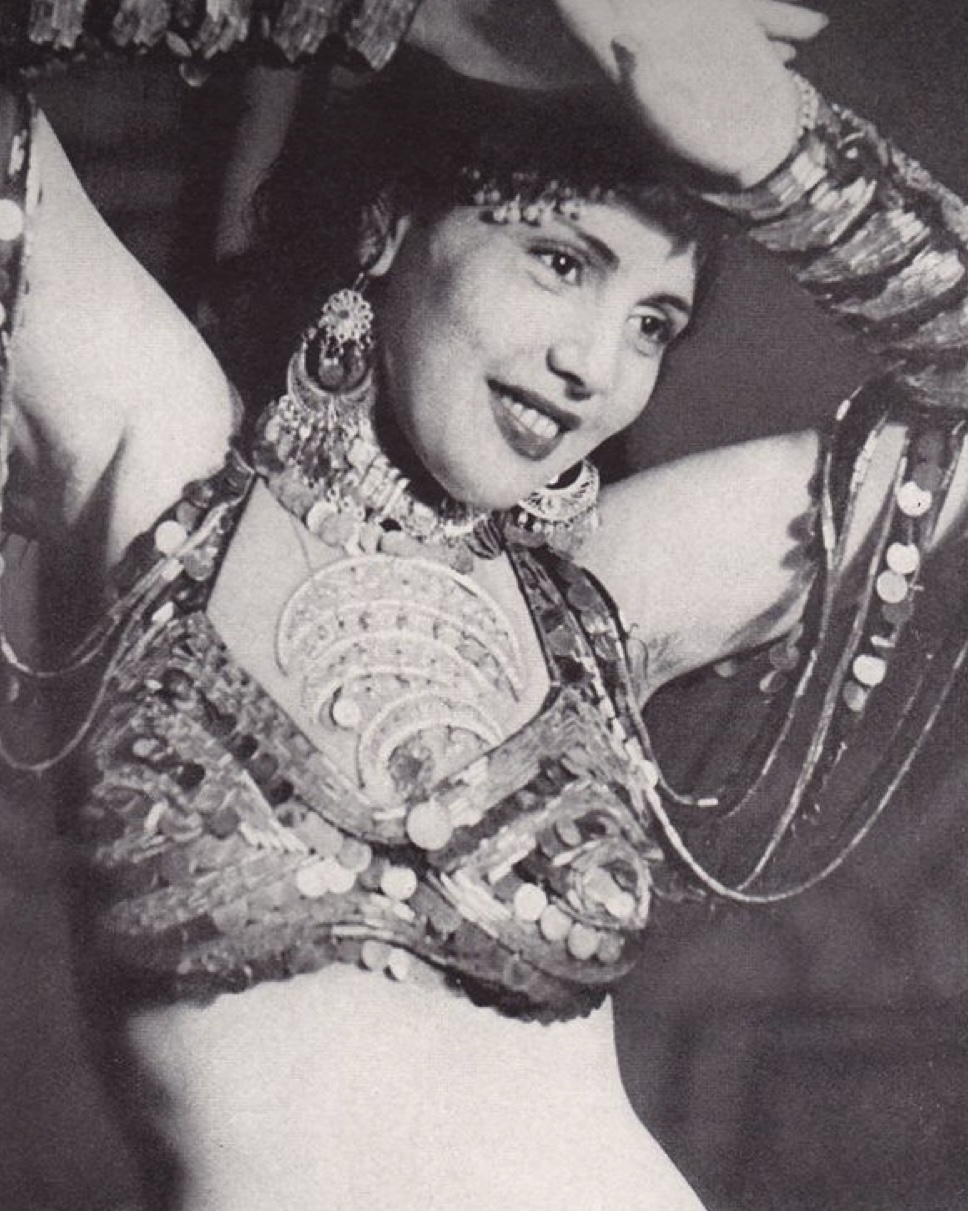
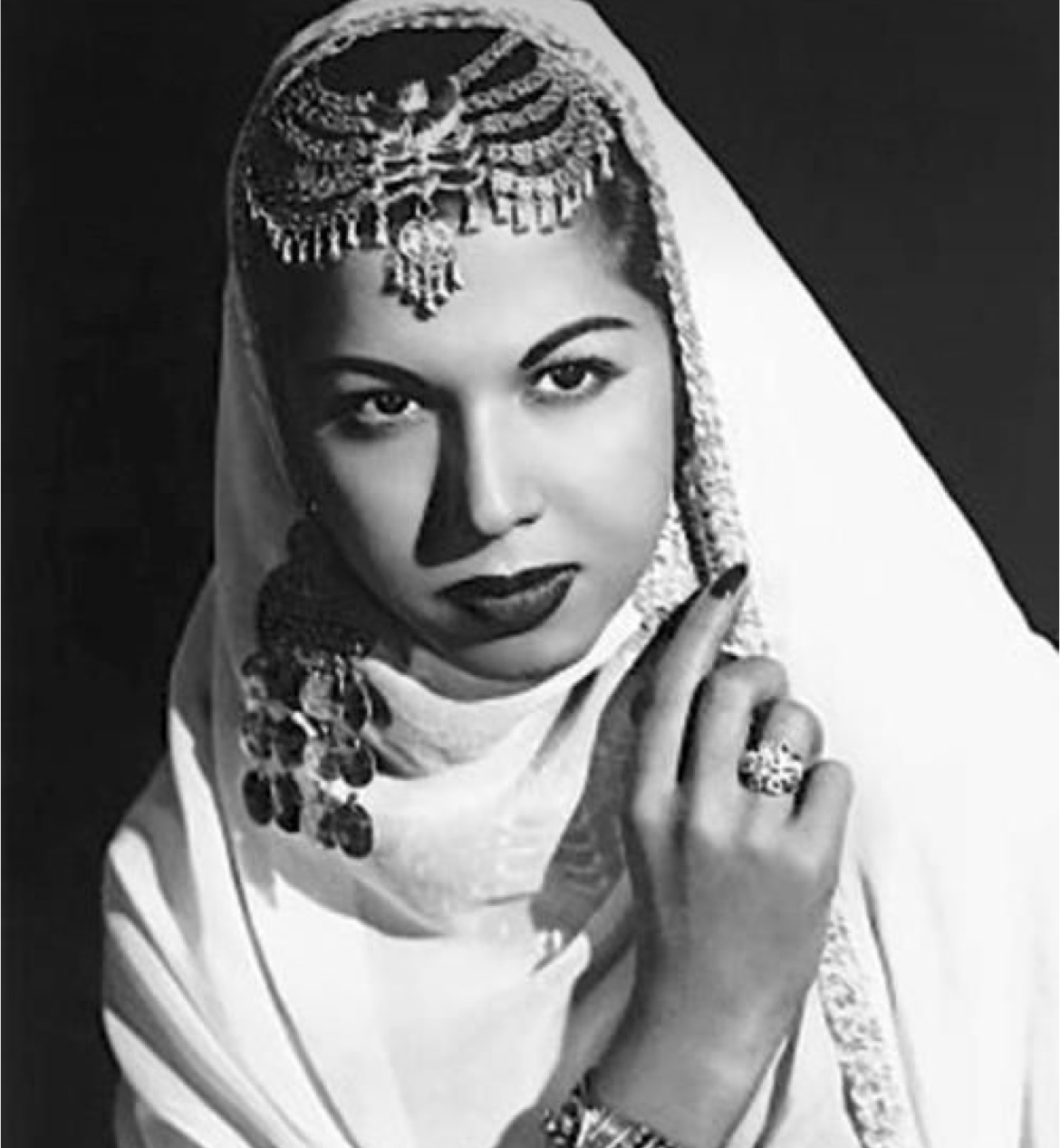
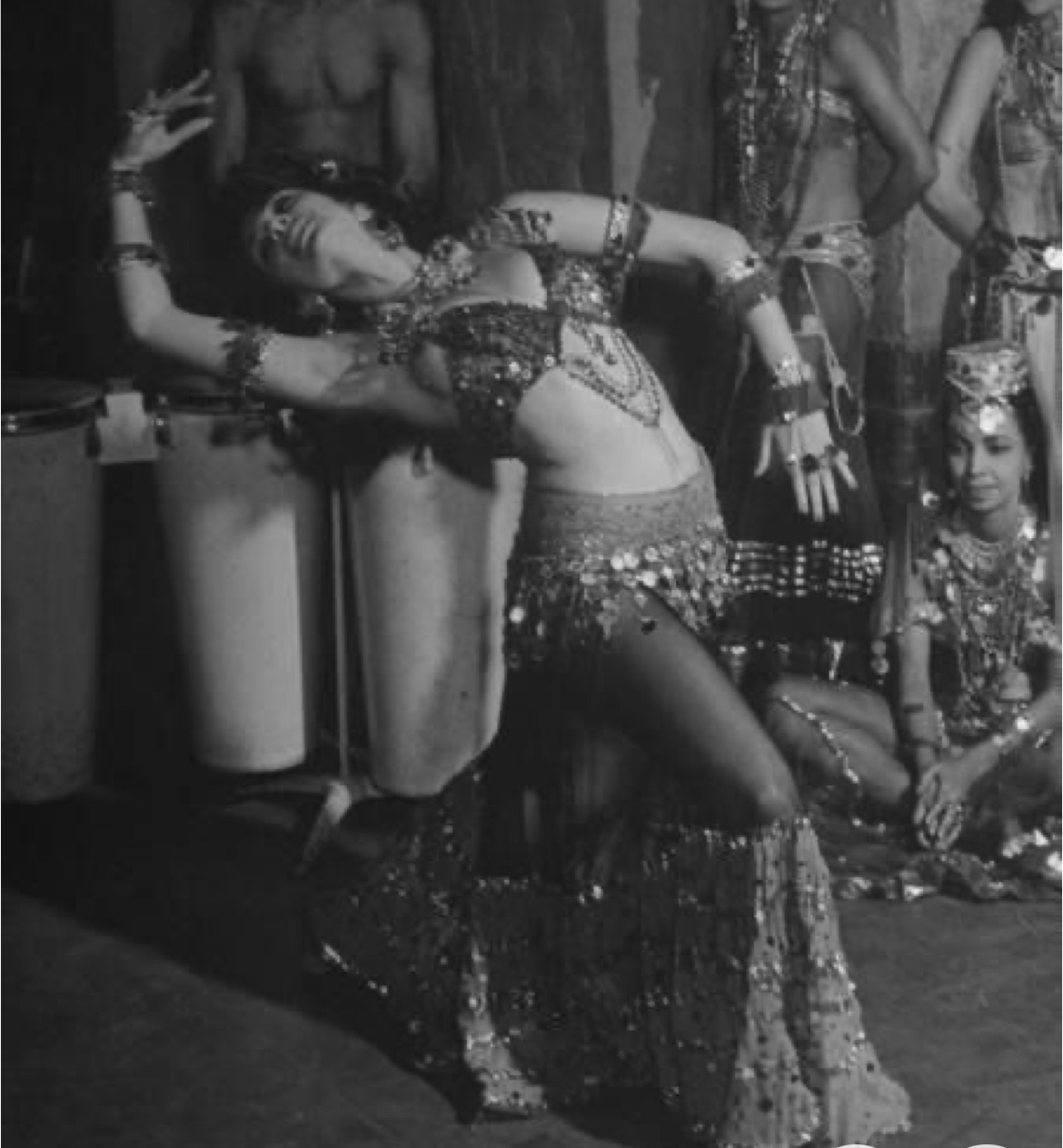
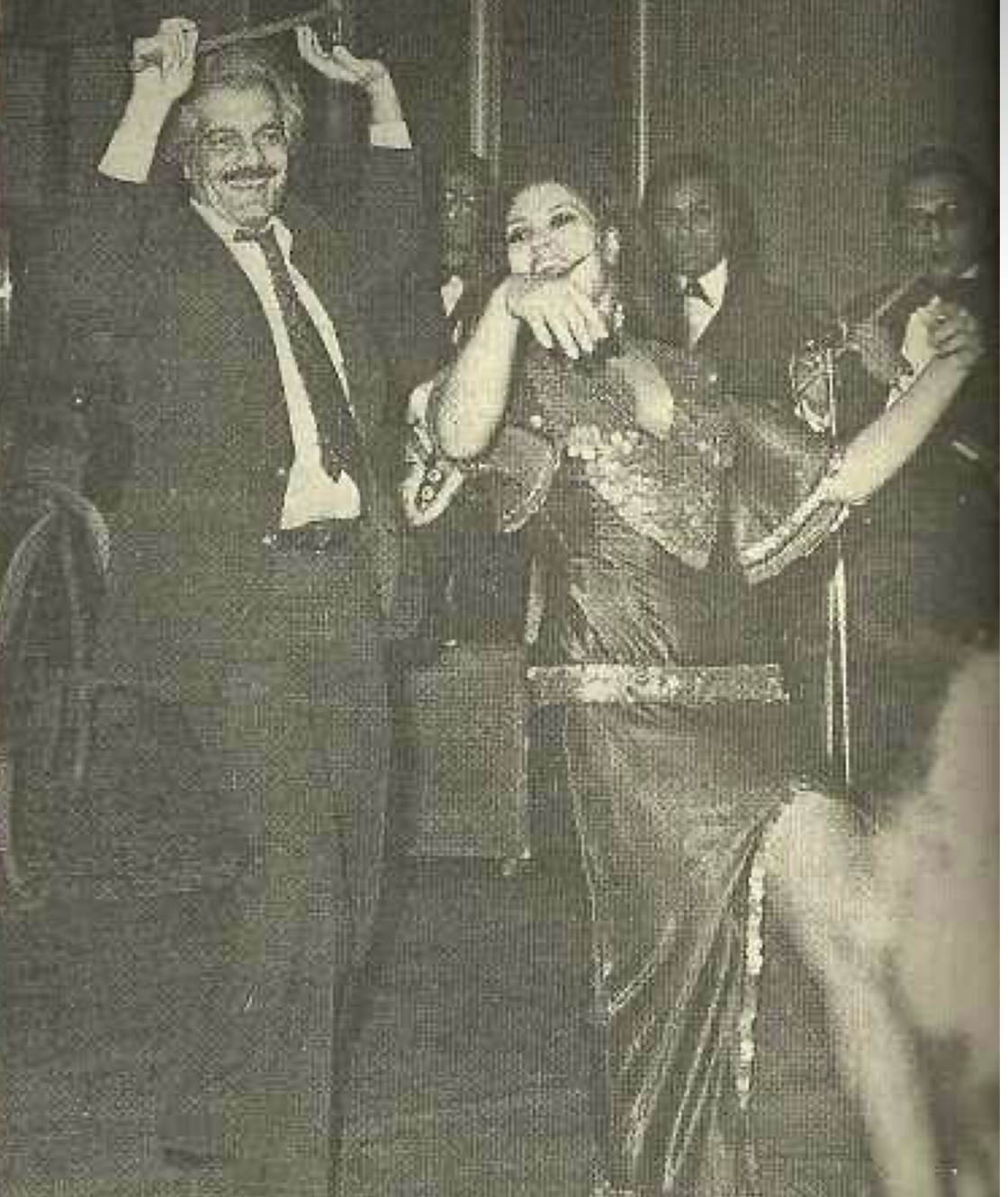
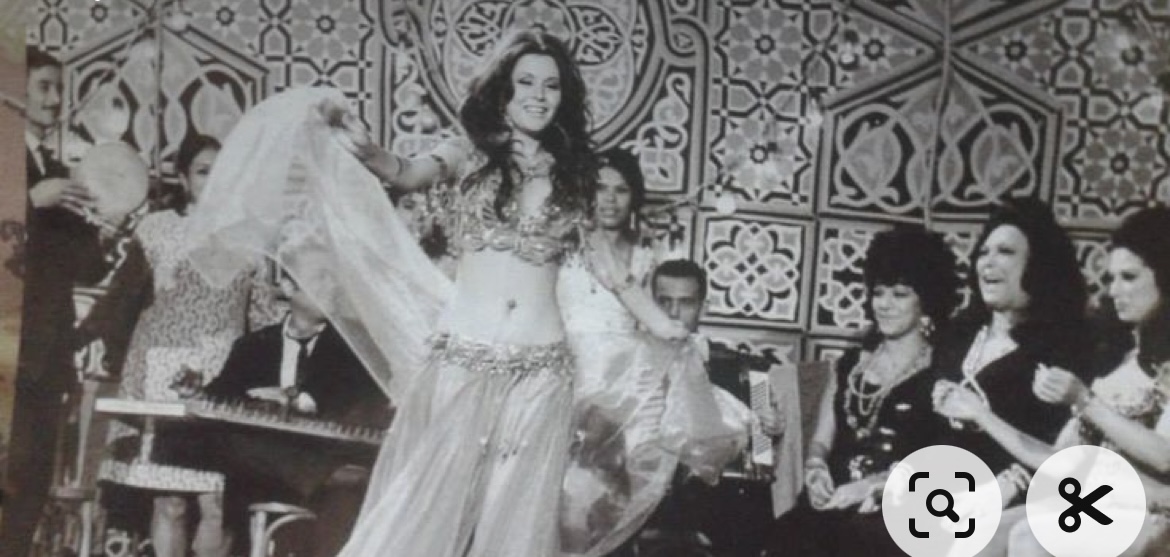
Here I put together sounds that sound like the atmosphere when a belly dancer dances. People cheering laughing clapping and ululate (an expression of delight in Egypt)
weekly reflection
During todays lesson we looked at sound installations and explored the powerful emotions sounds can convey. I found myself fascinated by the fact that sound has the ability to evoke images and emotions in us. Throughout the lesson I was constantly inspired, writing down ideas for my own project and how I can integrate sounds.
My project aims to portray my culture and heritage. I started considering the potential of interactive elements to make people understand how Egypt feels.
Recognosing Egypt’s vibrant and lively atmosphere, I was drawn to the idea of capturing the sounds of cairo’s streets- chaotic, lively and full of energy. I also layered sounds to create the sounds of a belly dancer dancing and people cheering to further immerse viewers in the cultural experience.
I integrated images to compliment the sounds as a way to enhance the audiences understanding and imagination.
All in all, I left this lesson inspired and with new ideas I want to integrate into my designs.
I learned about sound instillations which is something I would’ve never initially thought of connecting to a jewellery project.
I feel like this lesson enhanced my creativity and helped me generate new ideas.
Design brief
Title: El Rehla: A strengthening journey
Aims:
The designer aims to create narrative jewellery that reflects her personal journey and her Egyptian heritage, incorporating the themes of “strengthen” and “kitsch”.
Inspired by the symbolism of a louts flower the jewellery aims to tell a story about growth and adaption. To celebrate the designers cultural heritage, she will integrate interactive elements like sound to make the wearer engage in an immersive experience that captures the atmosphere and spirit of Egypt.
Concept:
To symbolize the designers strengthening journey of growth and adaptation to a new life abroad, she has chosen the lotus flower, which represents new beginnings born from difficulties. The lotus starts as a seed in murky waters, navigating obstacles like rocks to blossom into a beautiful flower, which portrays my own process of overcoming challenges and growing. The word kitsch, brings up images of the atmosphere in Egypt which is always loud, lively and crowded. From the lively streets filled with laughter, chatter, and street vendors, to the rich sounds of traditional music played on Arabic drums and the rhythmic dances of belly dancers wearing scarves full of coins. Incorporating cultural elements, Islamic motifs, coins and interactive elements the designs will narrate a story of growth as well as a celebration of cultural identity.
Inspiration:
The project is inspired by the atmosphere of Egypt and it’s culture. Like belly dancers, islamic art and ancient symbolism.
The designer aims to get inspired by traditions and turn them into contemporary jewellery pieces to celebrate and preserve her culture. more acceptable
The project is also inspired by two jewellery designer who have successfully integrated eastern, Egyptian and islamic motifs into contemporary designs worldwide.
Azza Fahmy has written a book talking about the different jewellery all around Egypt, and how she drew inspiration from not only Islamic motifs and ancient Egypt but also different tribes and groups in Egypt. Louis Cartier had seen Islamic art as a path to modernity and managed to create designs inspired by the Islamic and eastern culture without losing individuality.
Additionally inspiration will be drawn from artist who create sound installations to express their emotions and opinion and have explored the use of sound to evoke the feelings of specific atmospheres.
Experimentation and execution:
- Research: The designer will be researching Egyptian culture, symbolism of a lotus flower in different cultures , sound instillations and traditional techniques to develop her designs.
- Design Development and experimentation: The designer will be choosing materials based on the sounds they create, to have her piece evoke the feelings and atmosphere of Egypt.The sounds she is aiming to convey are the jingling sounds of coins. These are sounds that you can hear in most of the Egyptian music, as well as when belly dancer dance because of the scarves around their hips. To create these sounds she will experiment with materials such as aluminium, wire, glass and beads. She will also be exploring traditional techniques like macrame and embroidery to create her designs. Her idea is to create a headpiece, as it symbolises confidence, empowerment and strength.
- Integration of sound: The designer will be experimenting with sound elements to evoke the atmosphere of Egypt, she will be focusing on the jingling sounds of coins.
- Feedback: She will be seeking feedback from peers and tutors throughout the process to ensure the effectiveness of the narrative jewellery piece.
- Presentation: She will be using skills she learned at both workshops to create a poster to promote and showcase her work. She will use both the printmaking workshop and digital design to achieve the best, most creative and professional looking end results.
By following this design brief the designer will be able to produce a narrative jewellery piece that reflects her cultural identity and personal journey, while also celebrating and preserving her Egyptian heritage.

Weekly reflection
During today’s class we listened to the soundscapes made by our classmates. It was quite fascinating to see how everyone approached the task differently, creating soundscapes with unique ideas behind them. Listening to the soundscapes made me realise how sounds can make you feel different emotions and imagine different atmospheres. I found myself inspired by how some of my classmates incorporated videos and voiceovers to better express their ideas. This inspired me to maybe include a video in the soundscape for my final project to showcase the atmosphere of Egypt.
After listening to the soundscapes, we had one to one tutorials with our tutoe to discuss our projects and receive feedback. I always find these sessions helpful because they leave me feeling inspired and with clearer ideas. Our tutor helped us express our thoughts and put them together to continue working on our project.Samsun Young

Samson Young is a contemporary artist and composer from Hong Kong. He is known for his interdisciplinary approach, which incorporates sound art, music composition, installation, and performance. Young often explores themes related to identity, politics, and cultural exchange in his work. He has gained international recognition for his innovative and thought-provoking projects, which have been exhibited at prestigious institutions and events worldwide. Young’s work offers audiences a unique sensory experience, blending auditory and visual elements to create immersive environments that encourage reflection and dialogue.
Samson Young uses audio in his compositions for several reasons:
1. Emotional and Sensory Engagement: Our emotions and senses are greatly influenced by sound. Young aims to create immersive experiences and evoke strong emotions from his audience by incorporating music into his artworks.
2. Communication and Expression: Sound is an effective tool for both expression and communication. Young can communicate complicated concepts, narratives, and feelings to his audience in a nonverbal way by using sound, which creates a deeper connection between them.
3. Examining Cultural Identity: Sound has cultural importance and is often closely associated with heritage and identity. Young, a Hong Kong native, frequently addresses issues of cultural interchange and identity in his art. By incorporating sounds from diverse sources, he highlights the interconnectedness of cultures and challenges traditional notions of identity.
4. Interdisciplinary Exploration: Young’s practice is interdisciplinary, spanning the fields of art, music, and academia. By integrating sound into his visual artworks, he blurs the boundaries between these disciplines, creating dynamic and multi-dimensional pieces that defy categorisation.
There is one sound installation from Samson Young that especially inspired me, which is his “middle east bombing sound installation” where he recreated sounds of war with different mediums. The provocative and powerful “Middle East bombing sound installation” by Samson Young forces viewers to think about the psychological effects of violence and conflict. The installation had first appeared at the Venice Biennale in 2017 and is composed of a sequence of sound recordings that replicate gunfire and explosions, set against calm photographs of landscapes that are empty of people.
The installation’s beginnings can be linked to Young’s fascination with the auditory aspects of war and the ways in which sound influences our understanding of war. Young aimed to produce an immersive audio experience that would portray the physical effects of violence and make listeners to consider the broader human impact of war, taking inspiration from past and present conflicts in the Middle East.
The use of soundscapes to evoke the chaos and fear of conflict is the basis of the project. Young produces an overwhelming and unpleasant auditory world that immerses viewers in the emotional reality of conflict by layering recordings of explosions, gunshots, and other sounds associated with violence.
The contrast created by the combination of these sounds with peaceful landscape photos invites viewers to reflect on the sharp contrast between the cruelty of human conflict and the beauty of nature. In addition, the piece offers a critique on how modern war is communicated. Modern mass media and digital communication have sanitised and deconstructed war noises and visuals, which has distorted our perception of the pain that these conflicts cause to humanity. Young portrays this narrative with his sound installation, giving listeners an unfiltered, experience of the sounds of conflict.
“Middle East bombing sound installation” pushes viewers to face the graphic realities of war and rethink their views of war and its aftermath. It also forces us to face our role in the continuation of violence.
The way he conveys a message using sound so people understand the feelings and the atmosphere of war more really inspired me. He uses sounds make people feel closer to that scary atmosphere which makes them feel empathetic towards war. Pictures that he included showed a calm landscape and atmosphere which shows the contrast of a calm and good atmosphere and how war changes the feelings of any atmosphere even if it was calm initially, the sounds make it feel scary. In my final project I will be integrating sounds that remind me of Egyptian atmosphere to make people understand my culture better and feel more connected and closer. Instead of using contrasting pictures I will be using videos of different sceneries in Egypt and layer them with sounds that evoke feelings of the atmosphere.
Experimentation with wire
I decided to experiment with sounds, so my goal was that every piece I make should create sounds when moved. So my first experiment I wanted to trap beads into a piece made out of wire so it creates a jingling sound when moved.


I got inspired by an earring Azza Fahmy had designed. The crescent carries very deep significance in Islam. The crescent moon holds diverse and multifaceted symbolism in Islam, representing elements of timekeeping, cultural identity, spiritual devotion, and artistic expression within the Islamic tradition.
I felt that the crescent moon is very compatible for my project because of the symbolism behind it. The crescent also symbolises new beginnings and renewal just like the lotus flower and the story behind my project. The crescent moon is used to determine the beginning of each month in the Islamic lunar calendar. The sighting of the crescent moon marks the start of the new Islamic month, also the cyclic nature of the moon, including its waxing and waning phases, is sometimes interpreted as a symbol of renewal and spiritual growth in Islam. Just as the moon undergoes phases of darkness and illumination, Muslims believe in the potential for personal growth, repentance, and spiritual transformation throughout their lives. The lotus flower also symbolises new beginnings as it starts as a seed under water and has to navigate obstacles until it can blossom on the surface. I felt that I wanted to integrate both motifs into one design to symbolise my experience of moving abroad and starting a new life in a new country and having to navigate obstacles at the start. I decided to integrate both motifs into one design while also making a lively and crowded piece that reflects my Egyptian heritage and the atmosphere in Egypt.
Crescent experimentation

First I cut out a piece of cardboard in the shape of a crescent so I can wrap the wire around it and achieve the shape I wanted.

After that I put a few beads in between the wire and wrapped more wire around them to trap them and make them do jingling sounds when the moon is moved.
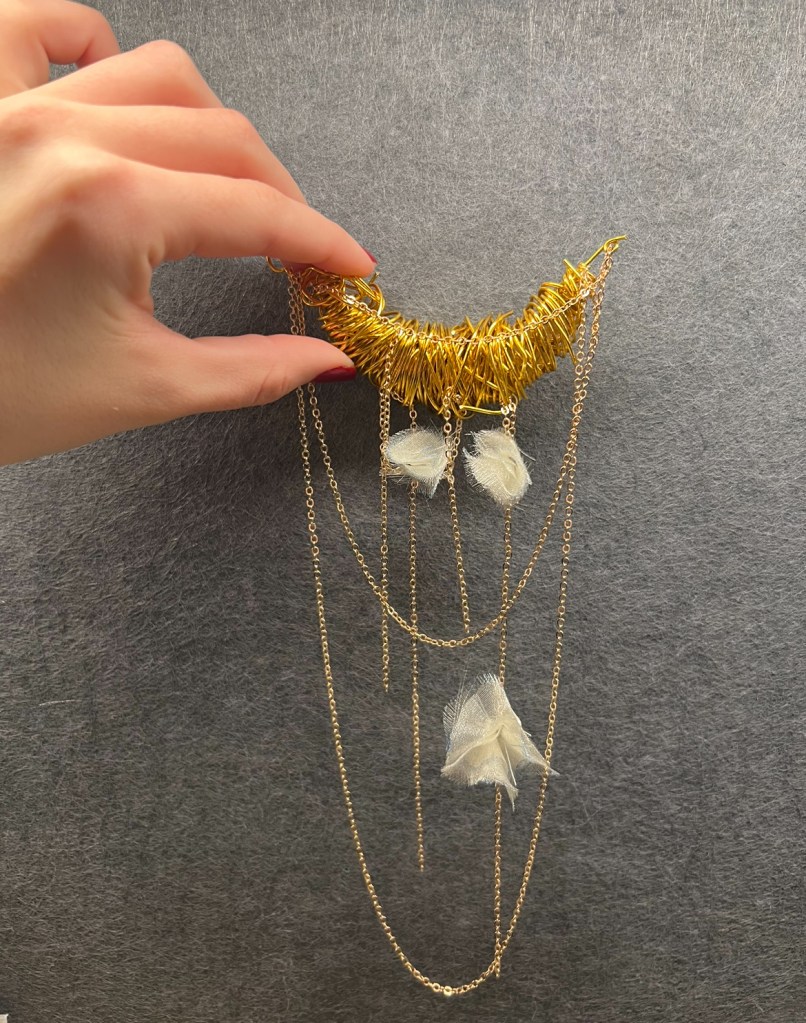
I then attached some chains to it, to give it a lively and loud feel. I was inspired by jewellery and body adornment worn by belly dancers as I felt they were quite loud and reminded me of my word kitsch.

After some experimentation I felt like it looked better as a belt, also because I was so inspired by belly dancers to represent the lively atmosphere in Egypt. So I decided to make it into a belt because most of the movement that happens while belly dancing is around the hips and waist area. The belts and scarves worn around the waist serve to accentuate the movements of the hips and torso during the dance. These accessories add visual interest and drama to the performance, enhancing the overall aesthetic appeal of the dance. Many belly dance belts are adorned with coins, beads, or metal embellishments that create a jingling or tinkling sound as the dancer moves. This auditory element adds another layer of excitement and rhythm to the performance, enhancing the music and captivating the audience. Reflecting back on this experiment, I like the outcome of the crescent shape and using wire allowed me to trap the beads inside which I also quite liked as the jingling sound of the beads bumping against the wire remind me of belly dancers and Egypts lively atmosphere. The way I attached the belt using yarn is something that I don’t find aesthetically pleasing and it also kept falling off so for next time I will have to problem solve this.
Experimenting with tiles
I was always fascinated by the geometrical forms on arabesque tiles and I decided that I wanted to somehow integrate that into my designs.

Most islamic ornament was governed by the principles of geometry. Many artists were trained to use a compass and a ruler. Geometric patterns, like nature, plants and celestial based designs were used both in religious and secular contexts. The geometric elements in the patterns can be detected by the repeated patterns, straight lines and exact curves of the designs and letters.
One motif really inspired me which was the 12- pointed star. I decided to get inspired by it and used geometric mosaic tiles and arranged them into a star shape.

Another element I wanted to add to my designs were coins as they are vey recurrent in Egyptian traditions and culture. Belly dancers always wear them around their waists to create sounds they were also used to show status.
Experimentation

After talking to Anne about how I could make gold coins that look quite authentic, she suggested using the inside of a tomato pure can which I found very useful. So I started cutting out circles to use them as coins. I really liked the hammered gold look the box made the coins have.
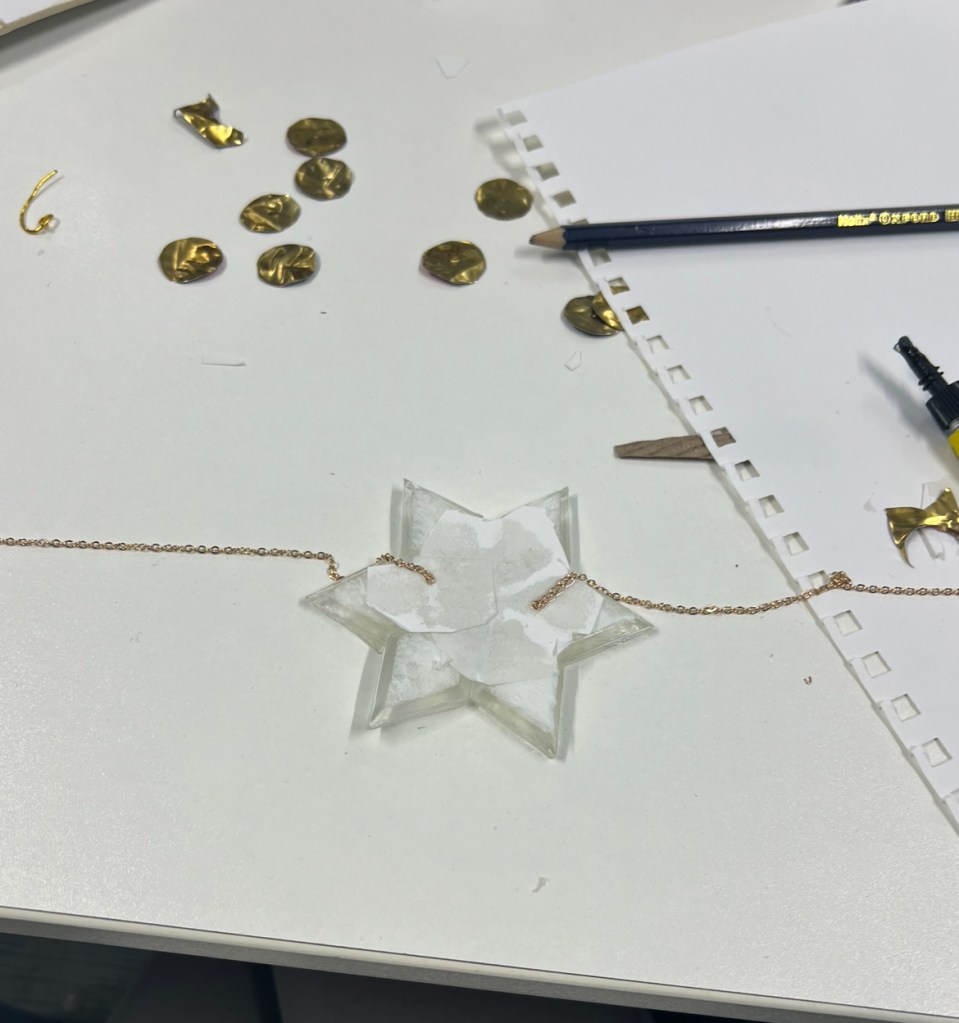
I struggled a bit with attaching the tiles to each other. First I tried using superglue and it didn’t work so I used a glue gun which didn’t work either. Chelsea suggested gluing the tiles onto another material, so I tried gluing it onto paper and cutting around it so the paper wouldn’t show.

I then attached the coins and I really liked the outcome. I felt like the hammered gold coins and the geometric shapes gave it this arabesque feel. What I struggled with was figuring out how to attach it to a back. I brainstormed some ideas with my classmates and felt that maybe attaching a necklace to it and making the neck hold up the back would be a good idea, also with clips and clipping it to the straps of the dress or shirt this person is wearing was another solution.


After I thought about the atmosphere I was trying to convey by getting inspired by belly dancers, I felt there is also a lot of movement happening in the neck and head area while dancing, so I decided to experiment and try it out as a headpiece. I really liked how it looked however I felt that the star in the middle was quite big and wouldn’t be very comfortable while dancing, on the other hand I felt that having it on the head would make it more of a statement piece and more visible, also the sounds it would create would be louder. Both the back and the headpiece were a successful experiment in my opinion and also inspired me to look further into body adornment.

I wanted to further develop this design so I decided to experiment with other Egyptian inspired elements. I decided to create a belt as I was inspired by how it reacts to belly dancers movements as it’s all in the hips, belly and waist. I liked how the coins would jingle with every movement, making people draw attention to the belly movements with both visually appealing elements and sounds.

I decided to get inspired by this necklace by Azza Fahmy and create shapes with wire that look like wings. Wings are elements that are included a lot in ancient Egypt. It especially reminded me of the goddess isis’ wings that symbolise healing and rebirth. I felt that it was quite connected to my narrative of starting a new life abroad.

I decided to further develop this design. I really liked the shape of the vultures wings they reminded me of goddess Isis wings. Godess Isis is a pharaoh who symbolises rebirth and new beginnings, I felt like the symbolism is really connected to my story. I wanted to fill in the wire shape as I felt like it needs to show the shape more so I tried it with hammered gold and I really liked the outcome as the geometric shapes of the wings were now more visible. I was quite fascinated by the celestial elements in the islamic patterns as they also carried very strong symbolism. The islamic calendar is a lunar calendar and the moon holds big symbolism for islam which inspired me to also get inspired by the starts. In the ancient times they would follow the stars in their travel, as it guided them to their destination. I felt like the star should be in the middle of the belt so it’s the centre of the attention it guides the eyes of the viewer with the movement of the belly dancer. I also felt connected to the symbolism, because even when you travel and start a new life you might feel lost but everywhere you go you can look up to the stars and have some sort of familiar feeling.

I decided to put some organza lotus flowers at the back of the belt also for the symbolism.
Design sheets
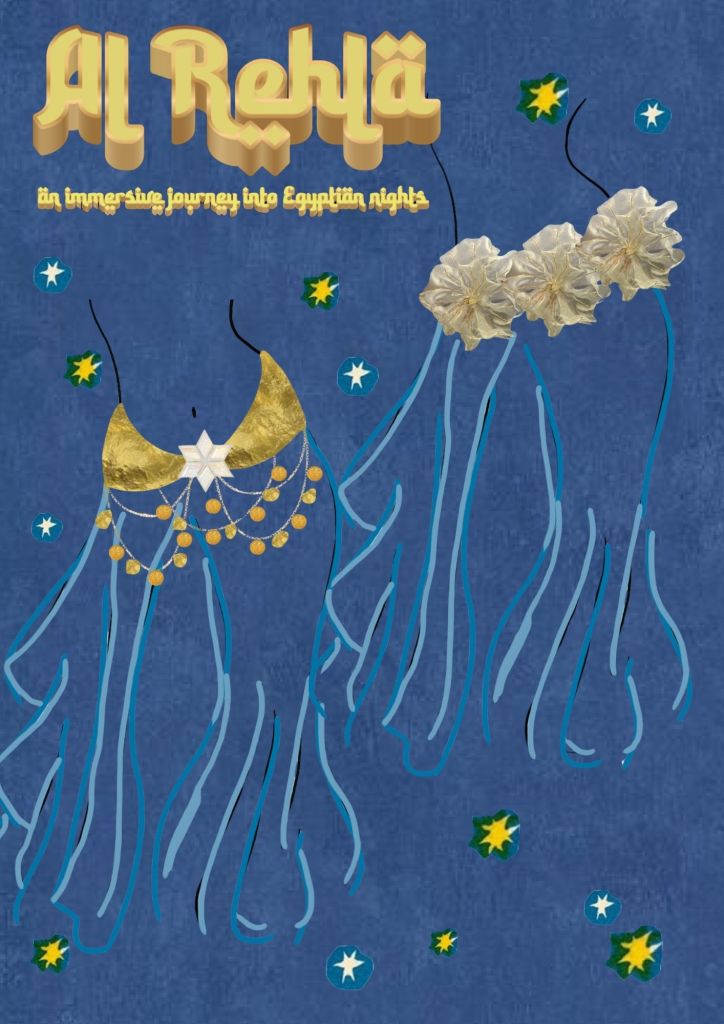
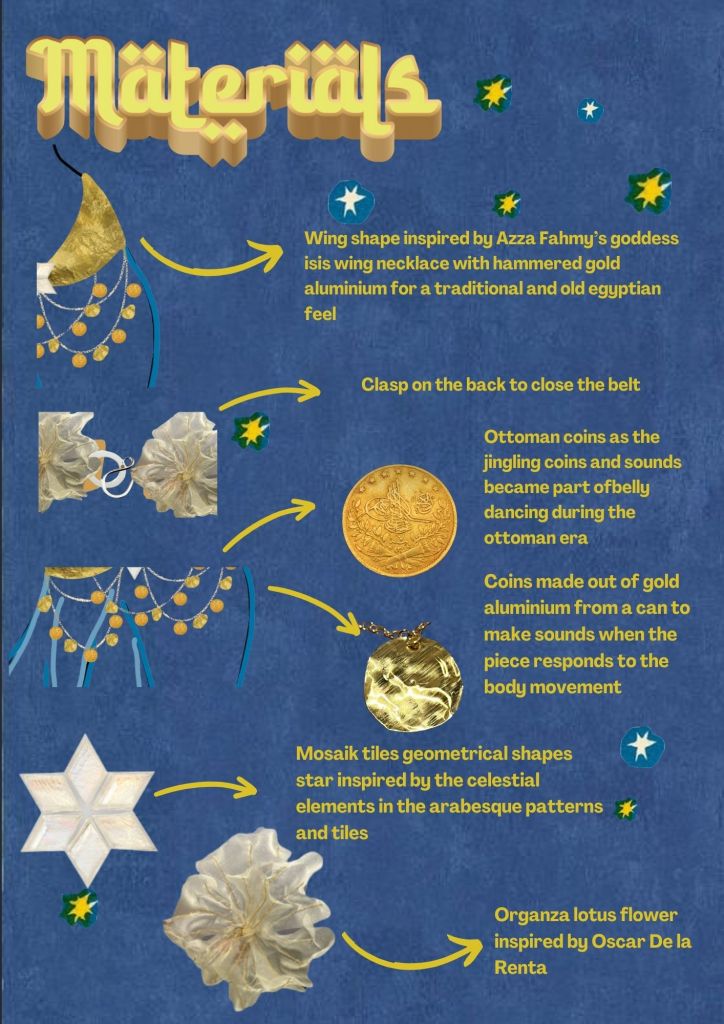
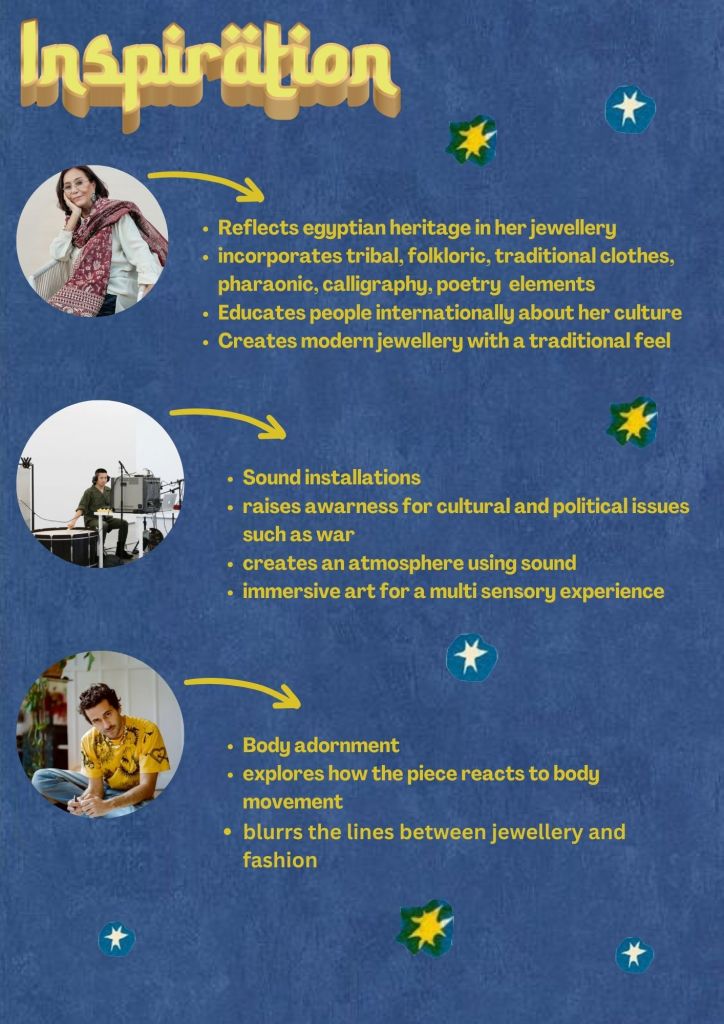
Sounds

I recorded sounds and layered them on top of each other to portray how the atmosphere feels like in Egypt. To me Egypt feels lively and crowded 24/7, Cairo is a city that never sleeps. People there are extremely talkative, friendly and joyful. From street vendors in the street to cars honking, people chatting and laughing. It’s chaotic, loud and crowded but in a happy way which is an atmosphere I am trying to portray using sounds and my jewellery piece. I felt like one thing that can kind of sum up the whole feeling is when a belly dancer is performing. The joy that is in the air with the music and people cheering and laughing when a belly dancer performs sums up Cairos atmosphere in just one minute. So I decided to create a mood board and sounds, so the viewers have a multi sensory journey into Egyptian nights and imagine what it feels like there.

 Farida’s Art and Design blog