
Information & Interpretation in Art&Design
ART103 project requirements
- – Produce an online sketchbook where you explore the historical, cultural, social and contemporary influences on your Art&Design
- – Submit a research essay of 1000 to 1500 words with visuals on an artist of your choice (explore the historical, contemporary, social and cultural influences on that artist)
- – Submit a broad range of body research to support your project
- – Submit a 500 word evaluation
- – Produce a self-reflective log
- – A 15min oral presentation with the title “Me and my influences” will be presented in class
Develop- Identify Projects
- – Research our chosen word more in depth
- – Develop the design ideas (broad range of designs)
- – Experiment with different materials and techniques
Overall Feedback for identify projects
- – Not enough research was done, also not deep enough (problem solve, investigate and dig deep)
- – Apply techniques you’ve learned in your project (show understanding of the modules)
- – Not enough design ideas were explored
- – Go further and explore your chosen artists influences
- – deeper primary and secondary research.
ART101 Reflection
I enjoyed the creative freedom in allowing us to choose our final project.
I found this to be beneficial as it created a stronger connection between me and the jewellery piece. One of my strengths during this project was connecting the different elements and symbolism to convey a certain story. I enjoyed exploring how jewellery is a powerful storytelling method and figuring out how to best translate my story into the designs by using symbolism.
The idea of having my piece tell such a personal story adds a unique and authentic dimension to the project.
I am quite proud of my hard work and determination despite having some hurdles at the start of the semester.
I was also able to apply skills that I acquired from class into my project which shows my understanding of course materials and my ability to translate theoretical concepts into tangible outcomes.
Also, my documentation of the project journey shows a deep understanding of the subject, my project and my ideas which makes it easier to explain my ideas to others clearly.
However, there are some areas of improvement to enhance the overall quality of my project.
Like the limited creativity that was shown in the final piece.
My final project turned out looking a bit more commercial when I should’ve explored my creativity and went all out. I also didn’t explore a wide range of design ideas. I can improve that using the SCAMPER technique for example. Developing one idea and making it lead to a lot of other ones. While I have researched artists and had primary and secondary research I should’ve dug deeper. By responding to my research and also researching more artists and their influences to expose myself to more ideas, new materials, techniques and inspirations.
I struggled with time management as I felt overwhelmed by the work load pretty quickly which resulted in me not having everything uploaded to my WordPress.
Despite the weaknesses, there are opportunities for growth, improvement and development in my project.
This semester I want to not only expose myself to more primary research like going to museums and exhibitions, but also respond to the inspirations by researching them more in depth for example or creating designs.
I also want to dig deeper when researching artists by also researching their historical, contemporary, social and cultural influences to better understand and also expose myself to more creativity and inspirations for my final project.
Additionally, pushing the boundaries of creativity and innovation can lead to more impactful unique and memorable designs.
I would like to further explore not only the symbolism but also the various representations of the lotus flower in different cultures.
Time management was a big threat last semester as it resulted in rushed or incomplete assignments that affected the quality of my work.
Therefore I will avoid procrastinating and manage my time better to also be able to revisit and explore ideas more in depth to maximise creativity and innovation.
In conclusion I will developing my design ideas as well as deepening my research this semester to achieve a more creative and unique outcome.
Weekly Reflection
This lesson we were introduce to the requirements of the course and also received feedback on last semesters final project. Reflecting on this week I think it really helped me understand how to improve this semester. I got to start organising my thoughts and having some initial ideas on how to improve. I realised that I need to work harder and more creatively. After this lesson I started applying the feedback I got to start improving by keeping my WordPress up to date as a start, avoiding procrastination and researching deeper and more thoroughly. All in all this lesson helped me gain perspective on how to improve and develop my projects to achieve more this semester.
John Galliano
John Galliano is a fashion designer who is well known for his dramatic, theatrical and innovative style.
Galliano was raised in London and was born in Gibraltar, Spain in 1960.
He attended Central Saint Martins College of Art and Design, where his skill was soon noticed. His flashy and avant-garde collections from the 1980s, which combined historical references, reinterpretation and pushing of social norms propelled him to prominence in the fashion industry.

Galliano found inspiration for this collection in Victorian dolls and the role of Brooke Shields’s character in the movie “Pretty Baby,” which followed a young girl living in a brothel.

Victorian inspired collection


Basically, Galliano’s sexualized, Victorian-inspired collection was a daring reinterpretation of a past age that he infused with his signature theatricality and innovative vision. By exploring themes of desire, power, and freedom in his designs, Galliano encouraged viewers to question their views and accept a deeper vision of gender and sexuality.
The clothes in Galliano’s collection included bustled rompers, corsets, and sheer materials with revealing accents like fluttery underpants and translucent sleeves. These styles challenged the idea that Victorian clothing was innocent by evoking feelings of playfulness and seduction. Galliano questioned conventional ideas of femininity and sexuality by contrasting sensuality with purity, which generated discussion and made people consider social norms and expectations.
Gender fluidity collection
John Galliano drew inspiration from the political unrest and social movements happening globally. He was particularly influenced by events like protests in Paris and the Women’s March in America, which symbolized a collective push for change and the courage to stand up for one’s beliefs. Galliano viewed these events as people expressing disagreement with the way things were and demanding more justice and equality in society. This inspiration made him want to challenge traditional values and norms through his fashion designs, which lead him to creating a collection that portrayed freedom of expression and gender fluidity.

The presentation challenged social norms, embracing progressive ideals that resonate with younger generations. Galliano’s belief that “there are no rules—you write the book” reflects a bold and innovative approach to fashion that sets a new standard for the industry.

The garments in the collection featured oversized capes, ponchos, and dresses crafted from repurposed materials. Unique details included translucent plastic mosaic skirts with grommeted silver hardware and iPhones attached to chunky platform boots, symbolizing the instant availability of information in the 21st century.

By drawing from historical references and reinterpreting them in a contemporary context, Galliano effectively engaged with themes of political unrest, gender fluidity, and freedom of expression


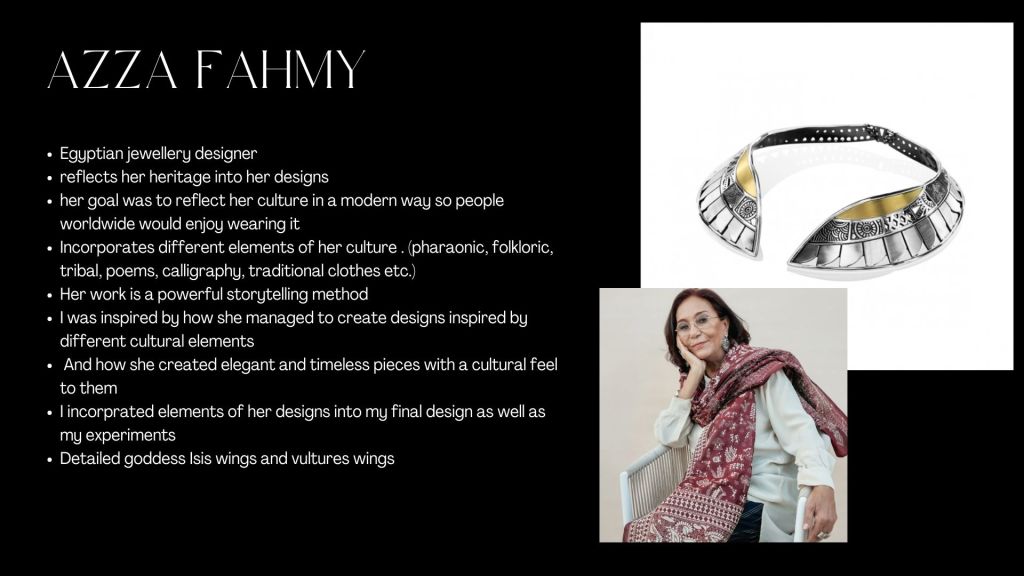
Azza Fahmy is an Egyptian jeweller who learned her silversmithing skills at a local Egyptian market and built herself up and became international. She started in journey to becoming a jewellery in the late 1960s.
In that time it was quite uncommon in Egypt for a well-educated, wealthy woman to work in a local silversmithing workshop. Women of this class were expected by society to prioritise taking care of their families or seek higher-profile careers. Therefore, traditional parts of society would have disapproved of a woman working physically, especially in a trade like silversmithing that is dominated by men. By doing so Azza Fahmy pushed boundaries and challenged traditional gender norms, proving her independence, determination, and willingness to go against the norms of society. This was viewed as out of the ordinary, and it represented women’s empowerment and the breakdown of conventional barriers.
Azza Fahmy had taken the role of translating the region’s culture and art and historic references to the world, through contemporary jewellery design.
1980 she launched her first collection “houses of the Nile” where she also showed how she didn’t only push traditional boundaries but also creative ones. She envisioned how combining silver and gold would create a beautiful contrast and became the first jeweller in Egypt who mixed materials together. This became her signature creating an authentic and innovative style in her work.
She used a lot of different methods to portray her heritage in her jewellery, from poetry, calligraphy and motifs to architecture, history and the society.
Azza Fahmy is a very well educated woman who enjoys reading and learning a lot. One of her inspirations is a famous historian and philosopher of the 11th century called. She was inspired by his book “ The Ring (or collar) of the dove”.
Ibn Hazm’s “The Ring of the Dove” is a treatise on love and the intricacies of romantic relationships. In the book, Ibn Hazm explores the nature of love, its different manifestations, and the challenges and joys it brings. He discusses topics such as the psychology of love, the role of passion, the dynamics of courtship, and the pain of separation. Drawing from his own experiences and observations, Ibn Hazm provides insights into human nature and the complexities of love, offering guidance and reflections on matters of the heart. Ibn Hazm’s “The Ring of the Dove” was quite revolutionary for its time in terms of its open and frank discussion of love and romantic relationships. During the era in which it was written (11th century), many scholars focused on religious and philosophical topics, and discussions about love were often limited to mystical or allegorical interpretations. Ibn Hazm, however, delved directly into the human experience of love, addressing its emotional, psychological, and practical aspects without allegorical or mystical layers. This direct exploration of love and its complexities was indeed pushing cultural boundaries for the time, making his work both controversial and groundbreaking.
Azza Fahmy explained “in our Islamic culture, love is either veiled or metaphysical. Or so I believed until I read the ring of the dove.”
Azza Fahmy’s work is a powerful storytelling method and also a method to push boundaries in a lot of ways.
She launched another collection where she used calligraphy to write famous lines from various love poems from different Egyptian poets. By doing that she again pushed social boundaries by talking freely about love and emotions.


- Wrap-around bracelet adorned with the love verse of poet Ahmed Shawqi – ‘لست امام عيني لكنك كل ما اري’, which translates to ‘You may be out of my sight, but you’re all I see’.
- motifs and calligraphy by Antara Ibn Shaddad, recalling a love story between him and his cousin Abla.‘If my heart still belonged to me, I would choose none other than you’ – Antarah Ibn Shaddadلو كان قلبي معى ما اخترتُ غيركم…ولا رضيتُ سِوَاكُمْ في الهَوى بدَلا” – عنترة بن شداد
Ancient Egyptian collection
Azza Fahmy’s Ancient Egypt Pharaonic collection represents a combination of culture and history, reflecting her dedication to portraying the rich heritage of Egypt in her projects. Pharaohs are a very significant aspect of Egyptian culture. Even Internationally Egypt is most known for the pharaonic era. Azza Fahmy wanted to make sure to dig deep into the symbolism and motifs associated with the pharaonic culture. She went on a 8 year research journey across Egypt to insure that there is authenticity and depth in her designs.
She makes sure to showcase how famous ancient Egyptians were for symbology. Every piece of jewellery carries meaning and tells a story. The lotus flower and snake in her collection for example, are both symbols of rebirth and renewal.
She displays the timeless cultural heritage of Egypt with her creative design and detailed study.

This choker draws inspiration from Tutankhamun’s iconic mask. The lotus flower symbolises rebirth and renewal.

A symbol of power and life-giving force, these Lotus bouquets can be seen beautifying offering tables in Ancient Egypt, where they are laid over gifts presented to the gods and loved ones.

Ostrich plume of ‘Maat’-symbol of cosmic balance, truth and justice
Sources
Fanack (2023) Azza Fahmy: Arab storytelling through jewellery, Fanack. Available at: https://fanack.com/faces/features-insights/azza-fahmy~126438/ (Accessed: 06 February 2024).
From ancient egypt to modern Arabia, Azza Fahmy jewellery draws inspiration from all eras and areas (2022) Grazia Middle East. Available at: https://graziamagazine.com/me/articles/azza-fahmy-jewellery-interview/ (Accessed: 06 February 2024).
Akkawi, D. (2020) Everyone’s favorite jewelry designer Azza Fahmy tells the story of her career Journey & How she discovered jewelry design was her passion: 925: The first online magazine of its kind in Egypt, 925. Available at: https://925egypt.com/2020/09/03/everyones-favorite-jewelry-designer-azza-fahmy-tells-the-story-of-her-career-journey-how-she-discovered-jewelry-design-was-her-passion/ (Accessed: 06 February 2024).
Timeline (no date) Azza Fahmy Jewellery – Official Website. Available at: https://www.azzafahmy.com/us/timeline (Accessed: 06 February 2024).
Interview: Azza Fahmy jewelry: Style.com/arabia (2013) Vogue Arabia. Available at: https://en.vogue.me/archive/faces_of_fashion/interview-azza-fahmy-jewelry/ (Accessed: 06 February 2024).

Nekhbet’- Vulture collar necklace. The openwork wings with feather and pharonic dress detail, with scarab and lotus flower terminal
FAHMY, A (2015) Azza Fahmy: The traditional jewlry of Egypt Cairo ; New York : The American University in Cairo Press
Oscar de la Renta
Oscar de la Renta was born on July 22, 1932,in Santo Domingo, Dominican Republic.
He showed an early interest in fashion and art, which motivated him to look for higher education in both of these areas. At the age of 18 he travelled to Madrid, Spain and studied painting at Academy of San Fernando before realising that fashion design was his actual passion. De la Renta started his career working for prestigious European couture businesses like Balenciaga and Lanvin after his outstanding talent was soon noticed. He established his own label, eponymous, in 1965 in New York City. Since then, he has gained recognition for his fine workmanship, classic elegance, and romantic style.
De la Renta got inspired by wide range of sources. His designs often reflected his Dominican heritage, European influences, and his love for art, culture, and travel.
His designs were characterised by rich materials, elaborate needlework, and vivid colours that were a translation of his Caribbean upbringing.
His time spent in Paris working for high-end fashion houses like Lanvin and Balenciaga had a big impact on his style. Throughout his stay in the European fashion cities, De la Renta developed his skills in tailoring, shapes, and timeless elegance, all of which you can see in his creations.

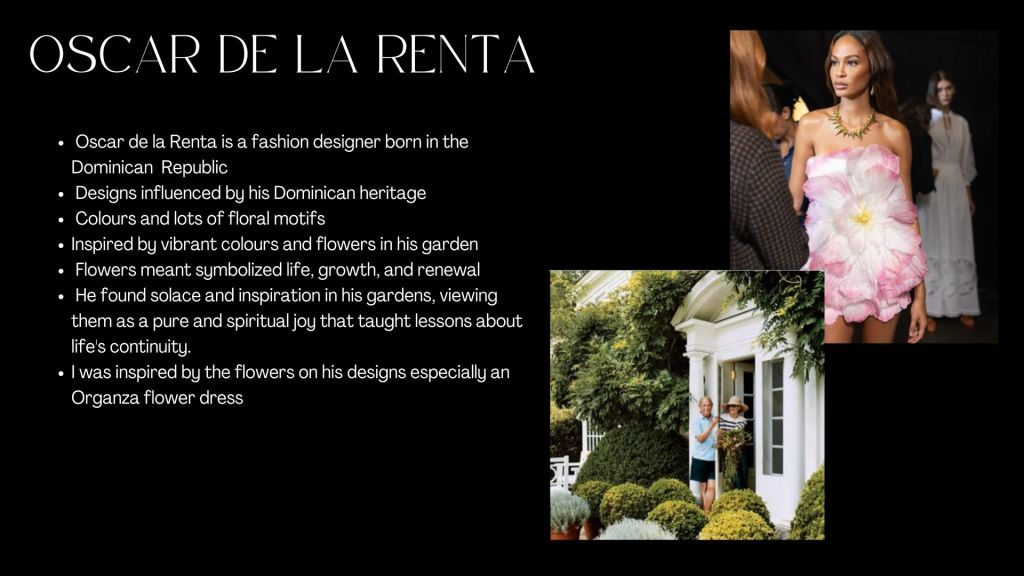
His own garden was a big source of inspiration. His passion for gardening was well known, and he frequently discussed how his gardens’ peace and beauty inspired his design work.
Gardening was more than just an exercise for him. In an interview in his book “Oscar de la Renta” he said “A Garden is probably the most pure and spiritual of joys- a communion with nature and beauty in their most simple and fundamental forms.” (page.163) He thinks that you can’t reflect on something bad in a garden and that it teaches you a lesson about life’s continuity.

De la Renta had an amazing collection of trees, plants, and flowers in his gardens, which were spread between his homes in the Dominican Republic and Connecticut. He created an environment that was beautiful and vibrant reflecting his outstanding taste and attention to detail, by carefully curating the place.
De la Renta was continuously inspired by the colours, shapes, and scents of the flowers in his garden. He created timeless and modern designs by drawing inspiration from the natural beauty around him.
Flowers represented life, growth, and renewal for De la Renta, who saw them as more than just decorative elements. His creations frequently had a playful and romantic feel to them, much like a fully blossoming garden.
Also, flowers mirrored De la Renta’s own happy and upbeat attitude on life.
He also drew inspiration by some historical eras for example:
1. Victorian and Edwardian era: De la Renta sometimes used romance and femininity from these eras into his creations. He played around with high necklines, lace accents, and silhouettes similar of corsetry, giving his designs a sense of vintage and old appeal.
2. Art Deco movement: De la Renta’s designs were influenced by the geometric shapes, strong lines, and luxurious materials linked with the Art Deco movement. He frequently included jewels, adornments, and prints with Art Deco influences in his collections.
He established his reputation as one of the most famous designers of his era by producing designs that were both classic and modern by taking inspiration from the past and reinterpreting it in a contemporary context.
Spring 2024 collection

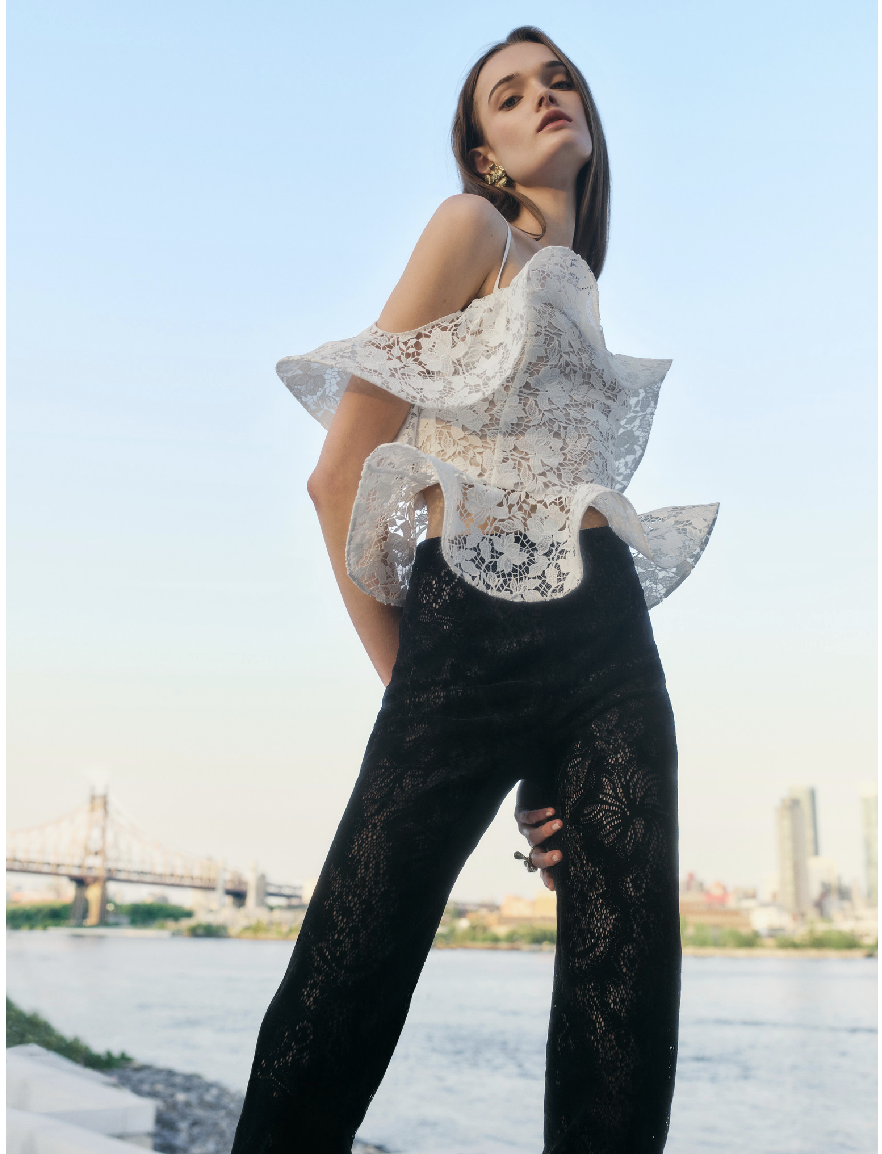


Floral motifs are a signature element in De la Renta’s spring collection, symbolizing renewal, growth, and natural beauty. He incorporated intricate floral embroidery and bold floral prints into his designs, drawing inspiration from the blossoming flowers in his own garden.
Additionally, De la Renta’s spring collection showcases a sense of lightness, life, ease and playfulness with flowing fabrics, ruffles, and breezy silhouettes.
Arline Fisch
Arline Fisch was born on January 18 1931 in Brooklyn New York.
She is an American jewellery designer and educator who is known for her creative application of textile techniques to metalworking. In her work, Fisch explores themes of identity, memory, and heritage while pushing boundaries of traditional skills. Throughout her career, Fisch has made a significant contribution to the field of modern jewellery.
Arline started exploring the boundaries of jewellery and clothing in the mid seventies.
She knitted, braided or wove using wire to create body adornments and jewellery.
Fisch travelled extensively and her first inspiration was Egyptian jewellery.
When she was a little girl, she would often visit the Metropolitan Museum of Art,
Where she was especially inspired by the Egyptian jewellery collection.
But she has also drawn inspiration by pre-Columbian textiles, Mediterranean cultures, viking and Celtic metalwork and Elizabethan ruff collars.
She has studied historical textile traditions from around the world, including lace making, embroidery, and weaving, and has adapted these techniques to create intricate and delicate metal jewellery.
The dramatic design of Egyptian broad collars, the extravagant style of African tribal ornaments, the richness of a Scythian gold helmet, and the extravagant designs of ornaments worn by nomadic peoples have always captivated her.

Fisch addressed themes of adaption often throughout her work. She draws inspiration from historical textile traditions and applies them to contemporary contexts, giving them an updated feel and meaning.
This idea is a reflection of Fisch’s belief that creativity has the ability to connect the past and present and that history is adaptable.

Fischer’s Headpiece “Flavour of the east”shows her ability to blend Eastern jewellery influences with her own innovative techniques. In my opinion, the design has elements that are reflective of Egyptian Bedouin inspiration, especially the whimsical usage of dangling coins that connect to the region’s rich history of culture and lifestyle. Overall “Flavour of the East” is showcases Fischers creative vision and her ability to combine several inspirations into a single and fascinating work of wearable art.
Fisch addressed themes of adaption often throughout her work. She draws inspiration from historical textile traditions and applies them to contemporary contexts, giving them an updated feel and meaning.
This idea is a reflection of Fisch’s belief that creativity has the ability to connect the past and present and that history is adaptable.

For this artwork Fisch got inspired by the hanging Gardens of Babylon.
One of the world wonders of the ancient world which was made around the Euphrates River around 600 B.C
Archaeologists claim to have discovered the ruins of the garden walls, although it’s possible that they never existed beyond the imagination of Greek poets and historians. Based on descriptions provided by these ancient Greek poets and historians, the only images that exist are creative reconstructions of the gardens. It was said that the exotic, growing plants in the gardens were grown above ground and dangled above the heads of the people.
She constructed her own interpretation of the hanging garden, with vibrant flower shapes hanging on long, green, knitted stems and hanged from the ceiling.
Critical analysis
Arline Fischer shows her ability to combine creativity, skill, and cultural awareness in her work. Her skill at weaving, which is clearly seen in pieces like “Hanging Garden,” displays her skills with metalworking and her ability to produce complicated and visually appealing textures. Her art gains depth and richness from the historical inspirations she incorporates, which also offers a basis for additional research and interpretation. In “Hanging Garden,” the vivid colours and complex patterns emphasise the vibrant and organic look that is created by the wire weaving process. It also showcases her ability to connect past and present and interpret historical inspirations to contemporary designs. I aim to apply her wire weaving techniques to my final project to create Islamic patterns and calligraphy.
Fischers “Flavour of the East” headpiece is an example of her ability to transform traditional Eastern wear into contemporary jewellery. The addition of dangling coins and the overall design, even though it may not use her trademark weaving skills, perfectly capture the essence of Eastern adornments. From my perspective the headpiece also showcases her Egyptian inspirations. As I am planning on integrating my Egyptian heritage and culture into my final design think her headpiece is a very good source of inspiration.
Sources
Museum, V. and A. (no date) ‘Lace Ascot’: Fisch, Arline M. (professor): V&A explore the collections, Victoria and Albert Museum: Explore the Collections. Available at: https://collections.vam.ac.uk/item/O55143/lace-ascot-brooch-fisch-arline-m/ (Accessed: 08 February 2024).
Art Jewelry Forum (2022) Arline Fisch: Hanging gardens, Art Jewelry Forum. Available at: https://artjewelryforum.org/articles/arline-fisch-hanging-gardens/ (Accessed: 08 February 2024).
Arline Fisch (no date) Smithsonian American Art Museum. Available at: https://americanart.si.edu/artist/arline-fisch-5748 (Accessed: 08 February 2024).
Alexander McQueen
At the age of sixteen, Alexander McQueen—then known as Lee McQueen—left school to work as an apprentice on Savile Row, the famous centre of British male tailoring, to start his career in fashion. He became an expert tailor by developing his skills at renowned businesses such as Anderson & Sheppard and Gieves & Hawkes.
Because of his creativity and innovative, McQueen quickly rose to popularity in the fashion industry. He took on the role of head designer at Givenchy, a move that raised eyebrows due to the stark contrast between his bold style and the conservative reputation of the fashion house. But McQueen boldly defied tradition, surprising colleagues with his unconventional style. His ideas, which changed shorts into bodysuits and lengthy skirts into daringly short pieces, aimed to modernise Givenchy’s aesthetic and bring it into the twenty-first century.
After his time at Givenchy, McQueen went back to the UK to complete his studies at the University of the Arts London in fashion. Over the course of his career, McQueen created controversial yet alluring designs by drawing influence from nature, especially animals and the human body. His provocative and creative runway displays drew the interest of celebrities such as Isabella Blow, a Vogue publicist who was captivated by the movement and beauty of his clothing.
Blow’s consistent support was important in McQueen’s journey to fame. She not only purchased and wore his designs but also provided him with a home and acted as a creative inspiration and promoter.
McQueen’s love for controversy and his ability to blend the beautiful with violence made him one of the most talked-about figures of the 1990s fashion scene.
Alexander McQueen was fascinated by nature, especially animals. He saw a connection between the short life of gazelles and the fleeting fame of fashion designers. This inspired his designs and runway shows, where he often used black makeup to make models resemble gazelles. His unique approach to fashion and his willingness to challenge conventions made him a legendary figure in the industry.
Weekly Reflection
During this lesson we looked at the British fashion designer Alexander McQueen. We watched a short documentary about him and got to know his inspirations and his work. We learned how he was one of the most controversial names of the 90s because of his innovative ideas and his modern visions. Reflecting on that I think I really benefited from watching the video. One thing especially stuck with me. Alexander McQueen said that his goal was to give people something they wouldn’t forget, which meant being different and controversial. I felt like this made me realise how as a designer your ideas should really stand out, because there’s a lot of competition and you won’t be special if your designs aren’t different in any way. Before this lesson we were asked to research abroad range of artists in depth. I think researching these artists really exposed me to new ideas, new symbolism and new materials to apply to my own designs. It was quite stressful to research all of these artists and I was worried about the research not being deep enough. But overall I think researching artists now gave me the chance to get feedback from my tutor about the depth and also really inspired me ad gave me new ideas for my final design.
Philip Treacy
Phillip treacy is an irish hat designer who was born may 26, 1967.
He studied at the National college of art and design in Dublin, before moving to London to attend the prestigious Royal College of Art in London.
There he specialised in hat design. His graduation show in 1991 caused a fashion sensation and it wasn’t long before his innovative style started gaining recognition from the worlds leading fashion designers.
Now he has designed signature pieces for clients such as Madonna, Celine Dion and Victoria Beckham as well as hats for royals such as Princess Beatrice, Princess Kate and Queen Camilla. His ability to create hats that can be worn at a red carpet as well as ones that can be worn at a royal wedding show his creativity and innovative style.

Whar sets treacy’s work apart is the emotional connection he creates with every piece he creates. By using couture techniques and talking at length to his clients about their lives, experiences and desires, Treacy has mastered the art of creating timeless pieces to be treasured, far from from today’s increasingly disposable world of fast fashion.

He usually works with concepts but he also loves to work with thin air. He likes a blank page with a pencil and he gets going and later decides what attracts him.
He also draws inspiration by various historical eras.
His exploration of historical eras adds depth and richness to his work, allowing him to create hats that are both timeless and contemporary. By drawing inspiration from the past, Treacy pays homage to the heritage of millinery while pushing the boundaries of hat design with his innovative and imaginative creations.


He also draws inspiration by various historical eras.
His exploration of historical eras adds depth and richness to his work, allowing him to create hats that are both timeless and contemporary. By drawing inspiration from the past, Treacy pays homage to the heritage of millinery while pushing the boundaries of hat design with his innovative and imaginative creations.
- Roaring Twenties: Treacy has often been inspired by the glamorous and daring styles of the 1920s, characterized by flapper fashion and Art Deco aesthetics. He incorporates elements such as cloche hats, feather embellishments, and geometric motifs into his designs, capturing the spirit of this vibrant era.
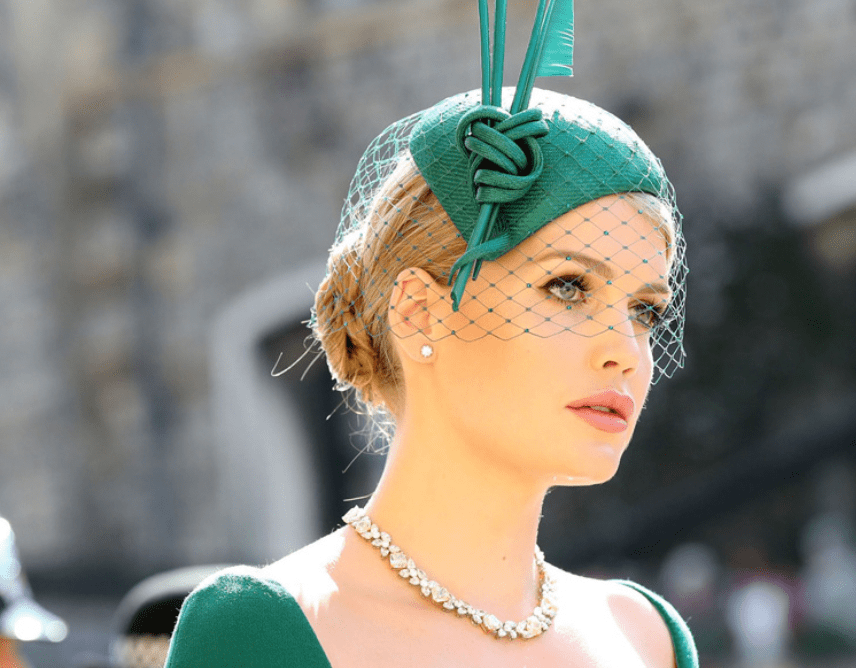
- Victorian Era: Treacy has drawn inspiration from the opulent and romantic styles of the Victorian era, known for its elaborate fashions and ornate accessories. He reinterprets Victorian bonnets, veils, and lace details in his designs, infusing them with a modern twist while paying homage to the elegance of the past.
3. Baroque and Rococo:Treacy’s work often reflects the grandeur and extravagance of the Baroque and Rococo periods, characterized by ornate decoration, elaborate embroidery, and rich fabrics. He incorporates elements such as brocade, pearls, and embellished trims into his designs, creating hats that exude luxury and sophistication.
He also draws inspiration from his friend and mentor Isabella blow.
Isabella Blow a Vogue publicist who was captivated by his innovative designs discovered Treacy’s work and became his mentor and muse. She played a pivotal role in promoting his designs and introducing him to influential figures in the fashion industry. Blow famously wore Treacy’s hats to various events and occasions, helping to establish his reputation as one of the foremost milliners of his time.

Their creative partnership was characterized by a shared appreciation for the avant-garde and a willingness to push the boundaries of fashion. Treacy’s hats perfectly complemented Blow’s bold and unconventional style, and their collaboration resulted in some of the most iconic and memorable fashion moments of the 1990s and early 2000s.


After her death in 2007 he and alexander McQueen collaborated and created a collection called ‘la dame bleu’ to pay tribute to their best friend
Isabella had told them that she wanted to be known as la dame bleu and that’s where the name came from.
Phillip Treacy and Alexander McQueen took off on a creative journey to pay tribute to Blow and appreciate her unique character. The collection had a wide range of mystical and innovative designs that were characterised by imaginative elements, surrealistic themes, and a bold use of blue colours. “La Dame Bleue” captured the spirit of Blow’s boldness, creativity, and provocative style, paying tribute to her legacy as a fashion icon and muse. By creating this collection, McQueen and Treacy preserved Blow’s legacy and made sure that her lasting impact will be felt for many years to come in the fashion industry.
Philip Treacy has addressed political and social issues in his work through various means, including his designs, collaborations, and public statements. While his primary focus is on fashion and design, Treacy occasionally incorporates themes related to social justice, diversity, and human rights into his creations. Here are some ways he has addressed these issues


Treacy said there are two major problems in the fashion industry. One is weight and the other is race.
As model after model, all of them of black origin, walked down Treacy’s runway, he decided which of the two would be the on-trend topic for London Fashion Week’s Spring/Summer 2013 season.
Treacy offers only one explanation for his decision to feature only black women in his production: “The show was an homage to the African woman and their sensibility to dress up.”
Sources
Murphy, N. (2023) Philip Treacy – Biography, HELLO! Available at: https://www.hellomagazine.com/profiles/20091008539/philip-treacy/ (Accessed: 07 February 2024).
Philip Treacy invites us inside his magical atelier with stories of McQueen and Isabella Blow (no date) Hero. Available at: https://hero-magazine.com/article/187555/philip-treacy (Accessed: 07 February 2024).
Evening Standard (2012) The new black… Philip Treacy’s show sparks colour on the catwalk, Evening Standard. Available at: https://www.standard.co.uk/lifestyle/fashion/the-new-black-philip-treacys-show-sparks-colour-on-the-catwalk-debate-8152554.html (Accessed: 07 February 2024).
Lego task
During the lesson we were asked to create a mythical creature using at least six lego pieces from each container around the room and also create a background story behind it.
I created a mythical creature called scary stairy.
Scary stairy is a mythical creature created by a little girl who once got her necklace stolen at a concert she went to on her birthday.
She is very short so she didn’t realise when someone just stole her necklace. After the concert she went home and kept crying about her necklace wishing she was taller so no one could reach her necklace.
There was a fairy nearby who heard her cries and decided to make her birthday wish come true. She couldn’t quite change the little girls body and make her taller so she decided to create a mythical creature called scary stairy.
Scary stairy is a big giant with steps on him. The little girl could climb up the steps and sit on top of scary stairy. He looked terrifying to anyone but her and her loved ones , so everyone who wanted to hurt her was scared to come close which made her feel stronger.

I didn’t get to take a picture of scary stairy before Bhavik destroyed him. So the whole point behind this task was for us to understand how important it is to clearly list our sources and say where we got the information from. After we presented our creature to our classmates, Bhavik asked us from which container we got a certain lego piece from. Because my answer wasn’t correct he destroyed scary stairy to make us understand how important it is to list our sources.
weekly reflection
Today we first talked about our artist research essay which is due in week 6. We looked at a template which made me understand more what to include and how deep my research should be. After that we had a lego task. I enjoyed the task a lot. Making up a whole story for my creature was fun and makes me think in a more creative way. Having activities like that makes us tap into our creative side, creating new stories for made up creatures helps with creating new and innovative designs because it makes you come up with an idea quite fast and these ideas can always be developed. I also feel like creating a story for something first helps me put this story together in a design or an illustration. The whole point of this activity was for us to understand the importance of listing our sources. When I was asked from which container I got a certain lego piece I couldn’t answer which resulted in Bhavik destroying my piece. This made me understand how important it is to list where I got my information from. I also wish I would’ve taken a picture of scary stairy before he was destroyed. I think I can apply this activity to my work in two different ways. First I want to write down a story for my work which will then help me visualise a design. And the second is to always list the exact sources where I got my information.
Cartier and Islamic Art
Introduction
This essay explores Louis Cartier and his inspiration with Islamic art. The author will be introducing his techniques, use of materials, inspirations and how they are linked to the author’s final project.
The author intends to reflect her Egyptian heritage and culture through Islamic art.
History of Cartier
According to Sarah Schleunig, Louis Francoise Cartier (1819-1904) began his career as a jeweller at Adolphe Picard’s shop, this experience set the stage for Cartier’s start of his own iconic brand. (Cartier and Islamic art: In search of modernity 2022, page 25).
When Picard moved to Paris, Cartier inherited the shop, reimagining it as his own brand.
Later on his grandchildren – Pierre, Louis, Jacques and Suzanne Cartier joined the family business and solidified it’s legacy. (Cartier and Islamic art: In search of modernity 2022, page 26).
Louis Cartier, the oldest grandson joined the family in 1898. Influenced by the prominent art nouveau trend, he aimed to shake up the jewellery industry and not stick to convention.
His experimentation with platinum created refined pieces inspired by the 18th century, represented by the Garland style which became the Emblem of the Maison. The Garland style was known for pieces that are made of platinum and mainly set with diamonds, also often decorated with garlands, bows and pear drop shaped pearls. (Ecker et al., Cartier and islamic art: In search of modernity 2022 page 27)


Islamic art inspiration
Louis Cartier was an innovator, which inspired his departure from convention and marked his transition towards a more linear modern style, characterised by geometric shapes, and influenced by Eastern civilizations, especially Islamic Art. (Cartier and islamic art: In search of modernity 2022 page 40). Cartier’s fascination with Islamic art stemmed from Paris as it became the centre for Islamic trade after the weakening of major Islamic empires by colonialization. As western countries grew appetite for Islamic art, huge exhibitions like the 1903 “Exposition des Arts Musulmans” in Paris, from which Cartier drew inspiration were planned. Islamic Art was seen as a path to modernity, influencing Cartier’s style towards Art Deco. Louis Cartier’s interest in the eastern culture is evident in his collection of oriental artefacts and antique objects which he would reuse or integrate into his designs (Magazine, How islamic art influenced one of fashion’s most famous jewelers 2022).
Cartier’s archives
Cartier’s archives reveal the importance of this theme which is reflected in Louis Cartier’s library as well as his brother Jacques Cartier’s travel accounts, who had travelled to India and Bahrain in 1911, providing first hand inspiration (Cartier and islamic art: In search of modernity 2022 page 31).
The Maison’s influence with Islamic art and it’s impact on the designs became visible in 1908, as they started creating plaster casts that were models made from completed pieces of jewellery he had bought from oriental dealers. (Cartier and islamic art: In search of modernity 2022 page 35)
In 1935 Cartier published an advertisement in Vogue that had been inspired by the pictures Jacques took of Arabic architecture in Cairo.


| Fig. 1 Advertisement for Cartier (detail). Abel ImblotBritish Vogue, October 1935Cartier Documentation, Paris | Fig. 2Details from photographs of the minbars of the Mosques of al-Salih Tala’ and Ibu Tulun, Cairo Photo album1932Cartier London ArchivesInv. C1612_023, C1612_019 |
(Cartier and Islamic art: In search of modernity 2022 page 250)
The poster blends Islamic inspiration with a modern and abstract aesthetic which showcases a fusion between innovation and tradition.
His use of Islamic forms gives the poster an Arabic feel while their decision to illustrate it in a more abstract style adds a contemporary twist.
Despite the abstraction you can still sense the Arabic feel and essence.
.
Louis’s lifelong interest wasn’t only sparked by the exhibitions but also by his grandfather’s interest in the theme. His Grandfather started learning eastern languages in his later life and owned a library full of books about the eastern culture and language to which Louis Cartier constantly added.
As a designer Louis Cartier was interested in the artistic production of his time, and he sae Islamic design as a source of inspiration for contemporary artists. (Mehta, How cartier built an empire by claiming Indian and Islamic art as its own 2022)
Lexicon of forms
In the first decade of the twentieth century Louis Cartier began experimenting with new design ideas that moved away from Cartier’s previous style and leaned towards abstract ornamental forms reflecting Islamic designs. From all the sources and inspirations Cartier created a distinctive lexicon of Islamic forms including simple and interlocking geometric shapes, palmette finials, lotus blossoms, mamluk motifs and more. A lexicon was used here to collect forms to use in their designs as they were quite repetitive. Cartier was not the only jewellery house to introduce Islamic forms in the 1920s as it was quite popular, but Cartier was an innovator in his field and his designs were all based on a selected group of forms which made his designs recognizable.


(Cartier and Islamic art: In search of modernity 2022 page 163)
The Arab style
Research into Arab forms at Cartier proceeded alongside the continued production of the Garland style.
The development from the Garland style to the Islamic happened in two steps.
- A transitional mode jewels were conceived as geometrical Forms but incorporate classicizing elements such as bows, and floral motifs.


| Fig.1 Necklace, 1908, platinum, diamonds, inv. 010102430 | Fig. 2 Stomacher brooch Cartier Paris, special order, 1909 Platinum, diamonds 12 × 9.62 cm Cartier Collection Inv. CL 208 A09 |
- A more conventional Islamic style that includes jewels with six-, eight-, and twelve- pointed stars, as well as well rounded or hexagonal medallion shapes with internal designs.


| Fig. 1 Garland-style sketchbook. Cartier Paris, c. 1910Graphite, India ink, and gouache 27.5 × 22.5 cm Cartier Paris Archives Inv. CHGIV_094-095 | Fig. 2 SautoirCartier Paris, 1907 (necklace), 1908 (pendant) Platinum, pearls, diamonds Pendant: 5.70 × 4.90 cmCartier Collection |
(Cartier and islamic art: In search of modernity 2022 page 169)
Techniques
Louis Cartier created jewellery pieces with modern techniques rather than traditional technique, while keeping his significant style. His design was clearly influenced by Islamic art his techniques were unique and different from traditional eastern methods, such as granulation, which is the complex method of welding tiny metal balls to a surface or, the hollow box technique, which involves joining several layers of metal together to create elaborate shapes. Very rarely did he use filigree, which is the delicate craft of twisting and soldering small metal wires to create intricate shapes and patterns. Cartier rather preferred creative and innovative methods to demonstrate his ability to work with materials. (Cartier and the arts of Islam”, in the footsteps of Louis Cartier… 2023)
Cartier’s designs showcase how he used platinum as the main material of his design. His
innovation was in his ability to apply modern interpretations of Islamic art and design principles which often included colourful gemstones, intricate arabesques, and detailed geometric patterns all of which celebrate the Islamic heritage and culture while also giving his works a contemporary feel. (How cartier’s love of gemstones led to platinum – the French Jewelry Post 2023)
Why I chose Cartier
The author decided to research Louis Cartier for several reasons. The most important one was because she was impressed by his ability to take Islamic cultural motifs and turn them into elegant and timeless contemporary jewellery pieces. The author finds it very inspiring how he can abstract Islamic elements while keeping an Arabic feel to the piece. As a good example for an artist who managed to incorporate Islamic patterns and architectural inspirations into his designs without losing his personal aesthetic is Louis Cartier.
The author intends to reflect her Egyptian culture and heritage through Islamic art that is the main inspiration of the author’s final project.
Louis Cartier’s Motto “Never imitate, always innovate” resonates with the authors own goals. Her idea is inspired by how he managed to modernise designs, and pushed boundaries while still maintaining his signature style and aesthetic whether it was by incorporating garland style motifs, abstracting the forms or using platinum and his own design techniques. All in all, Cartier’s strategy for staying ahead of trends without losing individuality inspires her own goal of making items that are both modern and reflect her culture.
(Intro to cartier jewelry: The jeweler of kings and the King of Jewelers 2022)
Analyse and critically analyse his jewellery pieces and his work

This hair ornament here represents louis Cartier’s first signs of abstract thinking, it showcases his innovative designs that push boundaries of standard jewellery. (Cartier and Islamic art: In search of modernity 2022 page 164)Having it being made out of platinum and diamonds, portrays a part of Cartier’s signature but the design clearly shows a departure from the conventional Garland style showing a start of new design ideas and inspirations. The head ornament takes shape of a lock of hair or a sine curve of moiré silk. These motifs portray a sense of fluidity and organic shapes which is reminiscent of Islamic and Arabic aesthetics.
The big curves give the piece an Arabic feel. (Cartier and Islamic art: In search of modernity 2022 page 164) The use of Platinum and diamonds reflect the artist’s signature style and commitment to his craftmanship, however despite the use of familiar materials the overall aesthetic is different from any previous designs.

This design definitely reflects his inspiration by Islamic art more.
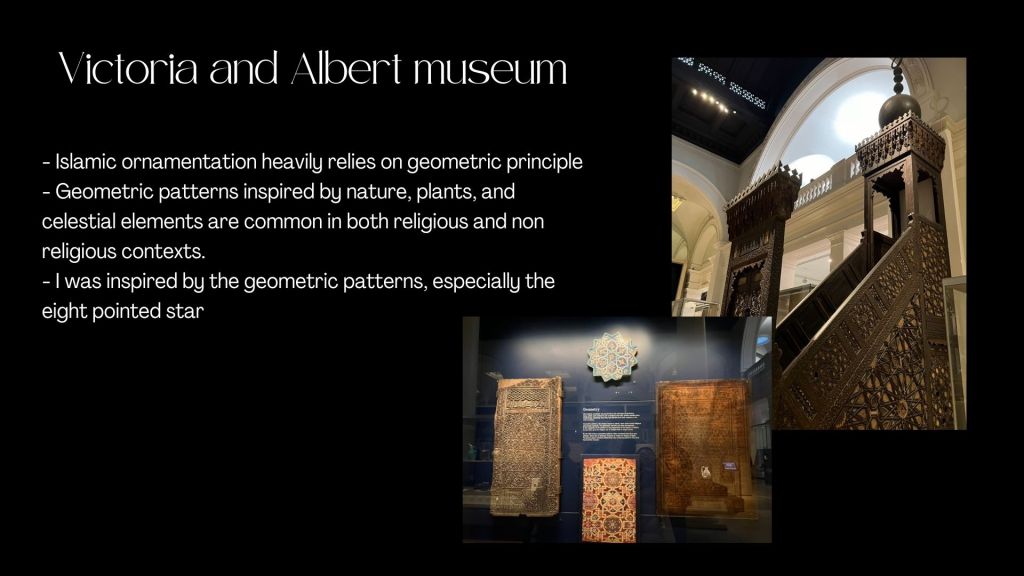
This repetitive 10-point star motif is seen in a lot of Islamic architecture, one of the pictures Louis Cartier’s brother had taken in Cairo show the exact same motif in a mosque.
Again traditional techniques like filigree work have not been used, which show that his inspiration was by the Islamic aesthetic only and not by the techniques. It also reflects his signature style and how he modernises the traditional artworks while not losing individuality (Cartier and Islamic art: In search of modernity 2022 page 236)

A picture his brother Jacques had taken in Cairo of a mosque shows the same exact forms. (Cartier and Islamic art: In search of modernity 2022 page 250)

This necklace is made out of gold and diamonds which is different than Louis Cartier’s signature material platinum.
The necklace was inspired by the “a sumptuous necklace of gold sequins set with brilliants and coloured stone” made by Femina. (Cartier and Islamic art: In search of modernity 2022 page 288)

These gold sequins reminded the author of coins, which are seen a lot in the islamic culture and jewellery.
Cartier’s design looks like he modernised this necklace, still keeping the circular shapes but using diamonds and gold instead of gold sequins.
Overall the author was inspired by how Cartier managed to modernise Islamic art, while still keeping his elegant signature style. Also how he managed to create something that was “trendy” but did not lose creativity and individuality in the process.
For her final project the author intends to get inspired by Elegance and timelessness and how he managed to abstract Islamic art in his designs but made sure the inspiration is still visible. But in her project she would like to include motifs that give it a more Islamic and traditional feel, like calligraphy and embroidery work for example.
Bibliography
‘Cartier and the arts of islam’, in the footsteps of Louis Cartier… (2023) The French Jewelry Post by Sandrine Merle. Available at: https://thefrenchjewelrypost.com/en/style/arts-of-islam-exhibition-louis-cartier-mad-paris/ (Accessed: 06 March 2024).
Zimnisky, P. et al. (2021) India shines at Cartier and Islamic Art Exhibit at Musée des Arts Decoratifs, India’s leading B2B gem and jewellery magazine. Available at: https://gjepc.org/solitaire/india-shines-at-cartier-and-islamic-art-exhibit-at-musee-des-arts-decoratifs/ (Accessed: 06 March 2024).
Mehta, S. (2022) How cartier built an empire by claiming Indian and Islamic art as its own, The Juggernaut. Available at: https://www.thejuggernaut.com/how-cartier-built-an-empire-by-claiming-indian-and-islamic-art-as-its-own# (Accessed: 06 March 2024).
Magazine, S. (2022) How islamic art influenced one of fashion’s most famous jewelers, Smithsonian.com. Available at: https://www.smithsonianmag.com/smart-news/islamic-art-influenced-fashion-most-famous-jeweler-cartier-180980099/ (Accessed: 06 March 2024).
Intro to cartier jewelry: The jeweler of kings and the King of Jewelers (2022) Invaluable. Available at: https://www.invaluable.com/blog/intro-to-cartier-jewelry-the-jeweler-of-kings-and-the-king-of-jewelers/#:~:text=Cartier%20jewelry%20is%20now%20produced,Parisian%20high%20society%20and%20beyond. (Accessed: 06 March 2024).
How cartier’s love of gemstones led to platinum – the French Jewelry Post (2023) The French Jewelry Post by Sandrine Merle. Available at: https://www.thefrenchjewelrypost.com/en/style/cartier-louis-platinum-diamonds/ (Accessed: 06 March 2024).
Ecker, H. et al. (eds.) (2022) Cartier and islamic art: In search of modernity. New York: Thames & Hudson.
Kinetic art presentation

The kinetic art movement emerged in the mid-20th century as a response to the desire to incorporate movement and time into visual art. Rooted in the principles of kinetic energy, the movement sought to challenge traditional notions of static art forms by introducing elements of motion, change, and viewer participation.
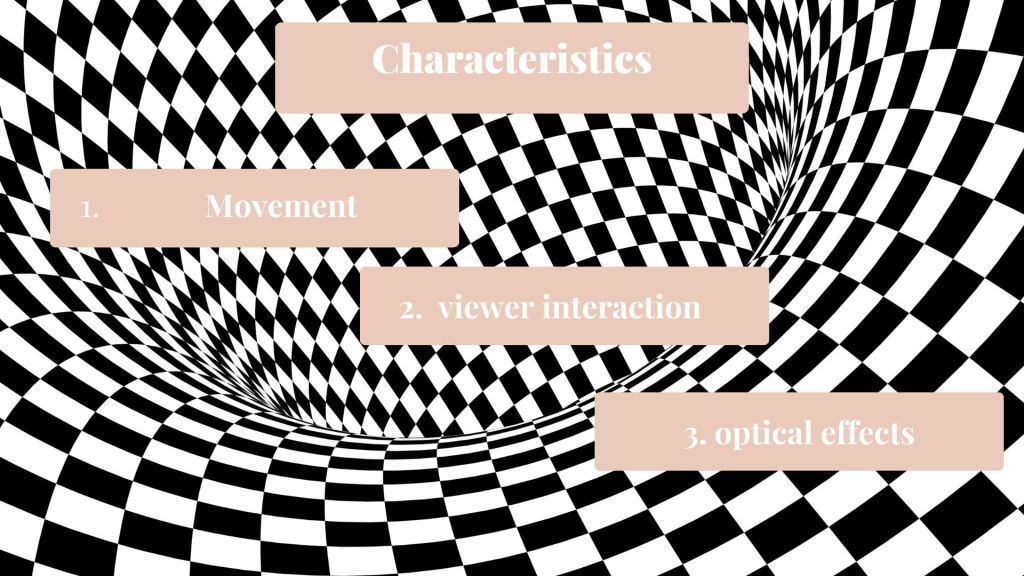
Key characteristics of kinetic art include:
- Movement: Kinetic artworks feature actual or implied movement, often achieved through mechanical or technological means. Artists use motors, gears, magnets, or other mechanisms to create dynamic sculptures, installations, and environments that change or evolve over time.
2. Interaction: A lot of kinetic artworks invite viewers to interact with the piece and take part in the kinetic experience as active participants. This engagement may be in the form of simple observation or direct manipulation of the artwork’s elements.
3. Optical Effects: Kinetic art frequently explores how movement affects vision, including the illusion of motion, patterns of light and shadow, and optical illusions. To create dynamic visual experiences that capture and interest viewers, artists experiment with colour, form, and composition.
The kinetic art movement reached its peak of popularity in the 1960s and 1970s, with artists like Bridget Riley, Jean Tinguely, and Naum Gabo pioneering new approaches to motion and sculpture. Today, contemporary artists continue to explore the possibilities of kinetic art, incorporating digital technologies, interactive media, and interdisciplinary approaches to create dynamic and immersive artworks that push the boundaries of traditional art forms.

Bridget Riley is a highly influential British artist known for her pioneering work in Op art, short for optical art. Born in 1931 in London, Riley rose to prominence in the 1960s as one of the leading figures of the Op art movement.
Op art is characterized by geometric abstraction and the use of optical illusions to create visual effects that appear to move, vibrate, or pulsate when viewed by the viewer. Riley’s paintings often feature bold, contrasting colours and repetitive patterns that produce optical effects such as moiré patterns, shimmering waves, and the illusion of depth and movement.
Bridget Riley draws inspiration from a variety of sources, including the study of optical phenomena, mathematical principles, and the natural world. However, she has stated that her primary inspiration comes from her own experiences of perception and visual sensations. Her interest lies in exploring how the mind processes visual information and constructs images, particularly in relation to colour, form, and spatial relationships.
Through her art, Riley aims to evoke a heightened sensory experience and engage viewers on both intellectual and emotional levels. While she does not adhere to specific narratives or themes in her work, she seeks to create dynamic visual experiences that challenge perception and provoke contemplation.
Riley’s art often conveys a sense of movement, rhythm, and energy, inviting viewers to actively participate in the act of seeing. By manipulating geometric shapes, patterns, and colors, she generates optical illusions that appear to shift and fluctuate, creating a sense of dynamism and vitality within the artwork itself.
While Riley’s work is not overtly political or ideological, it does reflect broader cultural and social contexts, particularly in its exploration of abstraction and the boundaries of artistic expression. Through her innovative use of optical effects and rigorous formal experimentation, she has made significant contributions to the fields of Op art and abstract painting, inspiring generations of artists and challenging viewers to reconsider their perceptions of the visual world.
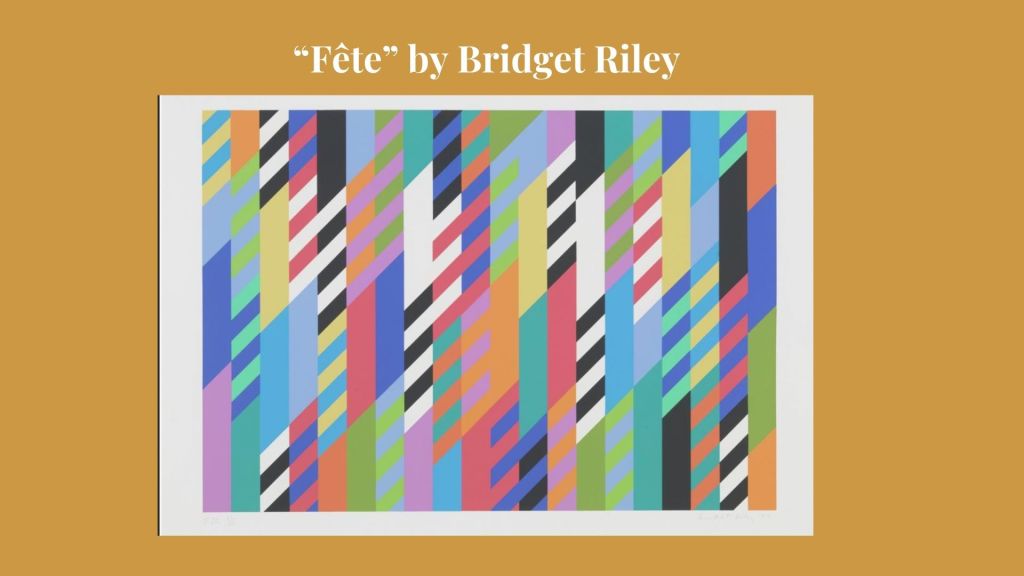
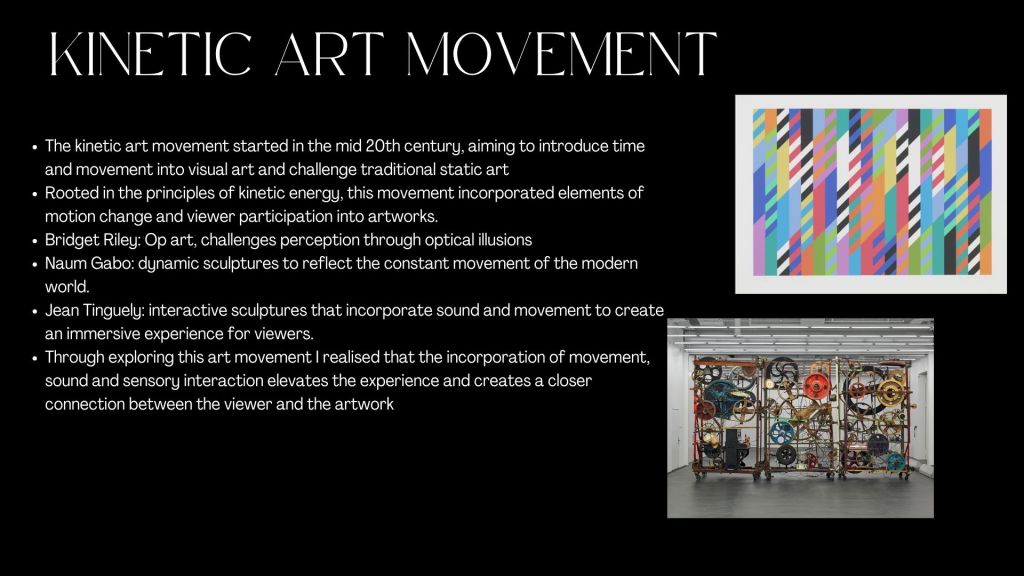
“Fête” is a colourful screen print by British artist Bridget Riley, created in 1989. It features a vibrant, abstract composition of twenty vertical bands, each divided into variously sized coloured parallelograms , some of which appear to cut diagonally across the bands.
Riley initially designed the composition as a gouache painting titled “February 15 ’89” before translating it into the final screen print, Printed on textured white paper. It relates to a series of paintings Riley created between 1986 and 1997, characterized by vertical bands combined with diagonally oriented areas of colour.
The title “Fête,” meaning “celebration” in French, likely emphasizes the joyful quality of the artwork’s bright colours and dynamic composition. Riley chooses titles that reflect the spirit of her works, often drawing on memories or sensations.
Fete by Bridget Riley is a captivating example of how colour and geometric shapes can be put together to evoke a specific atmosphere. In this artwork Riley uses vibrant colours and geometric forms to create a dynamic and joyful atmosphere.
The art piece portrays a very lively feeling which is also connected to the piece’s name.
What fascinated me the most was how she managed to portray this atmosphere with such an abstract piece. It shows the message she was conveying while still giving the viewer the freedom to interpret the piece. For my final project I aim to create a piece that conveys Egypt’s atmosphere, by creating an interactive jewellery piece that is inspired by Islamic art and the Egyptian culture. I will be playing around with geometrical forms to create different patterns. As much as I got inspired by her ability to create an atmosphere by using geometrical forms and colours, I aim to also integrate sounds and visuals, and scents to convey the atmosphere of Egypt.
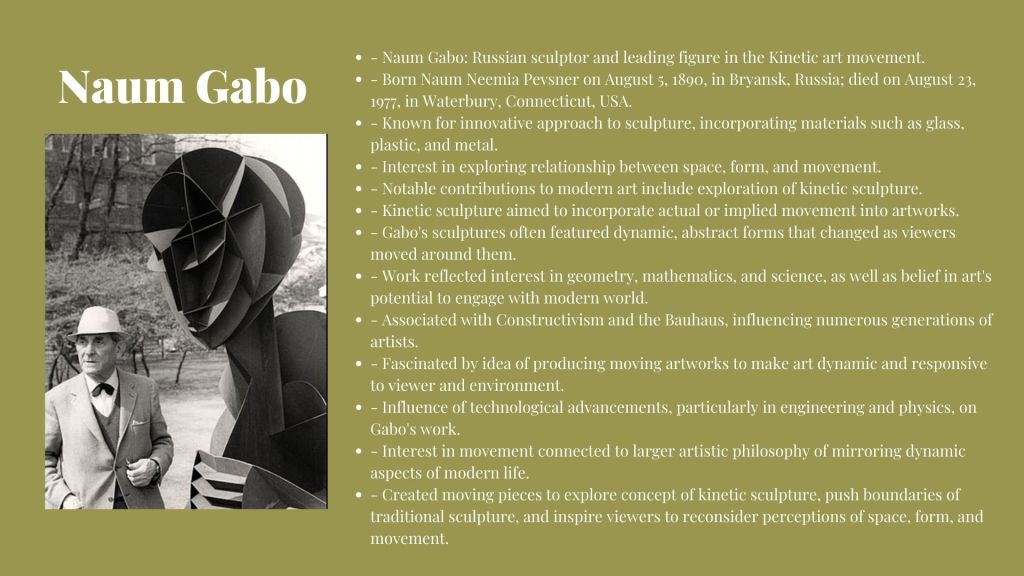
Naum Gabo, born Naum Neemia Pevsner, was an important Russian sculptor and one of the leading figures in the Kinetic art movement. He was born on August 5, 1890, in Bryansk, Russia, and passed away on August 23, 1977, in Waterbury, Connecticut, USA.
Gabo was known for his innovative approach to sculpture, which often incorporated materials such as glass, plastic, and metal. He was particularly interested in exploring the relationship between space, form, and movement, and his work played a significant role in shaping the development of modern sculpture in the 20th century.
One of Gabo’s notable contributions to modern art was his exploration of the concept of kinetic sculpture, which aimed to create artworks that incorporated actual or implied movement. His sculptures often featured dynamic, abstract forms that seemed to change and evolve as the viewer moved around them.
Throughout his career, Gabo’s work reflected his interest in geometry, mathematics, and science, as well as his belief in the potential of art to engage with and reflect the modern world. He was associated with various artistic movements, including Constructivism and the Bauhaus, and his work had a significant influence on numerous generations of artists.
Because he thought that art should be dynamic and responsive to the viewer as well as the surrounding environment, Naum Gabo was fascinated by the idea of producing moving artworks. The idea of kinetic sculpture, which aimed to include actual or suggested movement into artworks, attracted his curiosity in particular. Gabo attempted to convey the feeling of movement in his sculptures since he believed it to be an essential component of existence.
Additionally, Gabo was influenced by the technological advancements of his time, particularly in the fields of engineering and physics. He was fascinated by the principles of kinetics and the ways in which mechanical and structural elements could be combined to create dynamic forms. By creating moving pieces, Gabo aimed to push the boundaries of traditional sculpture and explore new possibilities for artistic expression.
Gabo’s interest in movement was also connected to his larger artistic philosophy, which set an important priority on the value of interacting with modern society. His belief was that art should mirror the dynamic and constantly evolving aspects of modern life, and he was able to look into this idea by making moving works.
Overall, Naum Gabo created moving pieces as a means of exploring the concept of kinetic sculpture, embracing technological advancements, and engaging with the dynamic nature of the modern world. Through his innovative approach to sculpture, Gabo wanted to challenge traditional norms of art and inspire viewers to reconsider their perceptions of space, form, and movement.
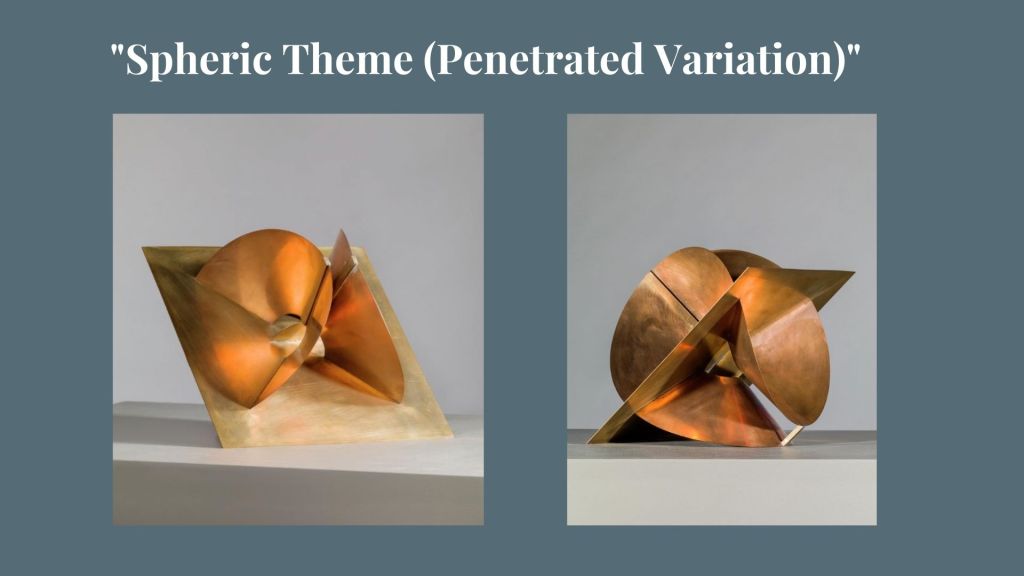
The bronze sculpture called “Spheric Theme (Penetrated Variation)” was made somewhere between 1937 and 1940. This piece of art is outstanding because of the way it plays with perspective and perception.
The geometric shapes appear to be intersecting one another from one angle, creating the impression of a dynamic and complicated composition. The artwork has a sense of depth and movement because of its design, which invites viewers to look at how the shapes and lines interplay.
On the other hand, viewed from another angle, the forms seem to be different and separate, almost like two completely different shapes. This changing perspective gives the artwork a sense of confusion and encourages viewers to think about how their perspective affects how they perceive the sculpture.
Gabo’s work is characterised by this double perspective, which reflects his fascination with the ways in which perspective changes can reshape shapes. Gabo invites viewers to actively interact with the artwork and discover its complex qualities by creating a sculpture that seems different from different perspectives.
This artwork inspired me by how different angles reveal different shapes. I feel that creating something so interactive, creates a bigger connection between the piece and the viewer and makes it unforgettable as it makes it into an experience for the viewer. This idea is what I aim to integrate into my final project. A piece that turns into an experience.
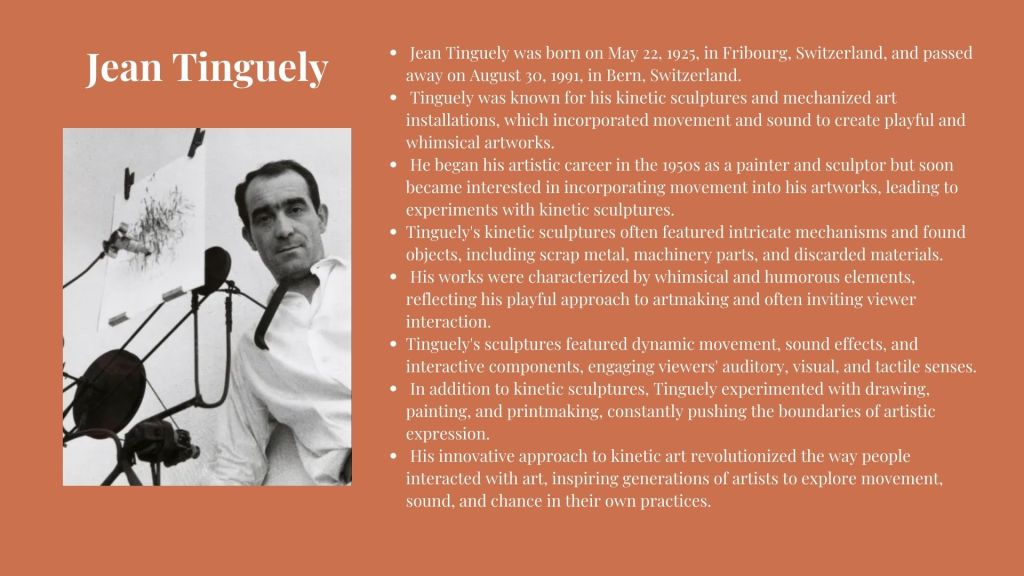
Jean Tinguely was a Swiss artist known for his kinetic sculptures and mechanized art installations. He was born on May 22, 1925, in Fribourg, Switzerland, and passed away on August 30, 1991, in Bern, Switzerland. Tinguely was a prominent figure in the kinetic art movement and is best known for his playful and whimsical artworks that incorporate movement and sound
Tinguely’s artistic career began in the 1950s, where he initially worked as a painter and sculptor. However, he soon became interested in incorporating movement into his artworks, leading him to experiment with kinetic sculptures. These sculptures often featured intricate mechanisms and found objects, such as scrap metal, machinery parts, and discarded materials.
Throughout his career, Tinguely continued to create kinetic sculptures and installations that blurred the boundaries between art and technology. His works often featured whimsical and humorous elements, reflecting his playful approach to artmaking. Tinguely’s sculptures were characterized by their dynamic movement, sound effects, and interactive components, inviting viewers to engage with the artwork in a tactile and sensory way.
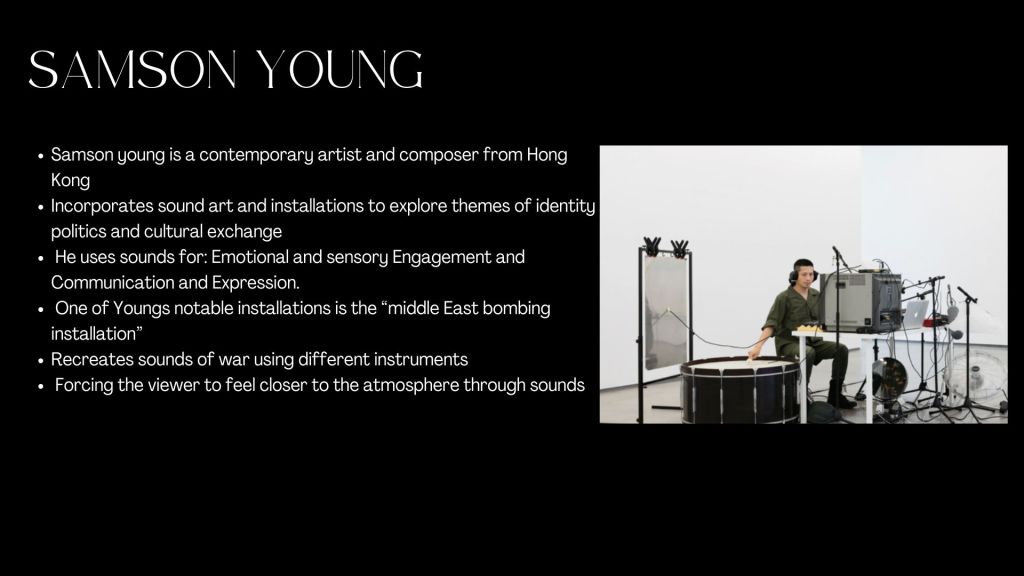
Jean Tinguely integrated sound effects into his kinetic sculptures and installations to enhance the overall sensory experience for viewers. By incorporating sound, Tinguely added another layer of dynamism and interactivity to his artworks, engaging the auditory senses in addition to the visual and tactile aspects
In addition to his kinetic sculptures, Tinguely also experimented with other artistic mediums, including drawing, painting, and printmaking. He was a versatile artist who constantly pushed the boundaries of artistic expression, exploring new techniques and concepts throughout his career.
Overall, Jean Tinguely was a pioneering artist whose innovative approach to kinetic art revolutionized the way people interacted with art. His playful and whimsical sculptures continue to captivate audiences around the world, inspiring generations of artists to explore the possibilities of movement, sound, and chance in their own artistic practices.

Jean Tinguely’s “Méta-Harmonie II” is a famous kinetic sound sculpture from 1979. This piece of art is one of several “Méta-Harmonies” that Tinguely created in the last stages of his career, demonstrating his ongoing exploration of movement, sound, and mechanical detail.
The sculpture is made up of a huge, complicated assembly of gears, mechanical parts, and random objects that are organised in an eye-catching and dynamic composition. The mechanism in the centre of the sculpture is what makes the different sections move and interact with one another to produce a symphony of sounds.
One of the defining features of “Méta-Harmonie II” is its incorporation of sound-producing mechanisms, which add an auditory dimension to the kinetic movement of the sculpture. These sounds range from rhythmic clanking and whirring to more melodic and harmonic tones, creating a rich and immersive environment for viewers.
The title of the sculpture, “Méta-Harmonie,” refers to a harmonic combination of mechanical and auditory components, indicating Tinguely’s fascination with investigating the connection between sound and motion. With this piece of art, Tinguely encourages viewers to interact with the auditory and visual perception of the dynamic interaction of mechanical shapes.
As with many of Tinguely’s works, “Méta-Harmonie II” is interactive, allowing viewers to actively engage with the sculpture by activating its mechanism or manipulating certain parts. This interactivity reflects Tinguely’s belief in the importance of audience participation and the idea of art as a dynamic and evolving experience.

The incorporation of sounds into the artwork showed how auditory elements can deepen the emotional impact and significance of the piece, elevating it beyond a visual experience.
Also, by allowing viewers to interact with the artwork, it creates a stronger connection between the viewer and the piece, making them feel involved and immersed in the artistic experience.
Viewer interaction not only heightened engagement but also created a deeper understanding of the artwork.
The interactive elements transformed the artwork into a personalized and immersive experience, where viewers felt like they were part of the creation process. This level of involvement enhanced their appreciation for the artwork.
This inspired me to integrate sound effects in my final piece to enhance the viewers understanding and connection to my jewellery piece. I aim to create narrative jewellery that reflects me and my experiences, hence my choice to reflect my cultural heritage. I want to create a piece that people can relate to and interpret into their own lives while still educating them about my culture. This piece inspired me to add auditory and visual effects as well as scents to enhance the viewers understanding of the atmosphere and the inspiration. It creates an experience for them which makes them feel more connected to my design ideas.

Design brief
Title: El Rehla: A strengthening journey
Aims:
The designer aims to create narrative jewellery that reflects her personal journey and her Egyptian heritage, incorporating the themes of “strengthen” and “kitsch”.
She wants to educate people about her cultural heritage, creating pieces that can be worn everywhere and by anyone and reflect her cultural heritage.
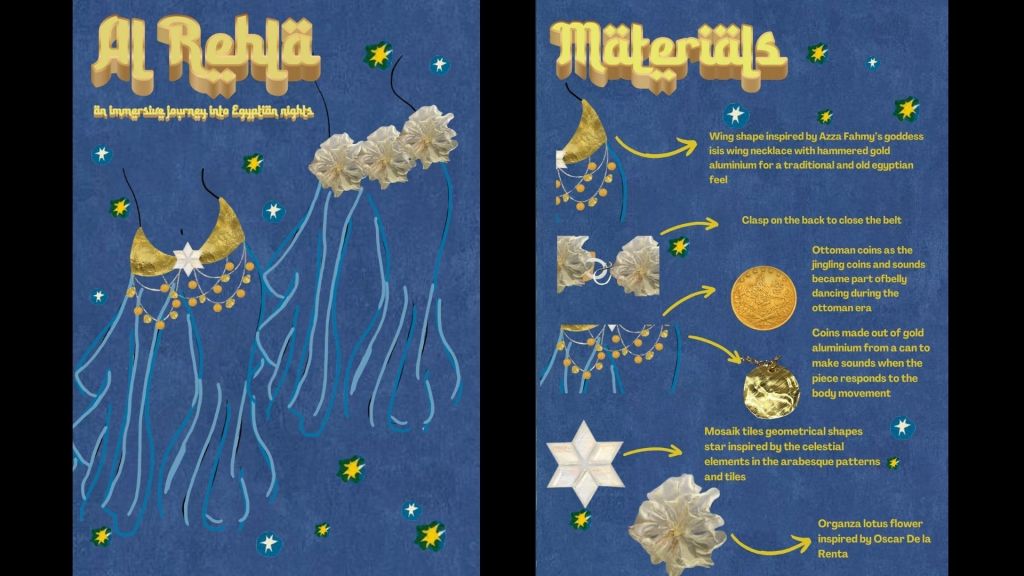
The Egyptian national flower is a lotus flower, hence her choice for a lotus flower to symbolise her experience. The lotus flowers and its symbolism holds a significant meaning both is ancient and modern Egypt.
Inspired by the symbolism of a lotus flower the jewellery aims to tell a story about growth and adaption. To celebrate the designers cultural heritage, she will integrate interactive elements like sound to make the wearer engage in an immersive experience that captures the atmosphere and spirit of Egypt.
Concept:
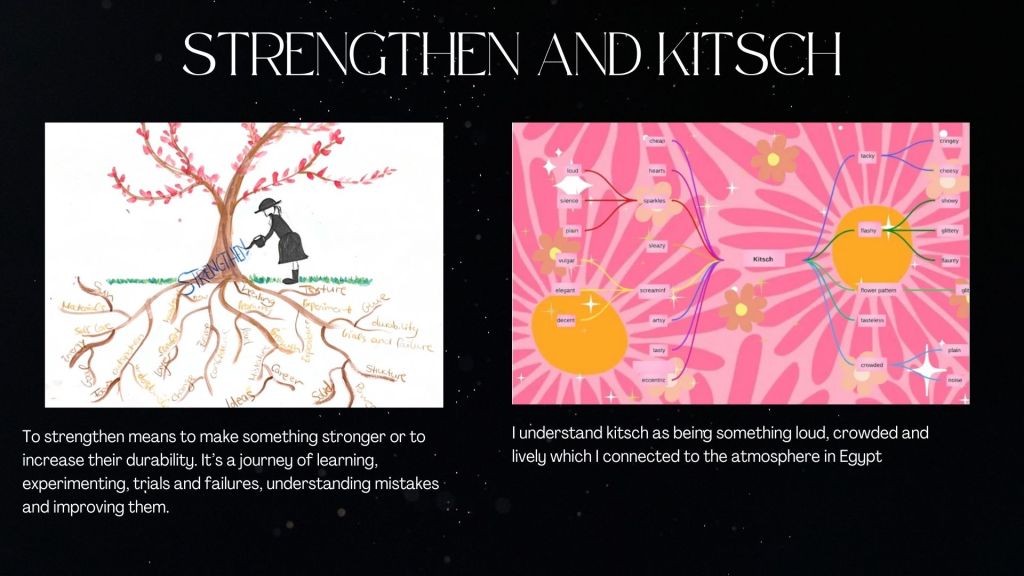
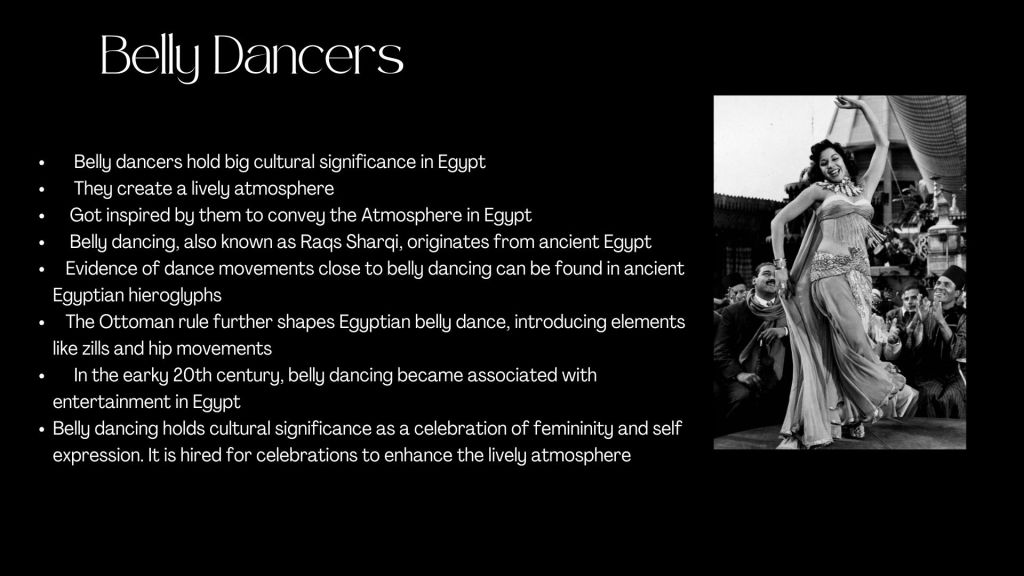
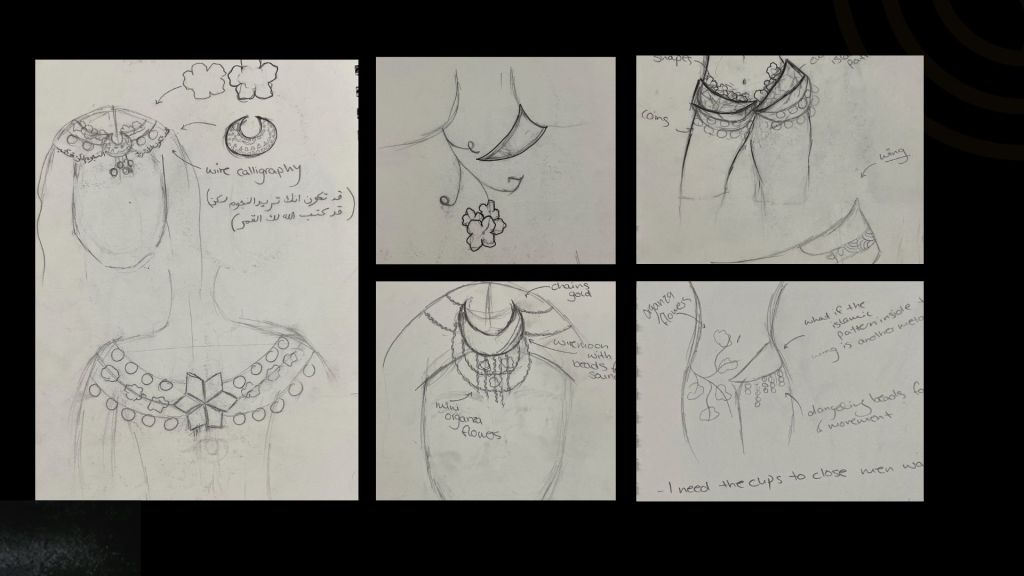
To symbolize the designers strengthening journey of growth and adaptation to a new life abroad, she has chosen the lotus flower, which represents new beginnings born from difficulties. The lotus starts as a seed in murky waters, navigating obstacles like rocks to blossom into a beautiful flower, which portrays my own process of overcoming challenges and growing. The word kitsch brings up images of the atmosphere in Egypt, which is always loud, lively and crowded. From the lively streets filled with laughter, chatter, and street vendors, to the rich sounds of traditional music played on Arabic drums and the rhythmic dances of belly dancers wearing scarves full of coins. Incorporating cultural elements, Islamic motifs, coins and interactive elements the designs will narrate a story of growth as well as a celebration of cultural identity. The choice of a flower to symbolise her story comes from how connected flowers are to Islamic art. They hold significant meaning in Islam as they symbolise beauty, purity and the connection between spirituality and nature and are often incorporated in geometrical Islamic patterns. She found that the lotus flower is most connected to the idea she is trying to portray.
Inspiration:
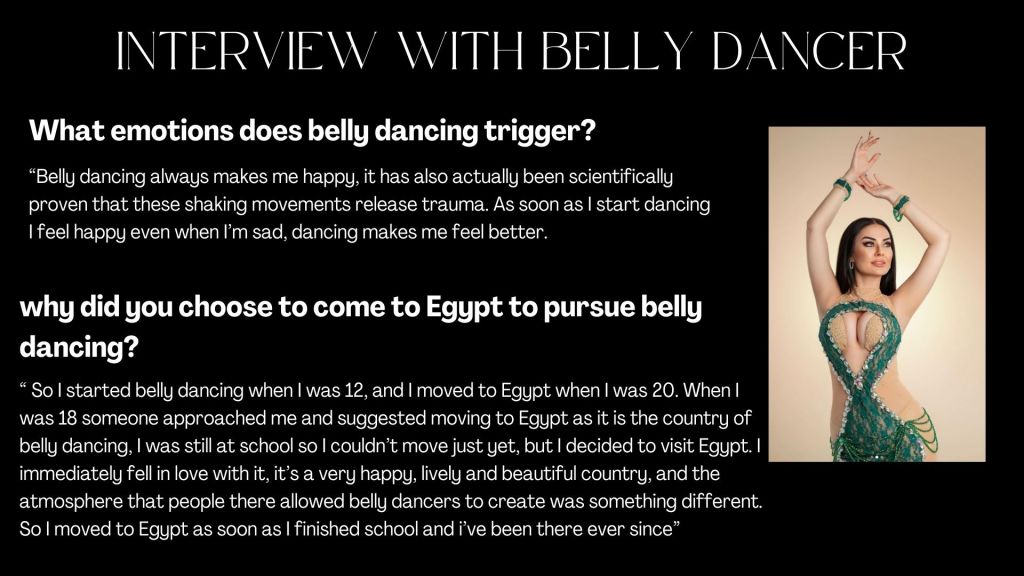
The project is inspired by the atmosphere of Egypt and it’s culture. Like belly dancers, islamic art and ancient symbolism.
The designer aims to get inspired by traditions and turn them into contemporary jewellery pieces to celebrate and preserve her culture.
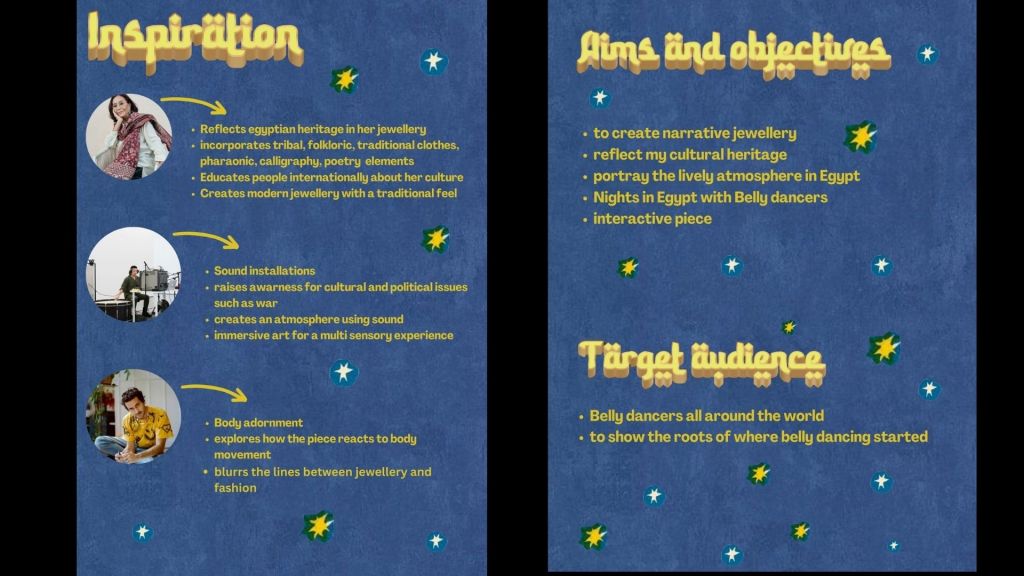
The project is also inspired by two jewellery designer who have successfully integrated eastern, Egyptian and islamic motifs into contemporary designs worldwide.
Azza Fahmy has written a book talking about the different jewellery all around Egypt, and how she drew inspiration from not only Islamic motifs and ancient Egypt but also different tribes and groups in Egypt. Louis Cartier had seen Islamic art as a path to modernity and managed to create designs inspired by the Islamic and eastern culture without losing individuality.
Additionally inspiration will be drawn from artist who create sound installations to express their emotions and opinion and have explored the use of sound to evoke the feelings of specific atmospheres.
Experimentation and execution:
- Research: The designer will be researching the inspiration with islamic art in thr Egyptian culture as well as the traditional clothes and jewellery for inspiration. She will also be researching sound art to integrate it to her final project. Forinspiration she will research other designers who also incorporate their cultural heritage, Egyptian heritage and floral themes like Azza Fahmy, Louis Cartier and Oscar de la renta
- Design Development and experimentation: The designer will be experimenting with different materials based on the sounds they create, to have her piece evoke the feelings and atmosphere of Egypt.
The sounds she is aiming to convey are the jingling sounds. These are sounds that you can hear in most of the Egyptian music, as well as when belly dancer dance because of the scarves around their hips.
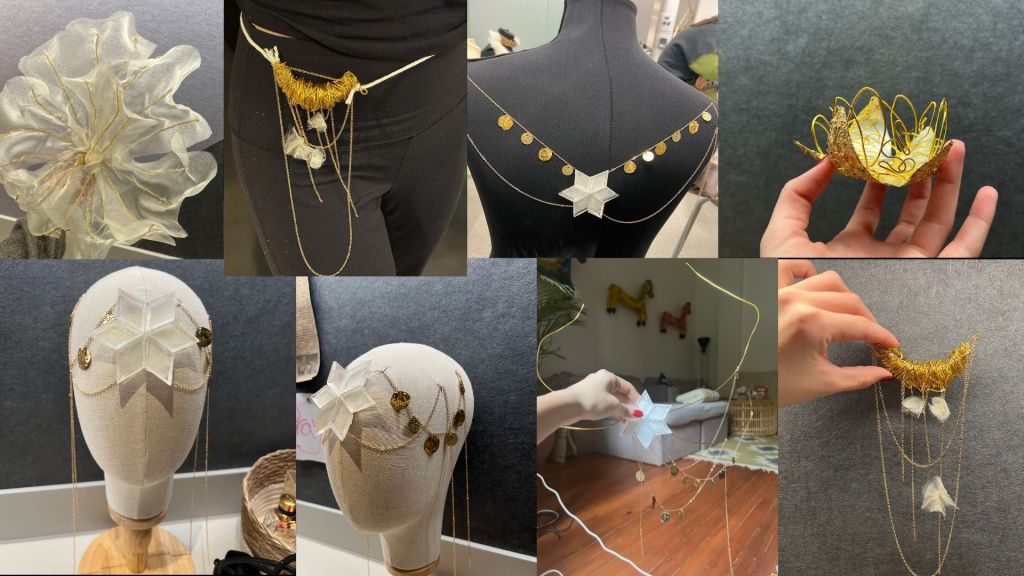
To create these sounds she will experiment with materials such as aluminium, wire, glass and beads. She will also be exploring traditional techniques like macrame and embroidery to create her designs. Her idea is to create a headpiece, as it symbolises confidence, empowerment and strength.
- Integration of sound : The designer will be experimenting with sound elements to evoke the atmosphere of Egypt, she will be focusing on the jingling sounds of coins.
- Feedback: She will be seeking feedback from peers and tutors throughout the process to ensure the effectiveness of the narrative jewellery piece.
- Presentation: She will be using skills she learned at both workshops to create a poster to promote and showcase her work. She will use both the printmaking workshop and digital design to achieve the best, most creative and professional looking end results.
By following this design brief the designer will be able to produce a narrative jewellery piece that reflects her cultural identity and personal journey, while also celebrating and preserving her Egyptian heritage.
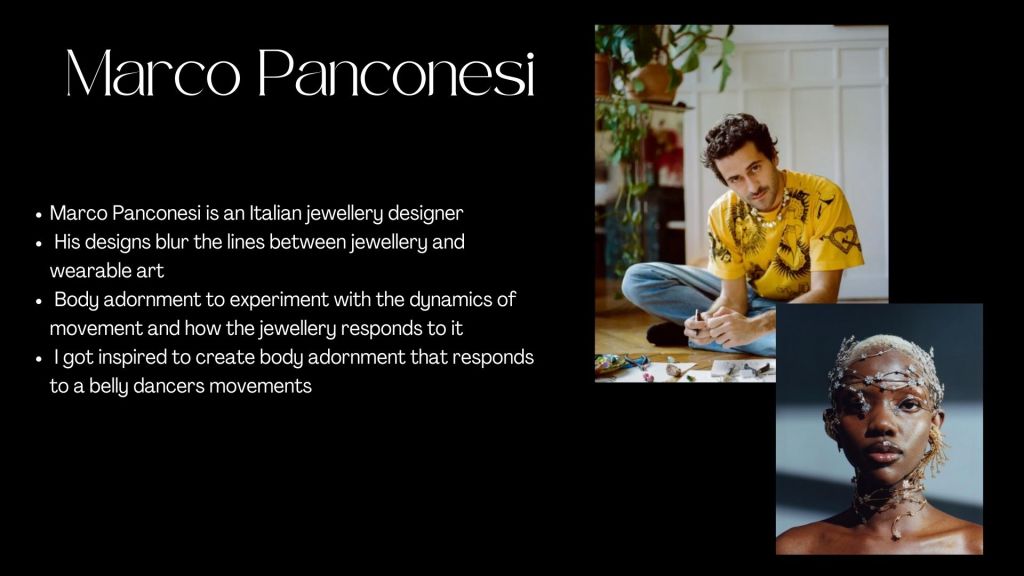
Marco Panconesi
Marco Panconesi is an Italian-born jewellery designer who has garnered attention for his innovative and avant-garde designs. He is known for his bold and imaginative approach to jewellery, incorporating elements of sculpture, architecture, and contemporary art into his creations.
Prior to starting his own jewellery company, Panconesi attended Central Saint Martins in London as an undergraduate. He pushes the limits of conventional jewellery design with his designs, which frequently use unusual materials and eye-catching geometric shapes.


His designs often blur the lines between jewellery and wearable art, attracting a clientele that appreciates distinctive and boundary-pushing accessories.
Marco Panconesi creates body adornment as part of his jewellery designs to explore the relationship between jewellery and the human body, as well as to push the boundaries of traditional jewellery design.

By exploring the relationship between jewellery and the movement of the body, Panconesi adds a dynamic and kinetic dimension to his designs, further blurring the boundaries between fashion, sculpture, and performance. This consideration of movement not only enhances the aesthetic appeal of his creations but also contributes to their functionality and wearability, ensuring that they are both visually striking and comfortable to wear in motion.
The incorporation of body adornment into his collections allows Panconesi to experiment with the dynamics of movement, considering how the jewellery responds to the body’s gestures and motions. This exploration adds an additional layer of depth and complexity to his designs, as they are not only static adornments but also dynamic elements that evolve with the wearer’s movements.
Furthermore, Panconesi’s focus on form, texture, and scale in his body adornment pieces is inherently tied to how they interact with the body in motion. The materials, shapes, and construction of his jewellery are carefully considered to ensure that they complement and enhance the wearer’s movements, whether subtle or dramatic.
Me and my influences



 Farida’s Art and Design blog